Home / Editorial guide


Quick response: In autumn 2026, well-tailored jackets with a soft structure, long straight coats, practical trench coats, compact short jackets, and urban sporty models are important choices for the season. For a practical Iranian style, do not choose the model of clothing solely based on trends; the length of the coat, shoulder form, fabric type, layering possibilities, the climate of your living area, and the coordination of the outfit with existing trousers and shawls in the wardrobe are more important.
Choosing the coat model for autumn 2026 is not just about knowing what form or color has been seen in fashion shows. A fall coat or jacket must remain comfortable and well-shaped during daily commutes, sitting, driving, using public transportation, at work, and with the temperature changes of morning and evening. A coat may look very attractive in a photo, but if its sleeve does not accommodate wearing a thin knit or if its fabric wrinkles and pills after a short time, it will not be a practical purchase. In this guide, we will turn global trends for autumn and winter 2026–2027 into wearable options for Iranian lifestyle and attire.
The goal of this article is not to provide a fleeting list of models; it is to help you understand which form is closer to your height and body shape, what fabric is compatible with the climate of your city, and how to wear a coat or jacket with several different combinations. If you are looking for practical content about fashion, attire, color, and smart clothing choices, in Redika Fashion and Beauty Magazine you can also follow other related guides. In this article, wherever global trends are mentioned, we have separated them from the practical recommendations of the editorial team for the Iranian audience to clarify the boundary between fashion reporting and style suggestions.
Method of preparing this guide:
- Reviewing Pantone’s official autumn/winter 2026–2027 color report alongside Redika’s fall/winter 2026–2027 color trends guide.
- Reviewing the seasonal fabric analysis from Première Vision.
- Reviewing the autumn 2026 trend report from Vogue.
- Matching the data with the need for coverage, layering, and the climatic differences of cities in Iran.
- Transforming runway suggestions into usable models and formulas for Iranian style.
Preparation and compilation: Redika Fashion and Beauty Editorial Team | Last source review: August 8, 2026
For a broader look at seasonal outfits, colors, and accessories, see Redika’s Fall 2026 fashion trends guide.
What coat and jacket models should we choose in autumn 2026?
For most Iranian wardrobes, a straight long coat, a well-tailored jacket with a soft structure, and a trench coat are three low-risk and versatile choices. A short jacket or sporty model can also be purchased as a second item for the wardrobe to refresh everyday style. The Fall 2026 Vogue report shows that modern jackets, short forms, softer structures, rich textures, and play with volume proportions have been seen in the season’s collections. These trends are not meant to enter daily wear unchanged; exaggerated elements should be simplified and coordinated with coverage, weather, and existing clothing.
| Your needs | Suggested model | Main advantage | Important note |
|---|---|---|---|
| A versatile model | Straight long coat | Coordination with most trousers and situations | The shoulder and width of the garment should be controlled |
| Work and tidy style | Well-tailored jacket with a soft structure | Professional appearance without too much stiffness | Should be tried with a thin texture |
| Rainy city or variable weather | Trench coat or water-repellent coat | Layering and protection in short rain | Water-repellent is not the same as waterproof |
| Young and layered style | Short and compact coat | Creating proportion with high-waisted pants | The end point of the coat on the body should be examined |
| Commuting and travel | Urban sporty coat | Comfort, pockets, and more durability | Overly busy models become outdated faster |
How do global trends of autumn 2026 transform into Iranian style?
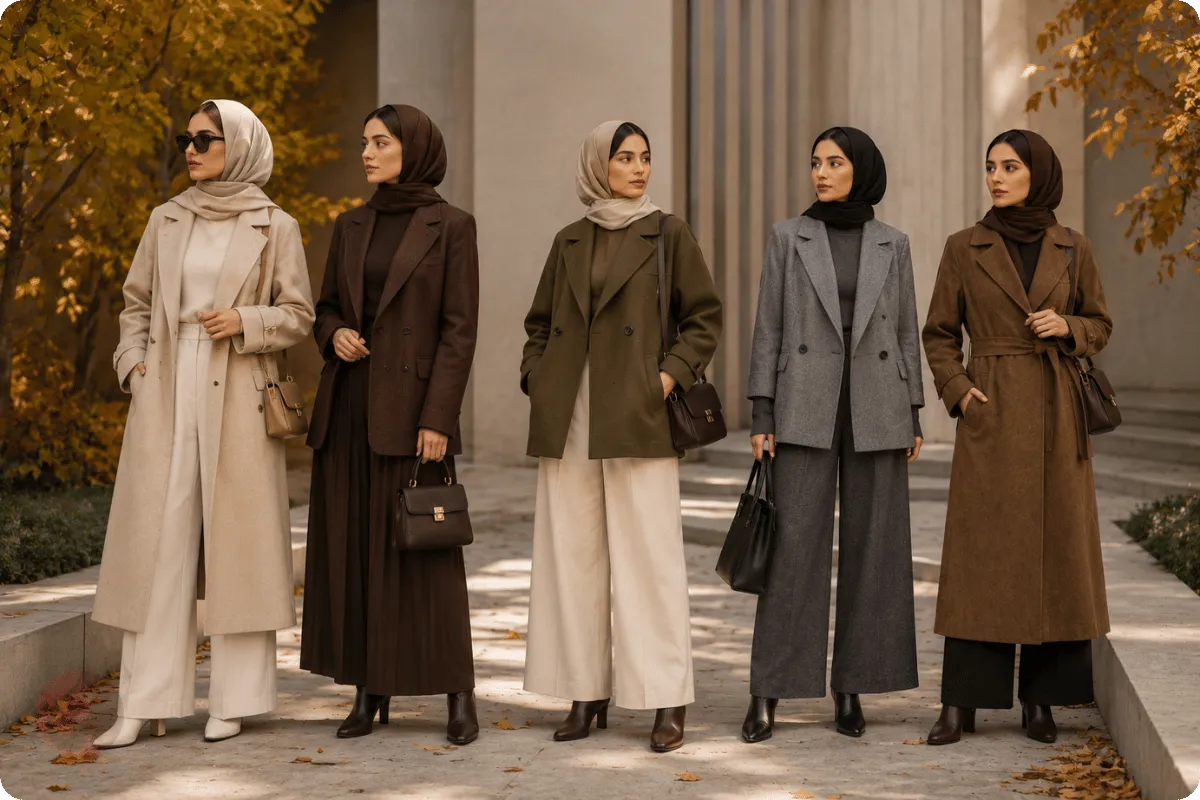
One of the notable trends for fall and winter 2026 is the return of well-tailored jackets with a softer structure than traditional office jackets. In Vogue’s report, gentle waists, sculptural jackets, short forms, and play with clothing proportions are observed; however, the everyday version of these models should allow for greater freedom of movement. For Iranian style, this trend can be transformed into single-button jackets, tailored coats with princess cuts, narrow belts, and defined but not exaggerated shoulders. The result should be neat and powerful, not tight, heavy, or restrictive.
Another important trend is the attention to the surface and texture of fabrics. Première Vision notes warm and flexible gabardines, twill fabrics, compact wools, suede-like surfaces, herringbone textures, and medium-weight fabrics for fall and winter 2026–2027. This means that even a monochromatic style can become attractive by combining smooth, textured, and matte surfaces. For example, a brown gabardine coat paired with a finely woven scarf and a smooth leather bag creates visual depth without using multiple colors.
Playing with volume is also present in the season’s collections, but excessive volume should be balanced. If the jacket has puffy sleeves or prominent shoulders, the pants, scarf, and bag should have a calmer form. If a short and fitted jacket is chosen, wide pants or a long skirt can become the focal point of volume. This method allows the trend to be seen in style, but the body is not hidden under several layers of bulky and mismatched clothing.
The most important models of coats and jackets for fall 1405
For fall 1405, a single model cannot be deemed suitable for everyone. The right choice depends on lifestyle, height, coverage level, body shape, city climate, and frequency of use. It is better to have a main neutral model for frequent use and, if necessary, a different model for variety. Below, we will examine the most important forms of the season along with their practical applications.
Well-tailored jacket with a soft structure and defined waist
A well-tailored jacket with a soft structure is suitable for those who want a neat and semi-formal appearance but are not comfortable with stiff and heavy jackets. This model can have defined shoulders, a semi-fitted waist, and a medium English collar. The waist shape is created with darts, princess seams, buttons, or a narrow belt, and it does not need to cling completely to the body. The length should be mid-thigh to slightly below for work environments, formal occasions, and urban use.
Suitable fabrics for this model include medium gabardine, lightweight suiting, dense crepe, and high-quality twill. Very thin fabric may show pocket lines, linings, and seams, while overly thick fabric can make the waist and collar stiff. A single-button model usually creates a cleaner vertical line, while a double-button or four-button model has a more classic appearance. Before purchasing, try the jacket on over a garment of similar thickness to your autumn coverage.
Long straight and semi-loose coat
The long straight coat is one of the most enduring and low-risk choices for fall. This model easily coordinates with straight, wide, and bootcut jeans and can be used in most everyday and work environments. Straightness should not be confused with shapelessness; the shoulders should sit correctly, and the garment should have controlled freedom around the body. A back slit or side slit also makes movement and sitting easier.
Narrow English collar, short standing collar, round collar, and collarless models are suitable for this form. A large patch pocket makes the style sportier, while a hidden or flap pocket creates a more formal appearance. If the color of the garment is neutral, you can introduce texture through a scarf, bag, or the fabric under the coat. A straight chocolate brown, burnt olive, navy, or clay coat usually has a high matching capacity.
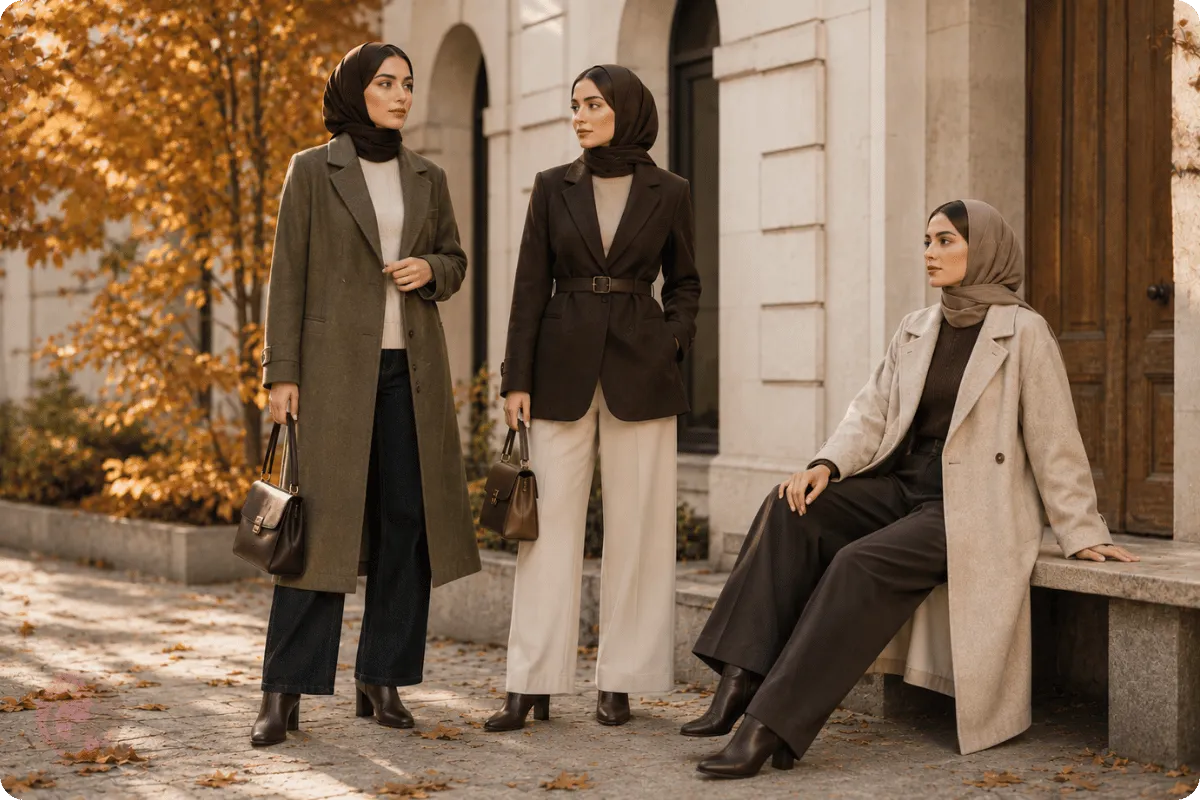
Trench coats and raincoats for variable autumn days.
A trench coat is suitable for days when the weather changes throughout the day and you need a light and adjustable layer. This model can be worn over a blouse, thin knitwear, or a vest and can remain open or closed with temperature changes. Simple models with a medium collar, deep pockets, and a separate belt usually have more utility than models with busy details. Cream, toffee, navy, olive, and clay colors are also usable colors for several seasons.
When buying a raincoat, consider the difference between water-repellent and waterproof fabrics. Water-repellent fabric usually withstands short rain, but may allow water to pass through in prolonged rain. The quality of the zipper, buttons, stitching around the pockets, lining, and breathability of the fabric should also be checked. In humid cities, a very heavy or completely synthetic lining may increase sweating.
Short and compact jackets for layered styling.
A short jacket is suitable for creating a youthful, layered, and balanced style with high-waisted pants. This model can be worn over a long blouse, dress, sundress, or a simple coat. Round collar, small English collar, collarless model, and short pocketed jackets are usable options. It is better for the jacket to have a clean cut and quality buttons instead of excessive decorations.
The length of the jacket is very important. If the edge of the jacket falls exactly on the widest part of the hips, it may accentuate that area; a model that is slightly shorter or longer can create a better fit. For short heights, combining a short jacket with high-waisted pants and shoes close to the color of the pants usually makes the legs appear longer. Also, check that the back of the jacket does not ride up and create horizontal creases when moving.
Urban sporty jackets and practical models.
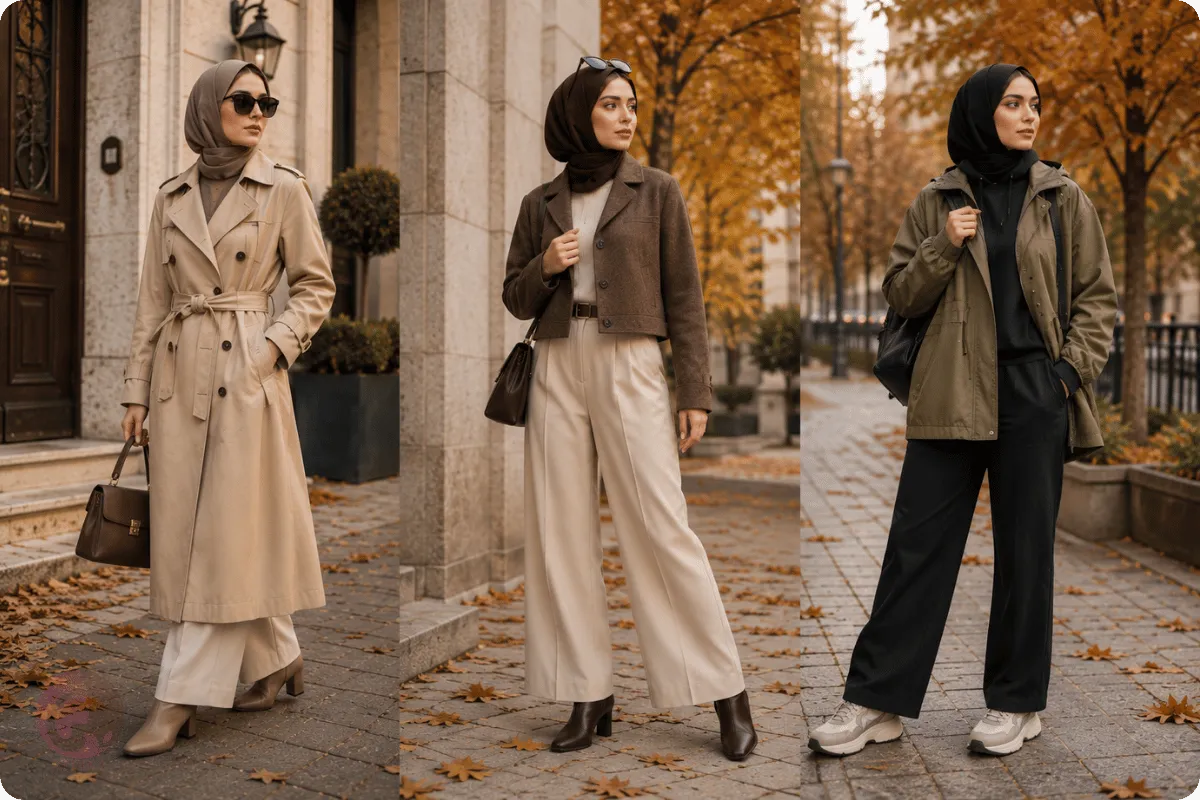
Urban sporty jackets are a suitable choice for university, travel, shopping, and daily commuting. Zip-up models, windbreakers, parkas, and jackets with adjustable straps can change the volume of clothing based on style. Using durable fabrics, practical pockets, and lightweight linings increases the value of this model. To prevent the jacket from looking overly sporty, it can be paired with straight fabric pants, a structured bag, or simple leather shoes.
In choosing colors, navy, burgundy, dark green, gray, and brown are more suitable for frequent use. Bright or contrasting colors are better seen in one part of clothing or accessories, not in several parts at the same time. Models with large writings, multiple straps, and excessive decorative details usually become outdated faster than simple models. The quality of the zipper and stitching of these jackets is more important than the number of pockets and decorations.
| Model | Main form | Best application | Suitable pants | Durability in the closet |
|---|---|---|---|---|
| Soft structure jacket | Semi-defined waist and controlled shoulder | Work and semi-formal position | Straight, wide, or bootcut | A lot |
| Long straight coat | Vertical line and medium freedom | Everyday, work, and university | Most pant models | Very much |
| Trench coat | Belt and turn-down collar | Rainy and variable days | Denim, straight and fabric | Very much |
| Short coat | Short length and controlled volume | Layered style and gathering | High-waisted, straight and wide | Medium to high |
| Urban sports jacket | Comfortable, zippered and practical | Commute, university and travel | Simple denim or fabric | A lot, in case of simple design |
Choosing a coat style based on height and body shape
The fit of the clothing is more important than the size number or the name of the body shape. When choosing a coat, the length of the garment, shoulder width, sleeve volume, waist location, pant width, and bag size should all be considered together. An oversized coat may look beautiful on its own, but paired with very loose pants and a bulky scarf, it can weigh down the style. In contrast, the same coat with straight pants and a lighter scarf can appear balanced.
Suitable model for short height
For many short individuals, a short coat or straight coat around the knee is a less risky choice; especially if worn with high-waisted pants and shoes close to the color of the pants. Single-row buttons, medium collars, and vertical seams help maintain the continuity of the style. Long coats are not prohibited, but it is better for their width to be controlled and the fabric to have a vertical drape. Simultaneously using a very long coat, a bulky scarf, a large bag, and very loose pants may disrupt the overall proportion.
- Try a short coat with high-waisted pants.
- Keep the color of the shoes and pants close to each other.
- Avoid very large pockets and collars in a short garment.
- Check the end location of the coat against the widest part of the hips.
- A medium or small bag usually creates a better proportion than a very large bag.
Suitable model for tall and plus size
Tall individuals usually have the option to wear midi coats, long coats, larger collars, and checkered patterns, but it is better not to combine all these details in one style. A loose long coat can be balanced with a belt, distinct buttoning, or more fitted pants. For plus size, very loose clothing is not always the better choice, as it can add extra volume. A model with the right shoulder, matte fabric, enough freedom in the stomach and arms, and controlled drape usually yields better results.
Single-button coats, straight coats with slits, and open collars can create a vertical line. Light colors or patterns are not prohibited, and the quality of the cut is more important than the darkness of the color. When trying on, the buttons should close without pulling, and the garment should maintain its shape while sitting. The size number should not lead you to choose a model with an ill-fitting shoulder or armhole.
Suitable model for apple, pear, hourglass, and rectangle shapes
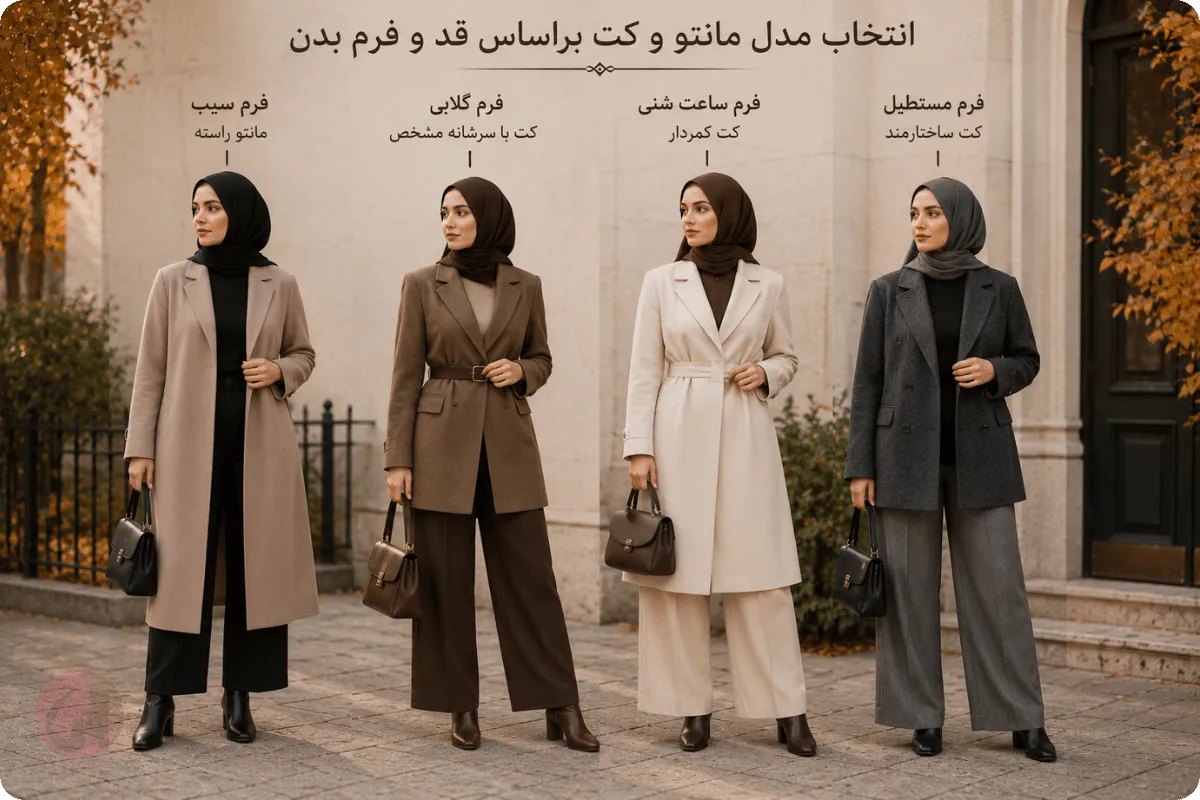
| Body shape | Suggested models | Suitable details | Notable point |
|---|---|---|---|
| Apple | Straight semi-loose coat and single-button blazer | Open collar and vertical lines | A wide and very strong belt may clutter the midsection |
| Pear | Coat with defined shoulders and a top coat with a balanced upper body | English collar and texture or color in the upper body | The edge of the coat should not end on the widest part of the hips |
| Hourglass | Waisted coat and tailored coat | Princess seam and semi-defined waist | The garment should not be overly tight for layering |
| Rectangle | Waistcoat or model with controlled volume | Targeted pocket and balanced shoulder | The upper and lower volume of the garment must be coordinated with each other |
These categories are not definitive and are not meant to limit your choice. Someone with a pear shape may feel better in a short coat, or someone with an apple shape may use a belt. Comfort, taste, quality of cut, and how the garment fits your actual body are more important than the name of the body shape. Use this table as a starting point, not an unchangeable rule.
The best fabric for autumn coats and jackets in 1405
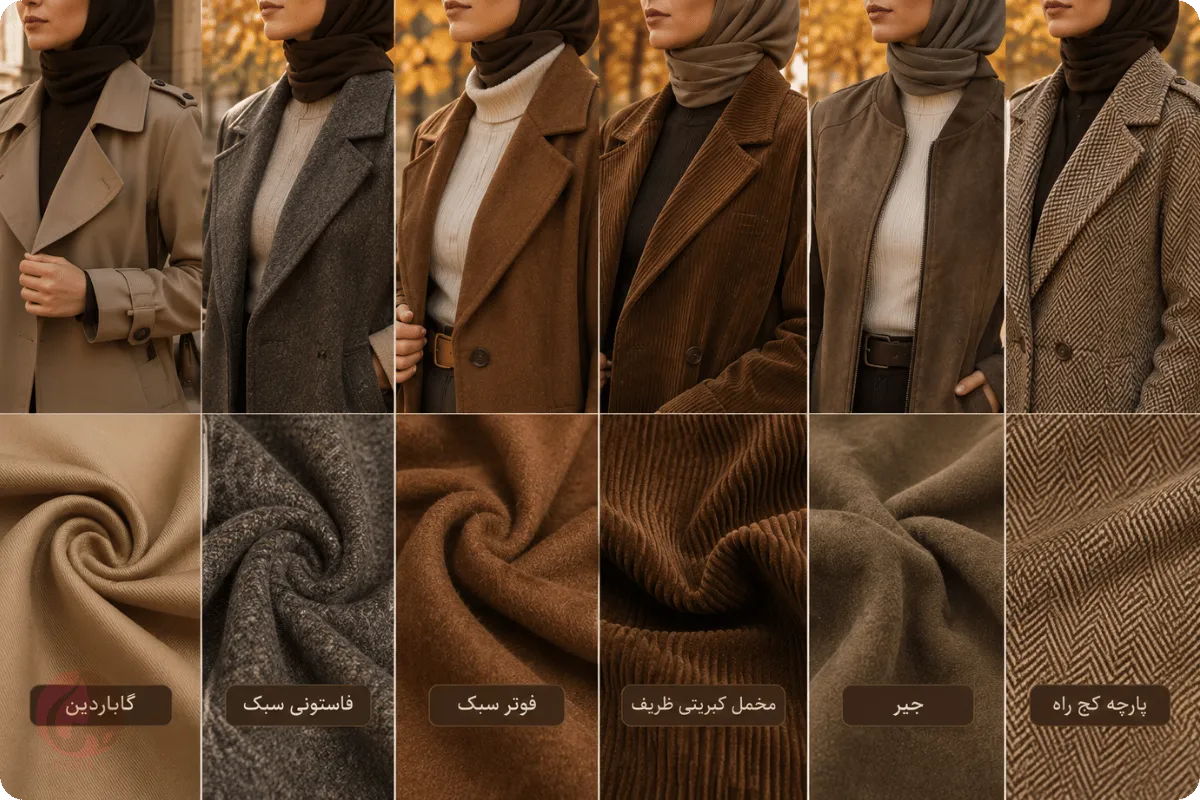
The best autumn fabric should create a balance between warmth, breathability, drape, and weight. The thickest fabric is not necessarily the best choice, as in many cities in Iran, the morning and noon temperatures differ significantly. Première Vision has pointed out twill fabrics, gabardine, compact wools, suede-like surfaces, and medium-weight and flexible fabrics in its seasonal analysis. These features are also applicable for Iranian coats and jackets, as they allow for layering and longer use throughout the season.
| Fabric | Drape | Amount of warmth | Suitable model | Maintenance and purchase |
|---|---|---|---|---|
| Gabardine | Medium to high | Medium | Trench, straight coat and overcoat | Fabric density, sheen and wrinkle resistance should be examined |
| Cotton twill fabric | Medium | Low to medium | Casual overcoat and everyday coat | Inquire about the possibility of shrinkage and color change |
| Light wool fabric | Neat and well-shaped | Medium | Formal coat and waistline model | Percentage of fibers and surface sheen is important |
| Light footer | Medium to high | High | Late autumn coat and jacket | The weight of the garment and the amount of pilling should be examined |
| Fine corduroy | Medium | Medium | Short coat and semi-loose jacket | The fabric for sleepwear must be uniform across all pieces |
| Natural or synthetic suede | Soft and textured | Medium | Short coat and special jacket | Stain resistance, pilling, and cleaning method should be examined |
| Technical water-repellent fabric | Variable | Low to medium | Rainy, parkas, and sport coats | Breathability, zipper quality, and seams are important |
In the market, various brand names may be used for a fabric. For example, the term ‘cashmere’ does not always mean a high percentage of cashmere fibers and may be based on different blends. Check the fiber composition label, washing instructions, pilling rate, and the fabric’s behavior in light. A fabric that only has an attractive name does not necessarily have high durability or value for money.
Choosing fabric based on the city’s climate
Climate research in Iran shows a clear difference between the humid Caspian regions, the cold northwest areas, the cooler western regions, and the hot southern cities. Therefore, recommending a fixed fabric for all cities is not logical. In humid cities, drying speed and lining weight are important, while in cold cities, heat retention and the ability to wear multiple layers are prioritized. In warmer cities, wearing heavy fleece from the beginning of autumn is usually not practical.
| Type of climate | Examples of cities | Recommended fabric | Suitable model | Practical tip |
|---|---|---|---|---|
| Humid and rainy | Rasht, Sari, and coastal cities of the north | Dense gabardine or water-repellent fabric | Trench and raincoat with a light lining | The length of the dress should not touch the wet surface of the street |
| Variable and relatively dry | Tehran, Isfahan, Shiraz, and Qom | Gabardine, lightweight worsted, and fine velvet | Layerable coat or long jacket | Several lightweight layers are more practical than a very warm single garment |
| Cold and semi-dry | Tabriz, Ardabil, Hamadan, and cold cities | Light to medium felt and blended wool fabric | Lined coat and long jacket | The sleeve opening should have enough space to wear a knit |
| Warm at the beginning of autumn | Ahvaz, Bushehr, and Bandar Abbas | Cotton twill fabric and lightweight gabardine | Heavy unlined coat or lightweight jacket | Keep thick fabric for the colder months |
Guide to maintaining autumn fabrics
The durability of a coat is not only dependent on its initial quality but also on the maintenance method, which can change the lifespan of the garment. Before washing, read the label inside the garment and use the method recommended by the manufacturer for wool, gabardine, or suede fabrics. Continuous use of a very hot iron can make the surface of some fabrics shiny. Heavy garments should also be stored on a wide and sturdy hanger to prevent shoulder deformation.
- Gabardine: Iron at medium heat and check color fastness before complete washing.
- Gabardine: Avoid direct pressure from a hot iron on the fabric surface.
- Felt: Fuzz should be groomed with a special clothing brush, and avoid frequent washing.
- Corduroy: Brush in the direction of the fabric nap and do not place under heavy objects.
- Suede: Stains should be removed quickly, and the cleaning method should be compatible with the natural or synthetic type of fabric.
- Raincoat: Make sure it is completely dry before folding to prevent odor and moisture stains.
Trend colors for coats and jackets in autumn 1405
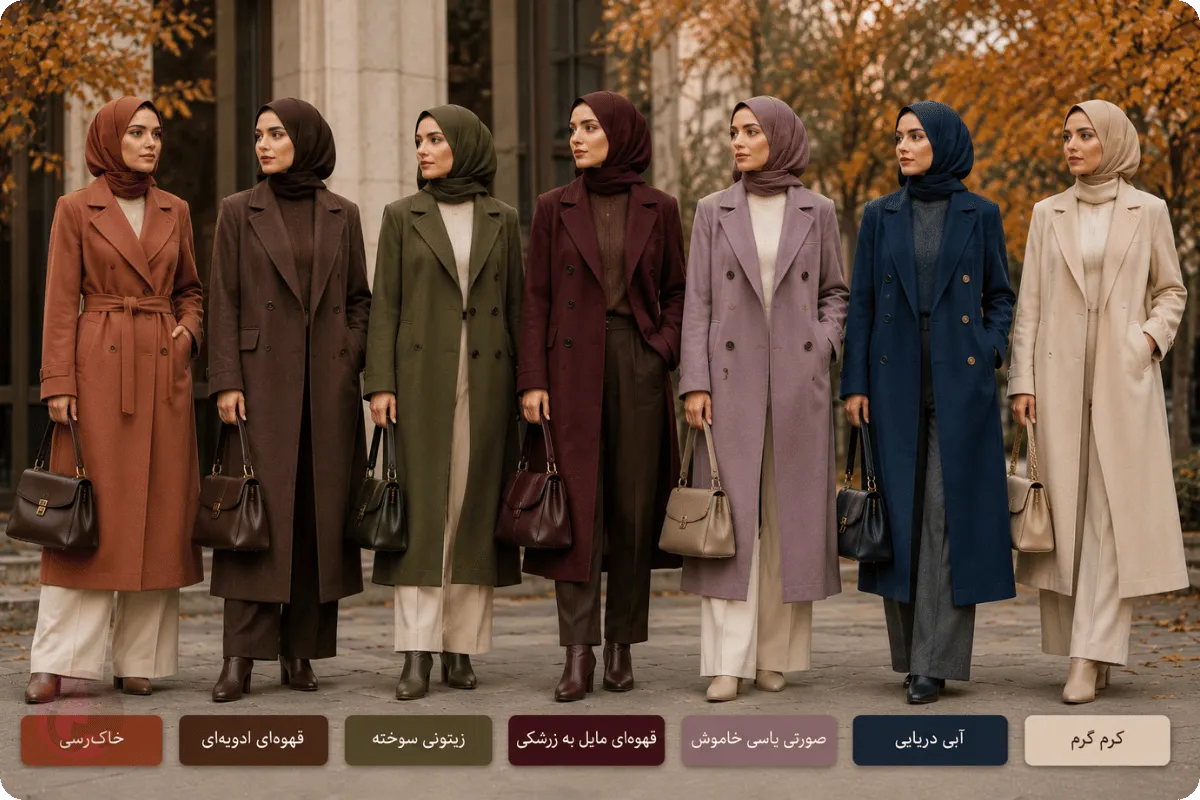
The official Pantone report for New York Fashion Week in autumn and winter 2026–2027 places familiar earthy colors alongside energetic and experimental colors. This palette is not just for purchasing a completely colorful coat; it can also be incorporated into scarves, bags, undercoat knits, or small details in style. For the main wardrobe pieces, colors like toffee, burnt olive, clay, spicy brown, and reddish-brown usually have greater usability. Brighter colors like fuchsia or greenish-yellow are better chosen based on personal style and matching possibilities.
| Color name in the report | Imagined Persian equivalent | Low-risk combination | More distinct combination | Best usage location |
|---|---|---|---|---|
| Muted Clay | Brick and muted clay | Cream, brown, and navy | Teal | Coat and trench |
| Neptune Green | Tealish green | Gray, navy, and warm white | Crimson | Coat, shawl or bag |
| Arabian Spice | Warm brown and spicy | Cream, dark jeans and toffee | Dirty pink | Overcoat, coat and shoes |
| Foxglove | Muted lilac pink | Gray, navy and brown | Olive | Shawl, knit or short coat |
| Red Mahogany | Brown with a hint of crimson | Black, cream and camel | Sea blue | Formal coat or overcoat |
| Festival Fuchsia | Energetic Fuchsia | Gray, Chocolate, and Navy | Red or Purple | Scarf, Bag, or Statement Jacket |
| Acacia | Yellowish Green | Brown, Olive, and Gray | Light Blue | Accessory or Under Jacket Knit |
| All Aboard | Light Navy | Warm White, Denim, and Toffee | Yellow or Fuchsia | Sport Jacket or Scarf |
| Burnt Olive | Deep olive green | Cream, brown, and black | Lilac pink | Coat, trench or jacket |
For economical shopping, choose the main clothing color from brown, olive, navy, gray, terracotta, or reddish-brown. Then introduce a more vibrant color in the scarf, bag, socks, knitwear, or shoes. This method allows the seasonal mood to be reflected in the style without completely changing the wardrobe. A trendy color is a good choice when it coordinates with at least three of your existing combinations.
What pants, scarf, and shoes should we match with the autumn coat and jacket?
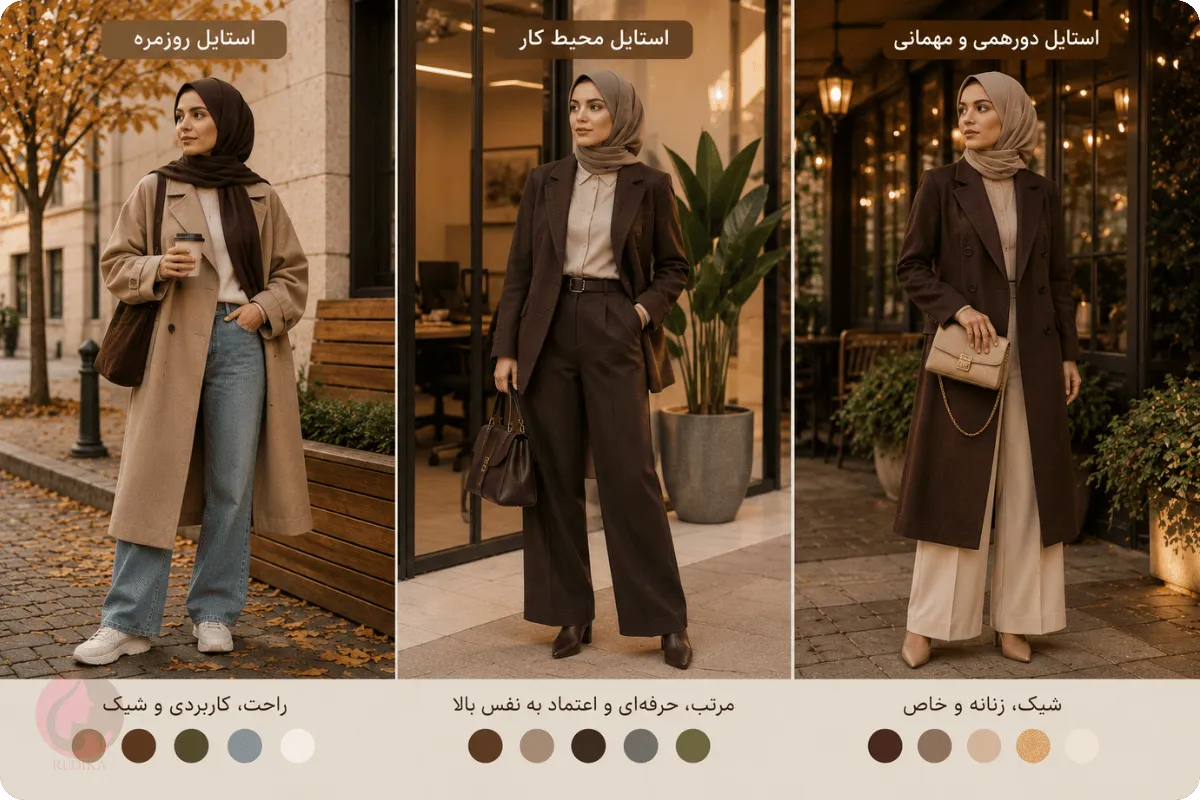
For matching autumn clothing, you can use the formula one dominant volume, one continuous line, and one point of emphasis If the coat or jacket is bulky, the pants and scarf should have a more controlled volume. If a short and fitted jacket is chosen, wide pants or a long skirt can create the main volume in the lower body. The point of emphasis can also be the color of the scarf, a textured bag, shoes, or a belt.
- Belted jacket: It pairs well with straight pants, bootcut, or well-fitted wide pants.
- Long straight coat: It creates a taller appearance with straight jeans, full-length pants, and shoes close to the color of the pants.
- Trench coat: It can be worn with dark jeans, cream pants, simple sneakers, loafers, or ankle boots.
- Short coat: It creates a good fit with high-waisted straight or wide pants and a long skirt.
- Sport coat: It is suitable with jeans for a casual style and with simple fabric pants for a neater appearance.
A scarf is not only chosen based on color. A coat with a large collar alongside a very thick scarf may clutter around the neck; in this case, a lighter scarf or a simple knot scarf is a better choice. A collarless coat or a small collar can be balanced with a textured scarf. A structured bag is more suitable for the workplace, a soft or shoulder bag for everyday use, and a smaller bag for gatherings.
Everyday and university outfit
Wear a long straight olive green coat with straight navy blue jeans, a thin cream knit, and warm white cotton loafers or brown loafers. The scarf can be in shades of cream, earthy, or muted lilac pink. A brown or navy shoulder bag with practical pockets is suitable for commuting. This combination is comfortable, repeatable, and coordinated with several daily situations.
Work environment outfit
Combine a well-tailored navy or burgundy-brown coat with medium gray straight or wide fabric pants. Under the coat, you can wear a warm white, cream, or dusty pink blouse. A simple scarf, structured bag, and clean loafers or ankle boots create a professional appearance. In more formal environments, use closer colors and fewer details.
Gathering and semi-formal party outfit
A short corduroy or suede coat in toffee, burgundy, or teal can be layered over a simple blouse or dress. Wide black, dark brown, or cream pants create a good balance with the short coat. A small bag, pointed shoes or simple ankle boots, and a standout accessory are enough to complete the style. Not all clothing components need to be decorative or shiny; a different texture alongside simple clothes usually results in a more elegant outcome.
How to buy a coat or autumn jacket on a budget?
For economical shopping, first choose a basic model in a neutral color that allows for at least three different outfits. The value of a purchase is not only dependent on the initial price but also on the number of times the clothing is worn. A quality coat that is used in two autumns and for several occasions may be more economical than a cheaper model that is only worn a few times. Prioritize the quality of the fabric, lining, buttons, zippers, and stitching over superficial decorations.
- First, determine whether the clothing is for work, university, everyday use, or a party.
- Choose a color that coordinates with at least three pants and two existing scarves.
- Do not choose the main wardrobe model to be overly trendy and with exaggerated details.
- Incorporate color trends with scarves, bags, or textures under the coat.
- Also consider the potential costs of dry cleaning, ironing, and fabric maintenance.
- Try the clothing while sitting and with a layer for autumn.
Checklist for buying a coat and autumn jacket
Before making a purchase, do not just check the appearance of the clothing while standing in front of a mirror. Raise your arms, sit down, button it up, and place a bag on your shoulder. This simple test shows how the sleeve opening, shoulder, and back of the garment behave in real use. The following points can prevent an impulsive and underused purchase.
- Is the shoulder seam positioned correctly?
- Is it still easy to move your arms while wearing a thin knit?
- Do the buttons close without pulling or radial lines?
- Does the garment not ride up when sitting or create pressure on the stomach and hips?
- Does the fabric surface not have any unnatural spots or extra lint under bright light?
- Is the lining not bunched up at the bottom of the garment or the sleeves?
- Do the pockets have enough depth and sturdiness for daily use?
- Does the garment coordinate with at least three combinations available in your wardrobe?
- Is the washing and care method compatible with your lifestyle?
- Is the weight of the garment bearable for several hours of use?
Common mistakes when buying an autumn coat
One common mistake is buying a larger size instead of choosing a true oversized pattern. In an oversized pattern, the shoulder, sleeve opening, collar, and proportions of the garment are designed from the beginning for a loose fit; however, randomly increasing the size may make the collar and sleeves disproportionate. Another mistake is trying on a coat only over a thin t-shirt, while the garment is worn in autumn with a blouse or knitwear. The thickness of the underlying layer can completely change the comfort of the coat.
Buying a trendy color without checking your wardrobe can also lead to underuse of the garment. A fuchsia coat may be attractive, but if you have no matching scarf, pants, or shoes, you will need to make more purchases to create any style. Ignoring the weight of the fabric, the length of the coat, the type of lining, and the washing instructions are also significant errors. The name of the fabric or brand alone does not guarantee quality, and the stitching and fiber composition should be checked separately.
Seven major mistakes you should avoid:
- Buying a tight coat without enough space for layering.
- Choosing very heavy clothing for daily use.
- Complete trust in the fabric brand.
- Buying a color that can only be worn with one combination.
- Ignoring the form of clothing when sitting.
- Choosing tight sleeves or limited armholes.
- Simultaneously combining a bulky coat, very loose pants, a thick scarf, and a large bag.
Summary; a choice that lasts more than one season.
Best Autumn coat model 1405 It is not a model that is only attractive in photos; the clothing should perform well in movement, sitting, layering, and matching with your actual wardrobe. Well-tailored coats with a soft structure, straight long coats, trench coats, short coats, and urban sporty models are important paths for this season. Alongside form, earthy colors, brown, olive, navy, marine blue, and muted pinks shape the identity of autumn 1405. However, the final color and model should align with your taste and frequency of use.
Before buying, ask yourself if this clothing can be matched with at least three existing pants, if its fabric is suitable for the city’s weather, and if it remains comfortable after wearing a thin layer. If the answers to these three questions are positive and the stitching, lining, and weight of the clothing are also of good quality, you are likely facing a practical purchase. It is better to first acquire a basic and timeless model and introduce bolder trends through scarves, bags, and accessories. Trends should complement your personal style, not hide it.
Frequently asked questions about coats and jackets for autumn 1405.
Is a long coat in style for autumn 1405 or a short one?
Both models are seen in the season’s trends, but they have different applications. A straight long coat is a more timeless and low-risk choice for daily use, university, and work environments. A short coat has a younger appearance and is more suitable for layering, and it usually coordinates better with high-waisted pants. The final choice should be based on height, coverage, and the clothing available in the wardrobe.
What is the best fabric for an autumn coat?
For most cities, medium gabardine, cotton twill, lightweight flannel, and fine corduroy are practical options. Lightweight felt is more suitable for colder cities or the second half of autumn. In humid areas, water-repellent fabric and lightweight lining are priorities. Also, check the weight of the fabric, washing method, and pilling along with the fabric name.
What coat model is more suitable for short stature?
A short coat paired with high-waisted pants or a straight coat up to the knee is a suitable choice for many short individuals. A color close to the shoes and pants can prevent visual breaks in the leg line. A long coat can also be used if it has controlled width, a suitable slit, and vertical draping. It is better to avoid gathering several large volumes in one style.
How to match an autumn coat with baggy or wide pants?
A short coat or a coat with a defined waist usually creates a good fit with baggy or wide pants. If the coat itself is very bulky, the pants should ideally have a soft drape and controlled volume. A lightweight scarf and a medium-sized bag prevent the upper body from looking heavy. To make the legs appear longer, choose shoe colors that are close to the pants.
What is the most practical color for a manteau in autumn 1405?
Toffee brown, burnt olive, navy blue, medium gray, clay, and reddish-brown are among the most practical choices. These colors easily match with cream, black, denim, warm white, and shades of brown. For introducing more vibrant colors like fuchsia or yellowish-green, start with a scarf, bag, or knitwear under the coat. The main color of the manteau should ideally coordinate with at least three of your existing combinations.
Reviewed sources
About the author

Join the conversation
Share your experience or question with REDIKA readers.
Your email stays private. Please avoid sharing personal or sensitive details.


