Home / Editorial guide

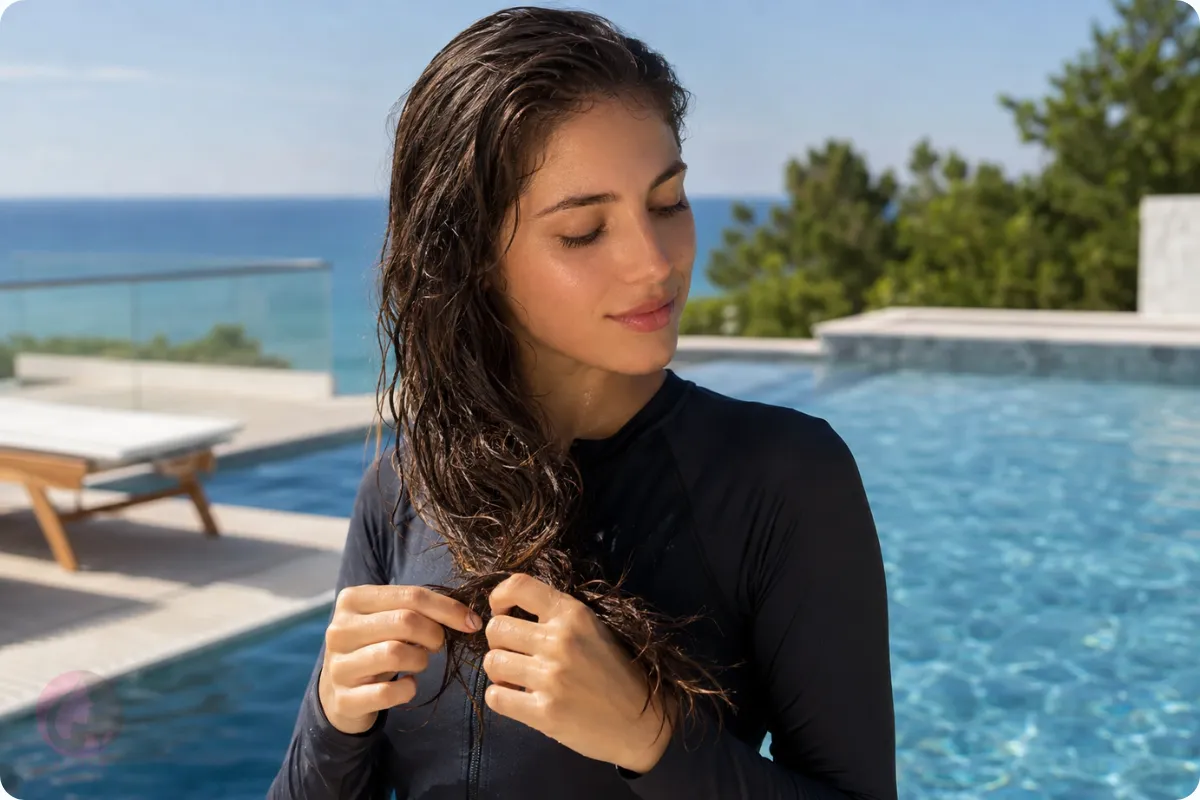
For hair care after swimming in the pool or sea, you do not need a complicated routine. Wetting your hair before swimming, reducing direct exposure to the water, rinsing immediately afterward, using shampoo and conditioner correctly, and limiting heat styling cover most of what your hair actually needs. The key is to start protecting your hair before entering the water, rather than waiting until it has already become dry and rough.
In this guide, we will look separately at the effects of chlorine, sea salt, and ultraviolet radiation, then explain which routine makes the most sense based on your hair type and how often you swim. We will also discuss why blonde hair can turn green after swimming, the difference between hair breakage and actual hair loss, and how to choose the right shampoo after a pool session.
Quick Answer: What Should You Do for Your Hair After Swimming in a Pool or the Sea?
If you do not have time to read the full guide, remember this one rule: do not let chlorinated or salty water dry on your hair for hours. Rinse your hair with fresh water as soon as possible, then choose your cleansing and conditioning routine based on how long you were in the water and the current condition of your hair.
- Before swimming: Thoroughly wet your hair with clean, fresh water.
- For dry, curly, or color-treated hair: Apply a small amount of leave-in conditioner to the lengths.
- In the pool: If you swim for long periods or regularly, wear a swim cap.
- Immediately after swimming: Rinse the entire length of your hair with fresh water.
- If needed: Use a gentle shampoo or a cleanser designed for swimmers.
- After washing: Apply conditioner to the mid-lengths and ends.
- When drying: Do not rub your hair aggressively, and keep blow-dryer heat as low as practical.
| When | Main Step | Purpose |
|---|---|---|
| Before swimming | Wet the hair and reduce direct exposure | Help limit additional dryness and roughness |
| Immediately after swimming | Rinse with fresh water | Reduce chlorine, salt, and mineral residue |
| After rinsing | Use shampoo according to your needs | Cleanse without excessive washing |
| Final step | Use conditioner or a hair mask | Reduce friction, tangles, and roughness |
Why Can Pools, Seawater, and Sun Exposure Make Hair More Vulnerable?
Unlike skin, the hair shaft cannot truly repair itself biologically. The surface of each strand is covered by overlapping layers called the cuticle. The smoother and more intact this surface is, the softer, shinier, and less tangled the hair usually feels. Repeated exposure to chemicals, sunlight, heat, and friction can gradually weather the surface of the hair shaft.
The main issue is that during a day at the pool or beach, your hair is rarely exposed to just one stressor. It may stay wet for a long time, come into contact with chlorine or seawater, dry under direct sunlight, and then be brushed or blow-dried afterward. This cumulative effect can be particularly important for bleached or already damaged hair.
| Factor | Potential Effect | Visible Signs | More Vulnerable Hair |
|---|---|---|---|
| Chlorinated water | Increased dryness and vulnerability of the hair surface | Roughness, tangling, and breakage | Color-treated and bleached hair |
| Saltwater | Greater feeling of dryness and roughness, especially in chemically processed hair | Reduced softness and increased tangling | Dry, curly, and bleached hair |
| Ultraviolet radiation | Oxidative damage to hair proteins and pigments | Dullness, dryness, and color changes | Light-colored, gray, white, and bleached hair |
| High heat | Additional thermal stress on vulnerable hair | Frizz, dryness, and breakage | All hair types, especially damaged hair |
What Exactly Does Chlorine Do to the Hair Shaft?
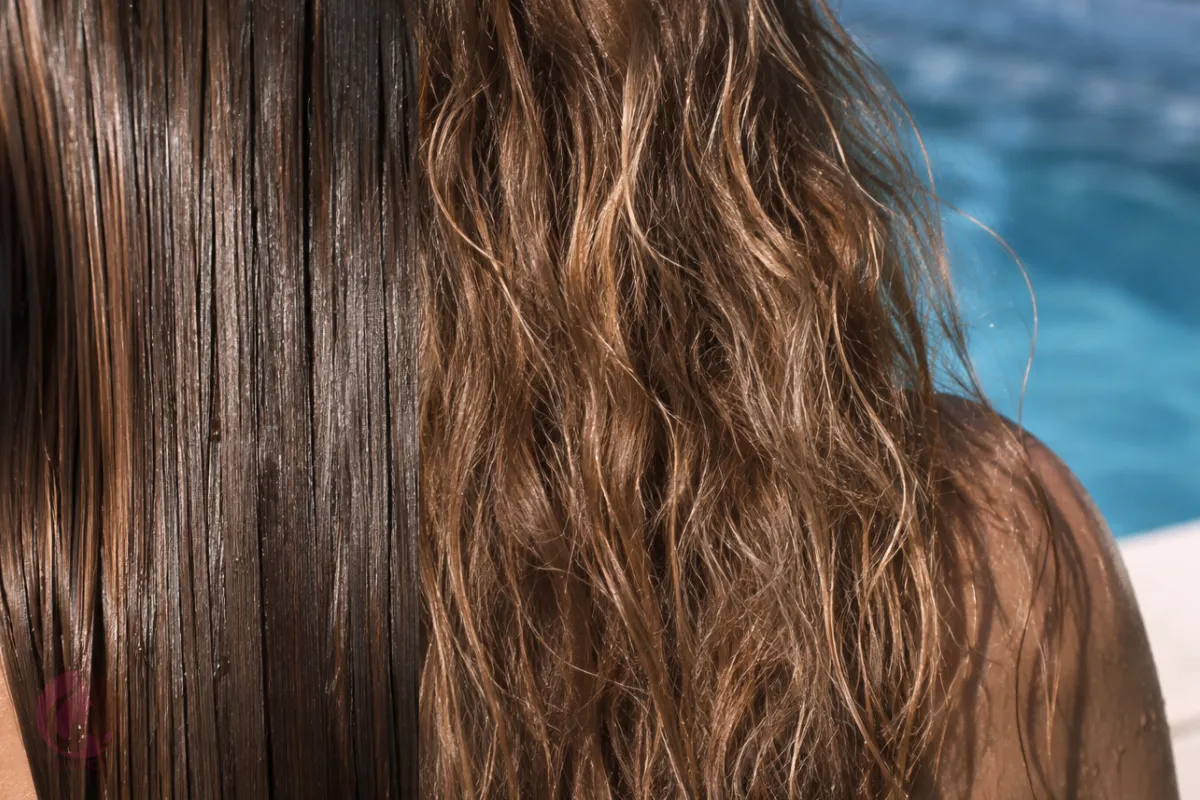
Chlorine is necessary for disinfecting swimming-pool water, but repeated exposure to chlorinated water can reduce protective lipids on the hair surface and leave the hair feeling drier, rougher, and more prone to tangling and breakage. This is generally more relevant for someone who swims several times a week than for someone who enters a pool only a few times a year.
The issue is not simply the presence of chlorine; exposure time and the hair’s initial condition also matter. Bleached or color-treated hair has already undergone chemical processing and may become rough more quickly after repeated pool exposure. If you would like to learn more about the different causes of hair damage, Redika’s guide to understanding hair damage is a useful companion to this section.
A practical summary of advice from the American Academy of Dermatology is to wet your hair with clean water before entering chlorinated water and rinse it promptly after swimming.
There is also an important point about blonde hair. Hair turning green after swimming does not necessarily mean that “chlorine turned the hair green.” Copper compounds present in the water can deposit on the hair, while the oxidative conditions in pool water may also contribute to the appearance of the green tint.
How Do Seawater and Sea Salt Affect Hair?
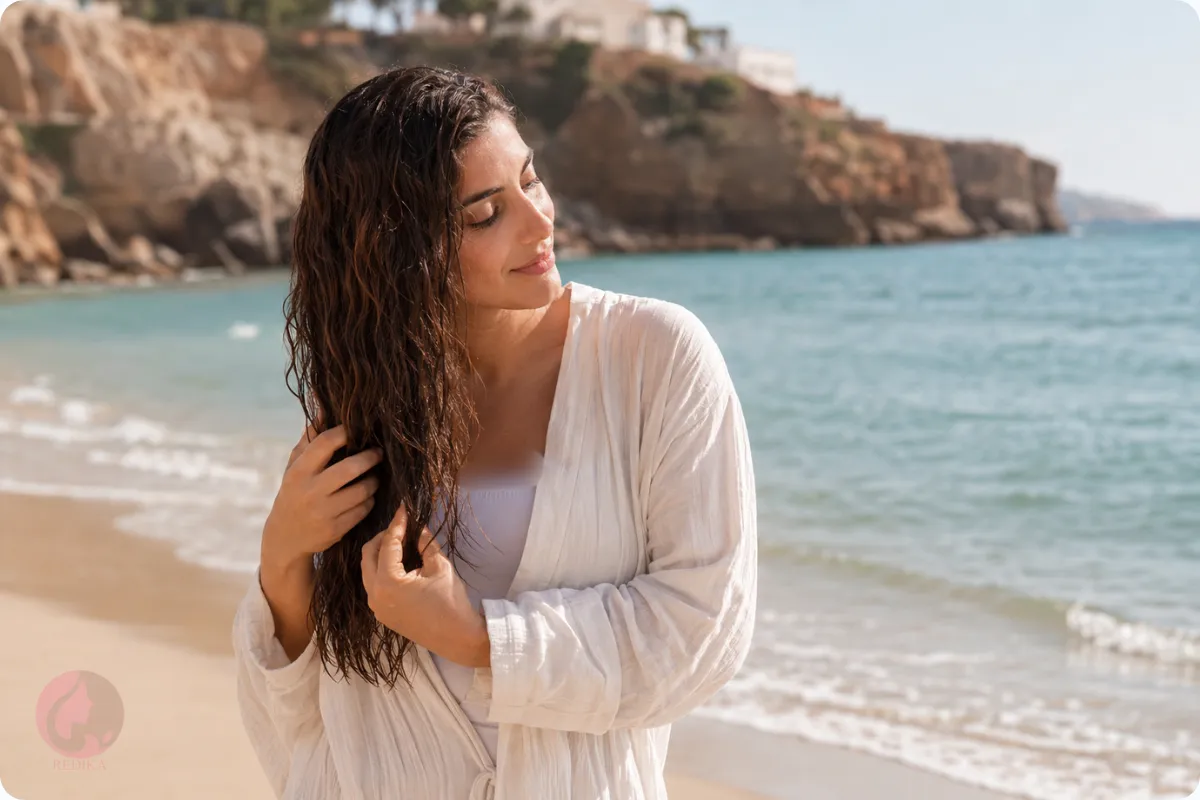
The effect of seawater on hair should not be oversimplified with claims such as “salt removes all the moisture from your hair.” Hair-fiber behavior is more complex, and direct scientific evidence on seawater is more limited than research on ultraviolet exposure. However, newer research suggests that bleached and color-treated hair may show more noticeable dryness and visual changes after exposure to saltwater than untreated natural hair.
When seawater dries on the hair, salt and minerals can remain on the strands and increase the sensation of roughness. As the surface becomes rougher, strands can catch against each other more easily and friction increases during detangling. This is why rinsing your hair with fresh water after swimming in the sea is one of the simplest and most useful habits.
If your hair feels straw-like after a day at the beach, avoid immediately applying a large amount of oil over salty hair. First rinse it with fresh water, cleanse it if necessary, and then use conditioner or a hair mask. This order helps reduce residue first and then focuses on restoring softness and slip.
Why Does Sunlight and UV Exposure Increase Hair Damage?

UV radiation does not affect only the skin; it can also influence the structure and pigments of the hair shaft. Prolonged sun exposure is associated with dryness, reduced shine, color changes, and increased brittleness. These effects may be more noticeable in light-colored, gray, white, and bleached hair because there is less natural pigment available to absorb part of the radiation.
Combining saltwater or chlorinated water with strong sunlight can put additional stress on the hair. Imagine leaving the water without rinsing your hair, allowing it to dry in the sun for several hours, and then straightening it with a flat iron that evening. In that situation, the hair experiences chemical, environmental, mechanical, and thermal stress within a short period.
At the beach or an outdoor pool, a wide-brimmed hat and spending time in the shade can provide simple physical protection. If your part is exposed or your hair is thinning, the scalp itself is also vulnerable to sun exposure, which makes physical sun protection even more important.
How to Protect Your Hair Before Swimming
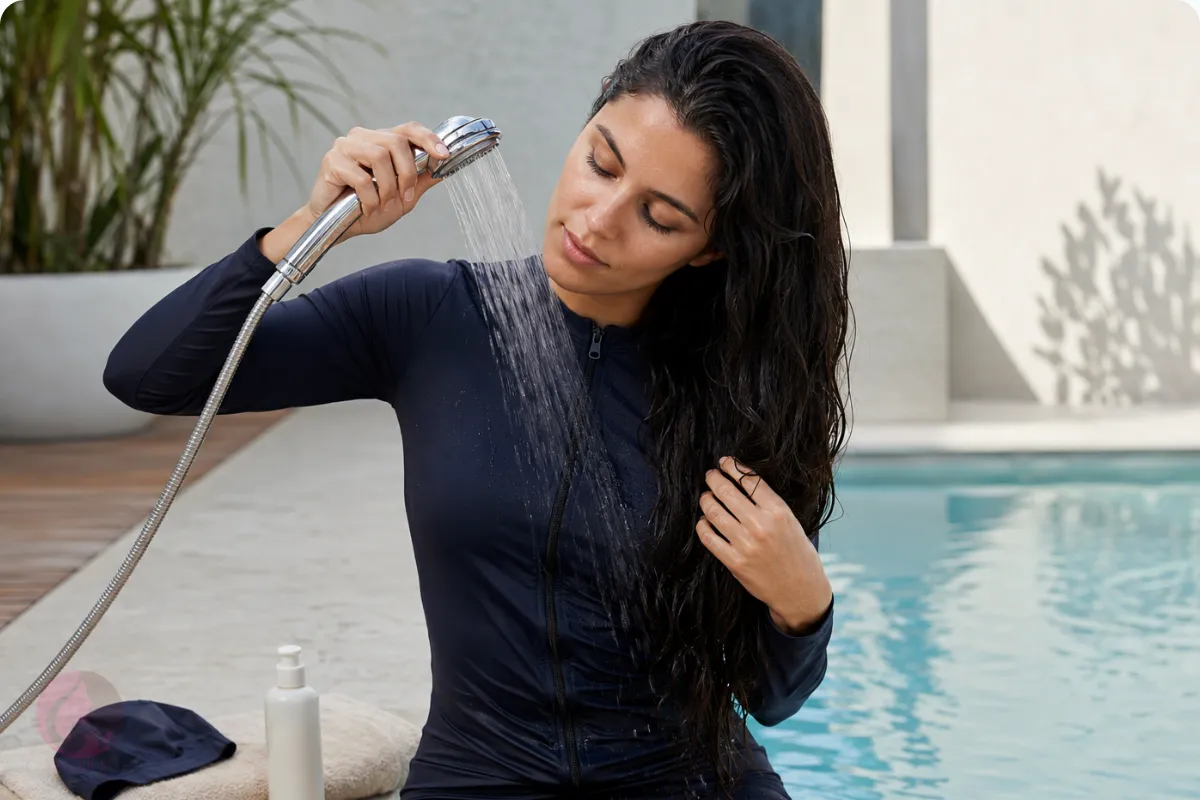
The best post-swim hair-care routine actually begins before you enter the water. If you can reduce direct exposure and limit how long pool or seawater remains on the strands, you will usually experience less dryness and tangling afterward.
- Before entering a pool or the sea, thoroughly wet your hair with fresh water.
- For dry, curly, or color-treated hair, apply a small amount of leave-in conditioner.
- If you swim regularly, use a swim cap.
- Arrange long hair neatly before putting on a swim cap, but do not tie it excessively tight.
- If you are planning a beach vacation, try not to schedule intensive bleaching immediately before the trip.
- At outdoor pools and beaches, use a hat or spend time in the shade during prolonged sun exposure.
Using more product does not always provide more protection. Applying a heavy layer of oil or another rich product may make cleansing more difficult afterward and could encourage you to use a stronger shampoo than necessary. For most people, a light, even layer on the hair shaft is enough.
Fine hair often feels better with lightweight products, while thick, curly, and very dry hair may tolerate richer formulas. The goal is to create some surface protection and reduce friction, not to completely coat or saturate every strand with product.
What Should You Do Immediately After Getting Out of the Water?
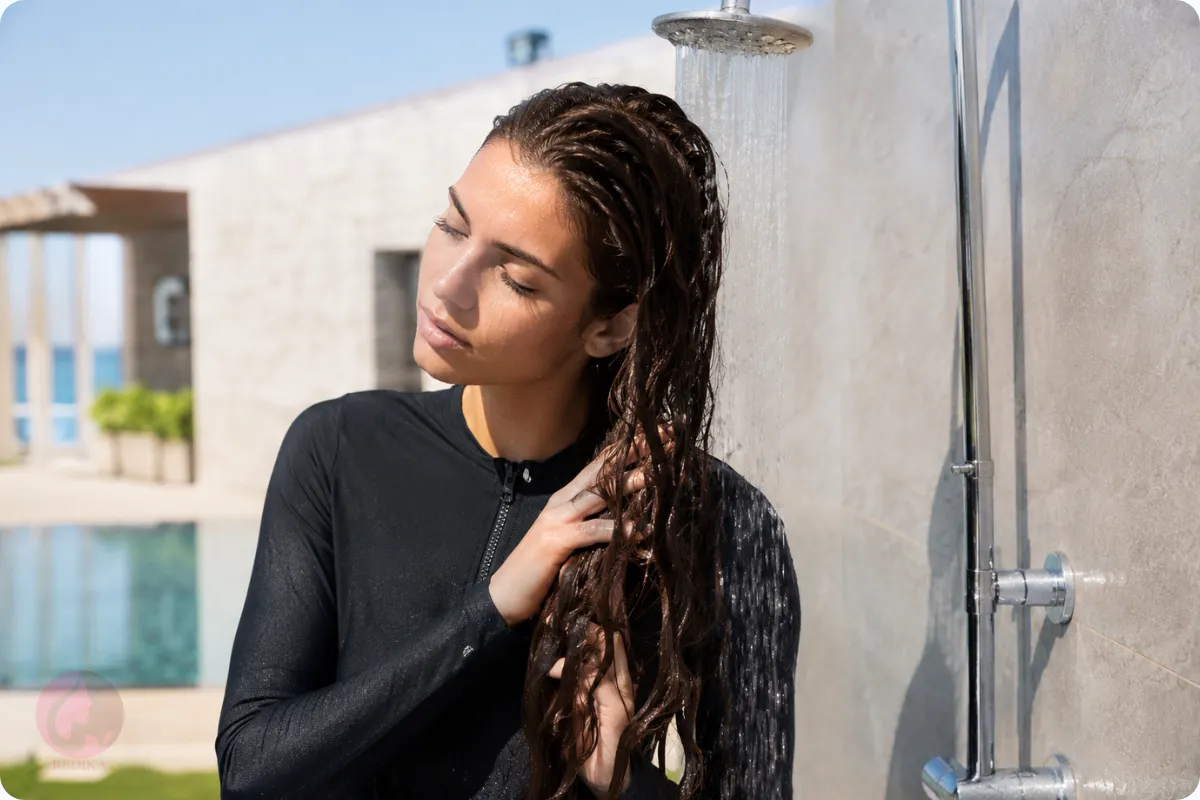
The first few minutes after leaving the water are important. If there is a shower at the pool or beach, do not wait until you get home. Rinse your hair with fresh water right away to reduce chlorine, salt, and mineral residue on the strands.
While rinsing, avoid wringing your hair out or rubbing sections aggressively against each other. Let the water flow naturally from the roots toward the ends. If you plan to shampoo, concentrate most of the cleanser on the scalp and allow the lather to travel through the lengths as you rinse.
What if there is no fresh-water shower at the beach? A bottle of drinking water can be surprisingly useful for an initial rinse. You do not need to perform a complete shampoo routine on the beach; the goal is simply to avoid leaving a substantial layer of salt to dry on your hair for several hours. You can wash your hair more thoroughly once you return to your accommodation.
Shampoo, Conditioner, and Hair Masks After the Pool or Sea
Shampoo after swimming should remove residue from the scalp and hair without exposing the strands to unnecessarily aggressive cleansing every time. Someone who swims once a month does not have the same needs as someone who enters a pool almost every day.
A clarifying shampoo is generally designed to reduce buildup from oils, styling products, and other residues. A chelating shampoo is more specifically relevant when minerals and metals present in the water are contributing to buildup. These two terms should not automatically be treated as interchangeable.
If blonde hair turns green after swimming, automatically using purple shampoo is not necessarily the best response. Purple shampoo is mainly intended to neutralize yellow or brassy tones, while a green pool-related tint can be associated with copper deposits. If the color change is strong or persistent, especially on heavily bleached hair, avoid aggressive home treatments.
After cleansing, conditioner becomes particularly valuable because it increases slip between strands and reduces friction during detangling. If your hair has been exposed to pool or seawater for several consecutive days, is bleached, or still feels rough after regular conditioner, a moisturizing hair mask may be useful.
- Occasional swimming: A shampoo suited to your scalp plus conditioner is usually enough.
- Regular pool swimming: If buildup develops, consider a swimmer’s shampoo or another cleanser appropriate for the type of residue.
- Very dry hair: Focus on reducing friction and improving conditioning.
- Bleached or color-treated hair: Avoid excessive cleansing and very strong shampoos after every swim.
- Green discoloration: Consider mineral deposits, particularly copper, rather than blaming chlorine alone.
If dryness is an ongoing problem, Redika’s guide to caring for dry hair (in Persian) can help you build a more suitable everyday routine.
How to Dry and Detangle Hair Without Causing More Damage
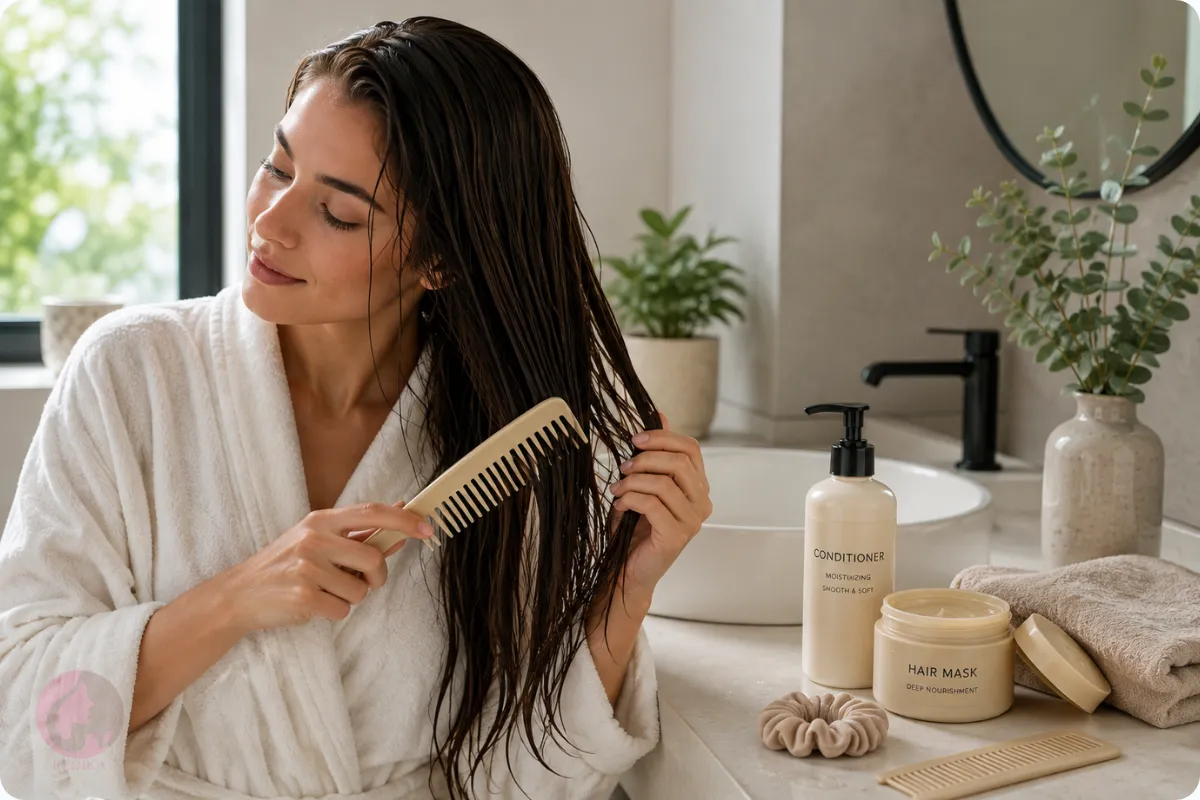
Once you have washed your hair correctly, the drying stage can either support or undo the previous steps. Do not vigorously rub wet hair back and forth with a rough towel. Instead, gently press or blot away excess water with a soft towel or suitable fabric.
When detangling, start at the ends and gradually work upward. Pulling a brush from the roots through tangled lengths can put unnecessary stress on the strands. Curly and highly textured hair is often easier to detangle while it is still damp and has enough conditioner or another slippery product on it.
- Remove excess water without aggressive rubbing.
- Detangle from the ends upward.
- Avoid very tight hair ties or clips on wet hair.
- If you need a blow dryer, use a lower temperature.
- Do not use flat irons or other direct high-heat tools on wet hair.
If you regularly use heated styling tools, Redika’s guide to protecting hair from heat (in Persian) can help reduce cumulative damage. A heat protectant does not make high temperatures harmless, but it can be one useful part of a sensible protective routine.
What Hair-Care Routine Is Best for You Based on Hair Type and Swimming Frequency?
There is no single routine that works for everyone. The most important factors include your hair’s current condition, whether it is colored or bleached, how often you swim, whether you swim in a pool or the sea, and how frequently you use heat styling.
| Your Situation | Before Swimming | After Swimming | Main Priority |
|---|---|---|---|
| Natural hair + occasional swimming | Wet the hair | Rinse + shampoo if needed + conditioner | Keep the routine simple |
| Dry or curly hair | Fresh water + lightweight leave-in conditioner | Gentle cleansing + richer conditioner | Reduce friction and tangling |
| Color-treated hair | Wet the hair + protective layer + swim cap in the pool | Gentle washing + conditioner | Reduce color changes and dryness |
| Bleached or very light blonde hair | Minimize exposure as much as possible + swim cap | Rinse quickly + manage mineral buildup + mask if needed | Reduce breakage and discoloration |
| Swimming several times a week | Wet the hair + swim cap + lightweight protective product | Rinse every time + cleanse according to buildup | Prevent cumulative damage |
| Multi-day beach vacation | Wet the hair + use physical sun protection | Rinse saltwater after every swim + conditioner | Manage salt, UV exposure, and heat |
If you swim almost every day, you do not need to wash your hair with the strongest clarifying shampoo every day. Rinsing after each session matters, but cleansing strength should match the actual amount and type of buildup. For frequent swimmers, using a swim cap, reducing friction, and conditioning consistently can be just as important as choosing the right shampoo.
If your hair is bleached, it makes sense to limit prolonged, direct exposure to chlorine and seawater more carefully. Bleached hair is generally more vulnerable than untreated hair and may become rough, discolored, or prone to breakage more quickly with repeated swimming.
Common Hair-Care Mistakes After Swimming in a Pool or the Sea
Sometimes what causes additional damage is not the swim itself, but what we do before or afterward. Excessive care can also become counterproductive when it involves unnecessary cleansing, heavy product buildup, or aggressive styling.
- Allowing chlorine or salt to dry on the hair for hours: If fresh water is available, do not postpone rinsing until you get home.
- Shampooing several times with a strong cleanser: More cleansing does not automatically mean better hair care.
- Automatically using purple shampoo on green hair: Pool-related green tones may be associated with copper deposits.
- Applying large amounts of oil to salty hair: Rinse the salt away first.
- Aggressively brushing wet hair: Work through tangles from the ends upward.
- Tying wet hair very tightly: Excessive mechanical tension may increase breakage.
- Using very hot blow dryers or flat irons immediately after swimming: Avoid adding unnecessary heat stress to already vulnerable hair.
- Using clarifying shampoo constantly: These cleansers are not necessarily intended for everyday use by everyone.
- Assuming every reduction in hair volume is hair loss: Hair-shaft breakage can create an appearance similar to thinning.
An effective routine is usually made up of a few practical steps that can be repeated consistently. Rinsing, appropriate cleansing, conditioning, and gentle handling of wet hair are often more useful than using many different products inconsistently.
When Does a Hair Problem After Swimming Need More Serious Attention?
Temporary dryness, tangling, or roughness after swimming often improves when the hair-care routine is adjusted. However, not every hair change should automatically be blamed on chlorine or seawater. If the problem continues for several weeks or appears to involve the scalp or hair roots, other causes should also be considered.
- Noticeable hair shedding from the roots continues for several weeks.
- Your part gradually becomes wider or your hair appears progressively thinner.
- A clearly defined patch of the scalp loses hair.
- Your scalp repeatedly develops significant redness, severe itching, or inflammation after swimming.
- The hair shaft continues to break easily even after improving your routine.
- Unusual hair discoloration does not improve with appropriate washing.
In these situations, evaluation by a dermatologist or another qualified hair professional may be more useful than simply adding more products. This is particularly important when hair is shedding from the roots, because swimming-pool exposure is only one possible factor and should not be assumed to be the primary cause without further assessment.
Conclusion: A Simple, Consistent Routine Is Better Than Trying to Repair Damage Later
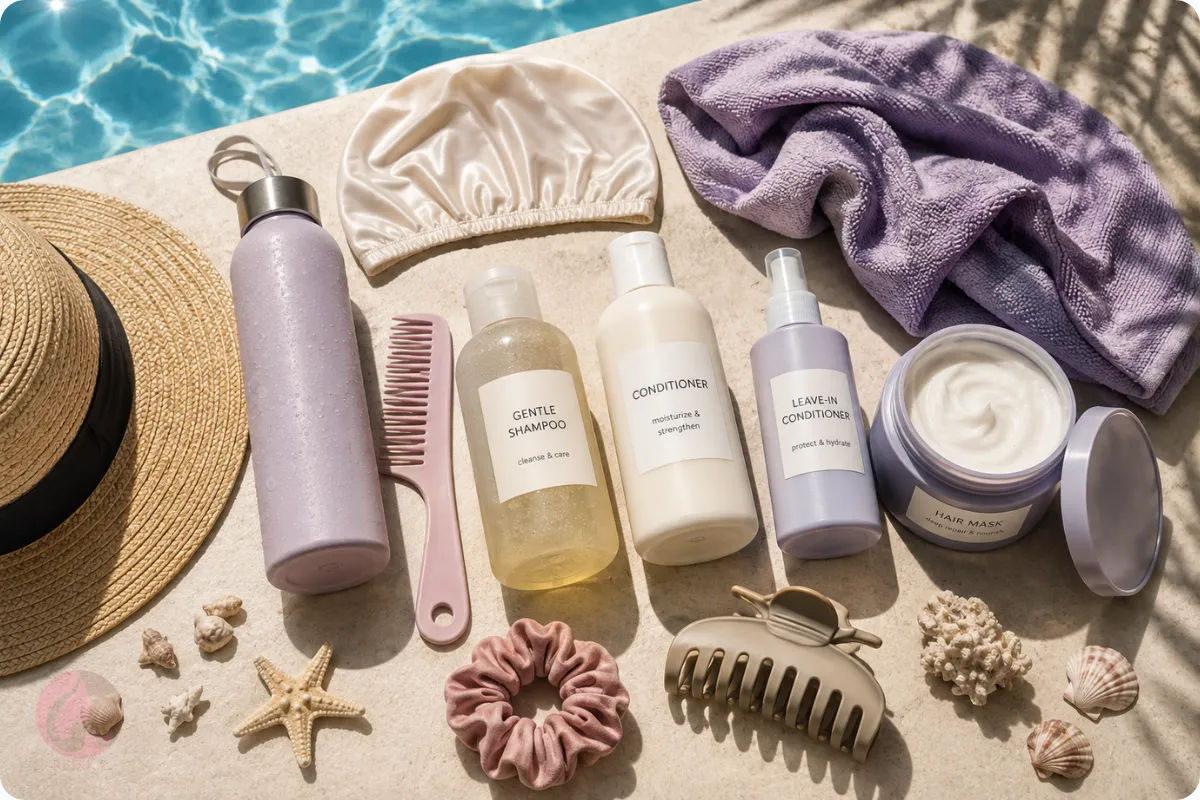
For effective hair care after swimming in the pool or sea, you do not have to give up swimming. The goal is to manage cumulative exposure to the factors that can make hair more vulnerable. Chlorine, salt, sunlight, and heat affect the hair in different ways, while color-treated, bleached, dry, and porous hair generally require more careful protection.
If you want to reduce this entire guide to one simple formula, remember: wet and protect your hair before swimming, rinse it promptly afterward, cleanse gently when needed, use conditioner, and avoid rough handling while the hair is wet.
| If You Have This Problem… | Do This First | Avoid This Mistake |
|---|---|---|
| Hair feels rough after the pool | Rinse + condition | Repeated washing with strong shampoo |
| Hair feels dry after the sea | Remove salt + conditioner or hair mask | Heavy oil before rinsing |
| Blonde hair has turned green | Consider copper or mineral buildup | Relying only on purple shampoo |
| You swim every day | Swim cap + regular rinsing + balanced cleansing | Unnecessary daily deep cleansing |
| You have bleached hair | Reduce exposure + increase protection | Ignoring UV exposure and heat |
No expensive hair mask or serum can completely replace good habits. If your hair is exposed to saltwater or chlorine every day, left to dry in the sun for hours, and then styled with high heat, a hair-care product can only compensate for part of that cycle. Prevention and a repeatable routine are usually the most effective strategy.
Frequently Asked Questions About Hair Care After Swimming in a Pool or the Sea
Does Pool Chlorine Cause Hair Loss?
Under normal conditions, it is important to distinguish between hair breakage and hair loss from the root. Repeated exposure to pool water can leave hair dry and brittle, increasing the likelihood of breakage. When many strands break along their lengths, the hair may appear thinner even though the follicles themselves are not necessarily shedding more hair.
If hair is shedding from the roots, your part is becoming wider, or excessive shedding continues for several weeks, do not automatically blame chlorine. In that situation, other potential causes of hair loss should be evaluated by a dermatologist.
Should You Shampoo Your Hair After Every Pool Session?
Rinsing after every swim is important, but the type and strength of shampoo should depend on how long you were in the water, how often you swim, and your hair type. Regular swimmers may occasionally benefit from a cleanser designed to remove buildup, but the strongest clarifying shampoo does not need to be used every day by everyone.
For dry, color-treated, or bleached hair, balancing cleansing with adequate conditioning becomes even more important. In short: rinse after every swim and choose shampoo according to the actual needs of your scalp and hair.
Why Does Blonde Hair Sometimes Turn Green After Swimming?
A green tint is more commonly associated with copper compounds depositing on the hair than with chlorine directly producing a green color. Blonde and bleached hair simply show these color changes more clearly because of their light base.
Wetting your hair before swimming, using a swim cap, and rinsing immediately afterward can help reduce buildup. If a green tint has already developed and persists, purple shampoo is not necessarily the direct solution, and a product designed to remove mineral deposits may be more relevant.
What Should You Do Before Swimming if Your Hair Is Colored or Bleached?
Thoroughly wet your hair with fresh water before entering the pool or sea and apply a small amount of leave-in conditioner to the lengths. In a swimming pool, a swim cap can reduce unrestricted contact between your hair and the water and becomes especially useful for frequent swimmers.
After swimming, rinse promptly and avoid overly aggressive cleansing. At the beach, also consider sunlight and heat as part of your protective routine because chemically processed hair is generally more vulnerable to the combined effects of environmental exposure.
Is a Hair Mask or Conditioner Better After Swimming in the Sea?
For an ordinary swim, a suitable conditioner is often enough to reduce friction, tangling, and roughness. A hair mask may be more useful when your hair is already very dry or bleached, when you have been swimming for several consecutive days, or when normal conditioner is no longer enough to restore softness.
More important than choosing between the two is using them in the correct order: first rinse away the salt with fresh water, shampoo if needed, and then use conditioner or a hair mask. Applying more products to hair that is still covered in salt does not replace proper rinsing.
Selected scientific sources used to prepare and review this article:
- American Academy of Dermatology – Summer Hair Care
- American Academy of Dermatology – How to Stop Damaging Your Hair
- CDC – Swimming Pool Safety
- PubMed Central – Scientific Review of Hair Structure and Hair Damage
- PubMed Central – Environmental Factors and Hair Damage
- PubMed – Copper and Green Hair Discoloration
About the author

Join the conversation
Share your experience or question with REDIKA readers.
Your email stays private. Please avoid sharing personal or sensitive details.


