Home / Editorial guide
Editorial article
What Is Hair Porosity? How to Identify It, Limits of the Water Glass Test, and Routines for Each Type

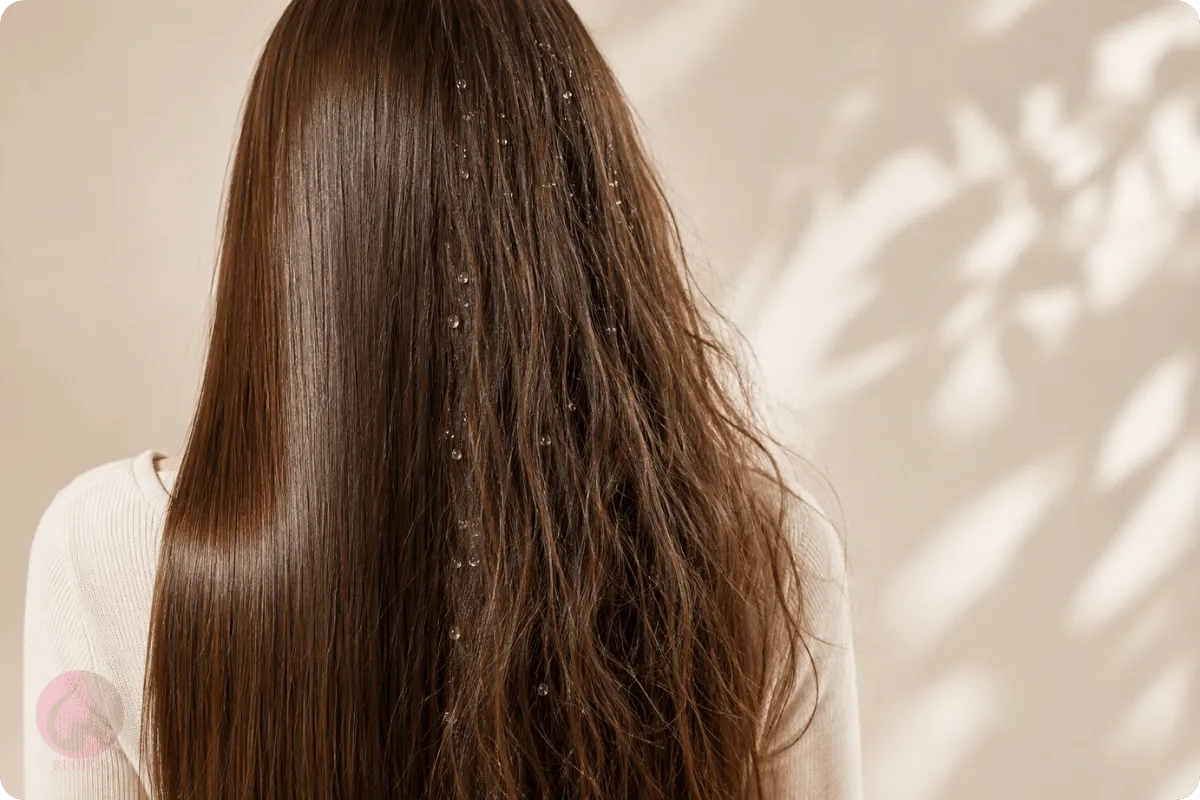
Quick answer: Hair porosity describes how the hair shaft interacts with water, moisture, and hair-care products. In the commonly used hair-care model, porosity is divided into low, medium, and high categories, but this classification is not a medical or laboratory diagnosis. The water glass test is also not reliable enough to determine hair porosity with certainty, because its result can be influenced by water surface tension, natural oils, conditioner, oils, and product residue left on the hair. A more practical approach is to observe how your hair behaves when it gets wet, when conditioner is applied, while it dries, and how well it retains softness over several wash cycles.
How this content was prepared: This guide was prepared by the Redika Magazine editorial team based on a review of scientific sources, research on hair-shaft structure, and recommendations from dermatology specialists.
Last updated: August 4, 2026
Medical note: This article was not written by a physician and is not a substitute for a dermatologist’s diagnosis. Hair porosity relates to the behavior of the hair shaft and is not intended to diagnose hair loss, scalp inflammation, infections, persistent itching, or hair and scalp disorders.
What Is Hair Porosity and How Is It Related to the Hair Cuticle?
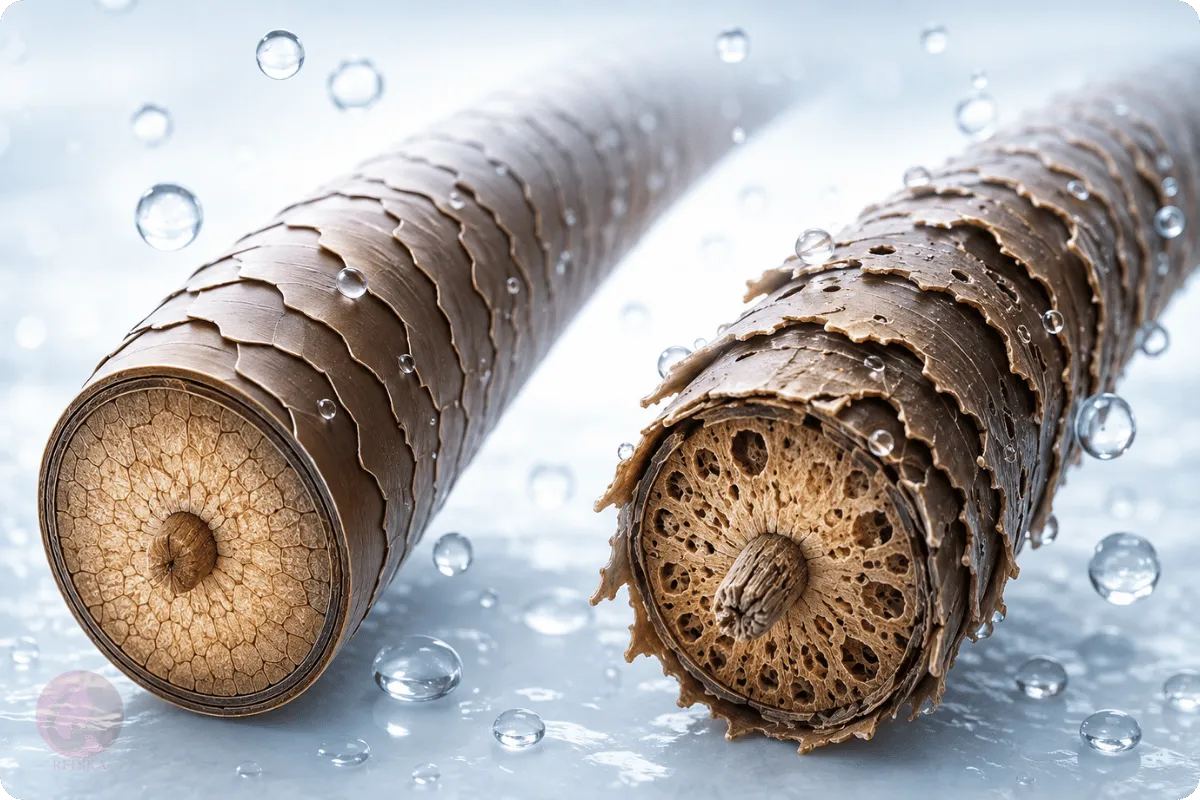
Hair porosity, in a scientific sense, relates to spaces and pathways within the structure of a hair fiber that can affect the penetration of water, chemicals, and certain compounds. In everyday hair-care discussions, however, the term is more often used to describe how quickly hair becomes wet, how it responds to conditioner, and how long it retains a feeling of softness. These two meanings are not exactly the same, which is why every aspect of hair behavior should not automatically be attributed to porosity. Dividing hair into low, medium, and high porosity is best understood as a practical model for adjusting a hair-care routine, rather than a definitive diagnosis.
The outermost layer of the hair shaft is called the cuticle. It consists of flat cells that overlap one another. You can think of the cuticle like overlapping roof tiles: the more orderly this layer is, the better protected the inner parts of the hair fiber tend to be. Beneath the cuticle lies the main body of the hair shaft, known as the cortex, which contributes significantly to the hair’s strength, flexibility, and color. Bleaching, intensive coloring, repeated heat exposure, sunlight, friction, and aggressive brushing can all alter the cuticle and cortex.
Damaged hair generally shows more friction, tangling, and breakage and may interact with water and other substances differently from less-damaged hair. Laboratory studies have shown that damage caused by oxidizing agents can extend from the cuticle into the internal structure of the hair, while more intensive bleaching can be associated with greater protein degradation. However, a dry or frizzy appearance alone does not prove that hair has high porosity. Environmental conditions, curl pattern, strand thickness, hair density, and products left on the surface can also change the way hair behaves.
Why Does Understanding Hair Porosity Matter When Choosing a Routine?
Understanding how your hair absorbs products and retains softness can help explain why some products do not work as expected. A rich hair mask may be excellent for someone else, yet sit heavily on your hair and leave it looking dull. On the other hand, a very lightweight conditioner may soften a bleached section of your hair for only a few hours before roughness returns. These differences are not always about whether a product is good or bad; the suitability of the formula, the amount used, and the actual condition of the hair shaft matter more.
Assessing porosity can reduce trial and error, but it should not be the only factor you use when choosing hair products. A sensible routine should also take into account scalp type, oil production, strand thickness, whether the hair is straight or curly, its history of coloring or bleaching, and how frequently heated styling tools are used. Porosity primarily relates to the hair shaft, while wash frequency is influenced largely by scalp condition. To learn more about the scalp’s natural oils, read Redika’s guide to what sebum is and how it affects the skin and hair (in Persian).
Key principle: The best routine is not necessarily one labeled “for low-porosity hair” or “for high-porosity hair.” A suitable routine is one that uses the least amount of product needed to make your hair softer, less tangled, lighter, and more resilient.
Types of Hair Porosity and Their Main Signs
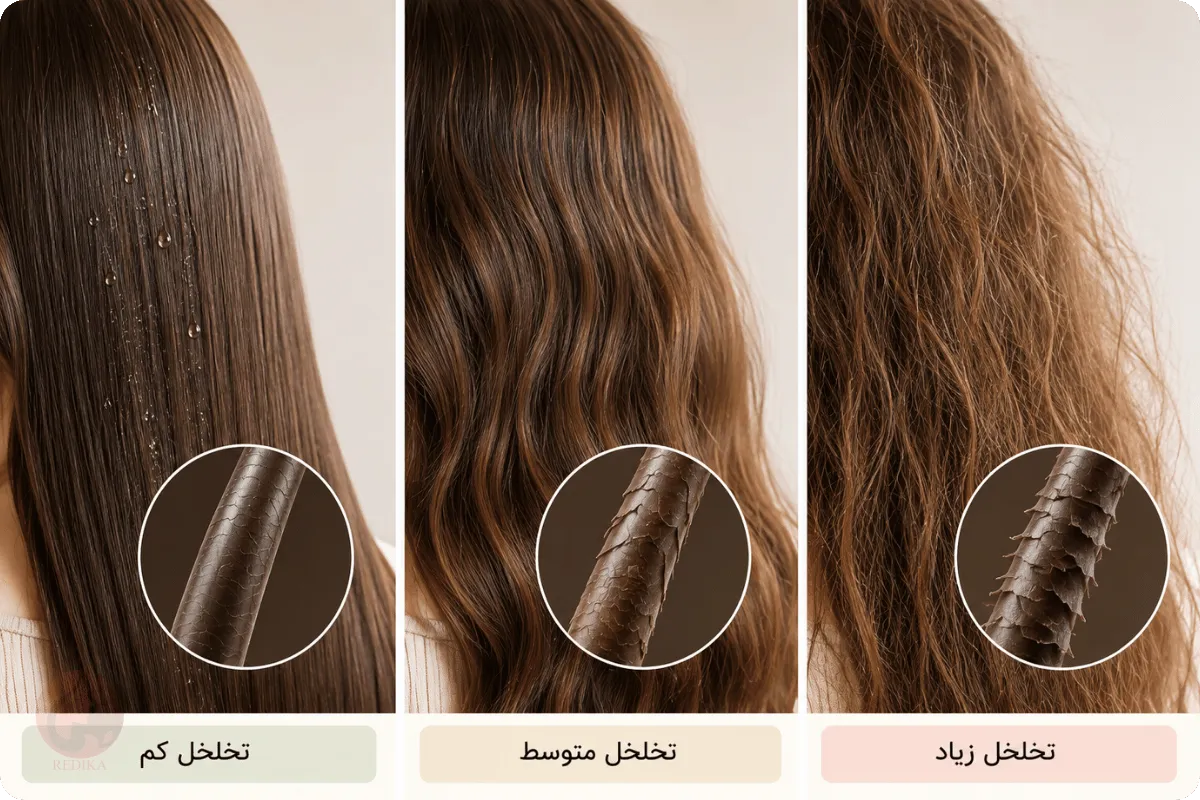
In the commonly used hair-care model, hair porosity is divided into low, medium, and high porosity. The boundaries between these groups are not precise laboratory categories, and one person may show characteristics of more than one group. Different parts of the same head of hair can also behave differently. For example, newly grown roots may have relatively little damage, while the ends may have become rougher and more permeable after years of coloring and heat exposure. Instead of choosing one permanent label, it is more useful to observe how different sections of your hair actually behave.
What Are the Signs of Low-Porosity Hair?
In the consumer hair-care model, low-porosity hair is generally described as having a relatively orderly surface and greater resistance to becoming fully wet or coated with water. At the beginning of a shower, you may notice water droplets sitting on the hair and it may take a little longer for the strands to become thoroughly wet. Rich products, heavy oils, and multiple layers of styling or care products may also remain on the surface and leave the hair flat, greasy, or dull. These signs should ideally be evaluated on relatively clean hair because product buildup can mimic some of the behaviors commonly associated with low porosity.
- The hair quickly feels weighed down by a small amount of oil or cream.
- The hair loses some of its natural movement after several products are layered on it.
- Rich conditioner seems to sit on the hair and can be more difficult to rinse out.
- The hair suddenly feels lighter and more manageable after an appropriate wash.
- Natural roots often behave better than colored or bleached lengths.
Low-porosity hair is not automatically dry, unhealthy, or problematic. In many people, newly grown sections have a more orderly surface simply because they have experienced less damage. Problems may arise when every sign of roughness leads to adding more oil, masks, or creams until the hair becomes coated in multiple product layers. In that situation, appropriate cleansing and simplifying the routine may be more helpful than adding another heavy treatment.
What Are the Signs of Medium-Porosity Hair?
Medium-porosity hair generally becomes wet within a reasonable amount of time, allows conditioner to spread easily, and retains the resulting softness for an appropriate period. This does not mean that the hair can never be dry or frizzy, but its behavior tends to be relatively predictable. Using slightly more or less product usually does not immediately cause extreme heaviness or noticeable roughness. Hair with this pattern often benefits more from a balanced, preventive routine than from frequent intensive treatments.
- The hair becomes wet without strong resistance.
- A regular conditioner improves detangling.
- The hairstyle and softness remain for a reasonable amount of time.
- Lightweight to medium-weight products usually work well.
- Dryness tends to be more noticeable at the ends rather than throughout the entire length.
One of the biggest risks for this group is doing too much. When the hair is already soft, manageable, and relatively free of tangles, simultaneously using a rich mask, oil, cream, serum, and repeated protein treatments can disrupt that balance. A medium-porosity routine is usually better kept simple and adjusted only when necessary, such as after coloring, during travel to a dry climate, or when heat styling becomes more frequent. The main goal is to prevent limited damage from developing into more widespread damage.
What Are the Signs of High-Porosity Hair?
High-porosity hair often takes up water quickly but may have difficulty retaining the feeling of softness created by conditioning products. Hair that has been repeatedly bleached, colored, or exposed to high heat is more likely to experience increased surface and internal damage. It may become wet very quickly in the shower, tangle after washing, and feel rough or puffy again only a few hours after drying. These signs should still be interpreted together with the hair’s damage history and the actual condition of the shaft.
- Softness created by a mask or conditioner does not last very long.
- The ends tangle frequently or develop split ends.
- The hair reacts strongly to humid or dry weather.
- Detangling the lengths without conditioner is difficult.
- There is a history of bleaching, light hair color, frequent flat ironing, or blow-drying.
- Natural roots feel softer than colored or bleached lengths.
Not every curly, frizzy, or dry head of hair should be classified as highly porous. In curly hair, natural scalp oils have more difficulty traveling along the bends of the hair fiber, while brushing curly hair when dry can also increase frizz. Insufficient conditioning, dry air, rough towels, and friction from a pillow can produce a similar appearance. For this reason, damage history and how long the hair retains softness are generally more useful clues than how it looks on a single day.
Hair Porosity vs. Dryness, Damage, Strand Thickness, and Product Buildup
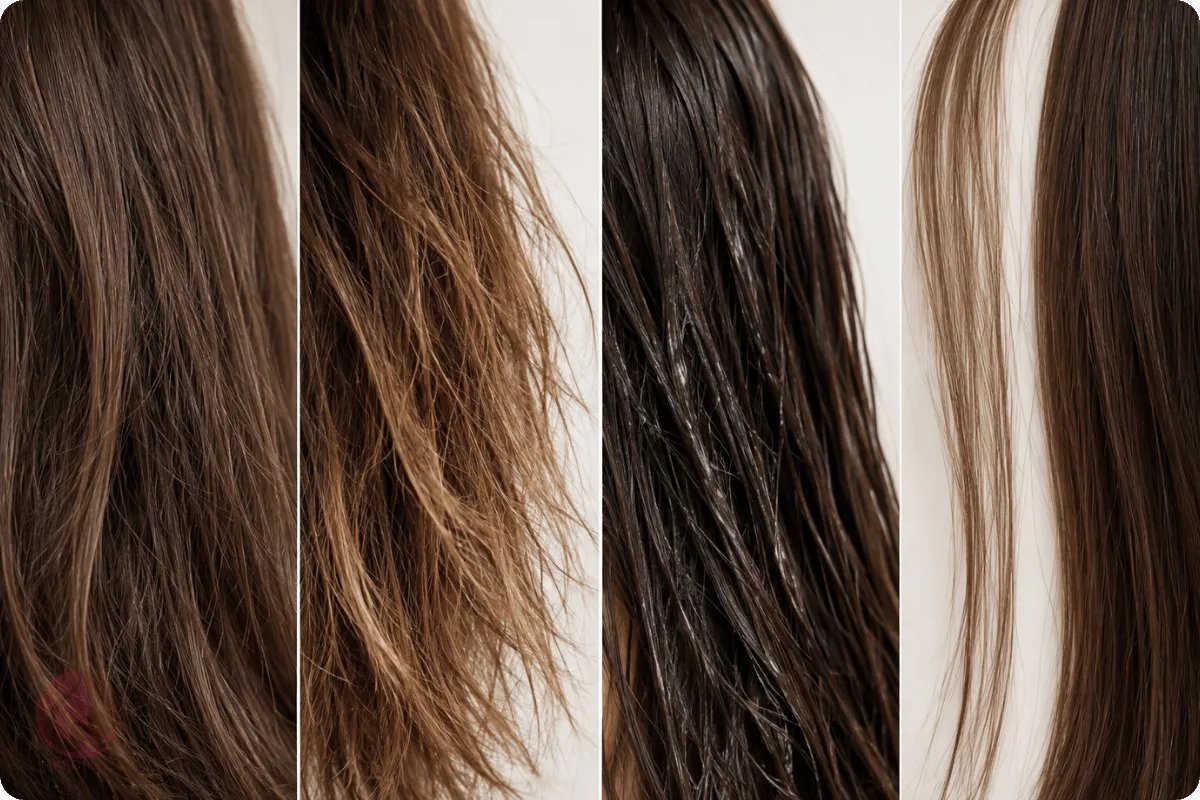
One of the most common mistakes is treating dryness, frizz, damage, and high porosity as the same thing. Hair dryness describes how the shaft feels and looks, whereas porosity relates to the structure of the fiber and the way substances can move into or through it. Product buildup can also make the hair surface feel rough, dull, or sticky even when the strand has relatively little structural damage. Strand thickness is another separate characteristic and refers to whether an individual hair fiber is fine, medium, or coarse.
| Condition | Main Issue | Practical Sign | Suitable First Step |
|---|---|---|---|
| Dry hair | Lack of softness, slip, or surface lubrication | The hair usually feels softer with a suitable conditioner | Adjust cleansing and add an appropriate level of conditioning |
| High porosity or significant damage | Changes to the cuticle or internal parts of the shaft | Tangling, breakage, and rapidly returning roughness, especially in bleached areas | Reduce friction, condition regularly, use heat protection, and limit further damage |
| Product buildup | Oil, wax, polymers, or conditioner remaining on the surface | More product makes the hair dull and heavy, while washing makes it feel lighter | Reduce layering and cleanse according to the products being used |
| Fine or coarse hair | The physical diameter of each strand | Fine hair becomes weighed down with less product; coarse hair may tolerate richer creams | Adjust product weight and amount instead of determining porosity from strand diameter |
For example, low-porosity hair can feel rough and flat because of oil and conditioner buildup. In contrast, bleached hair may look smooth and shiny after using a suitable conditioner while still having structural damage. This is why appearance at a single moment is not enough to draw a conclusion. Look at the pattern over several days and compare the roots, mid-lengths, and ends.
How Can You Assess Hair Porosity at Home?
No simple home test can measure hair porosity with the precision of laboratory methods. Depending on the research objective, laboratories may use microscopic imaging, water-absorption measurements, evaluation of protein loss, mechanical testing, and other techniques. At home, the goal is not to assign a numerical porosity value. Instead, the aim is to learn what level of cleansing, conditioning, and protection produces the best behavior in your hair. A multi-step observation is therefore more useful than relying on one isolated test.
Before you begin:
- Do not use a heavy oil treatment or very rich mask on the day of the assessment.
- Observe the roots, mid-lengths, and ends separately.
- Do not interpret drying time without considering hair volume and density.
- Do not generalize the result of one day to the entire year.
- Do not change several products at once; change only one variable at each stage.
Redika’s Three-Wash Protocol for Evaluating Hair Behavior
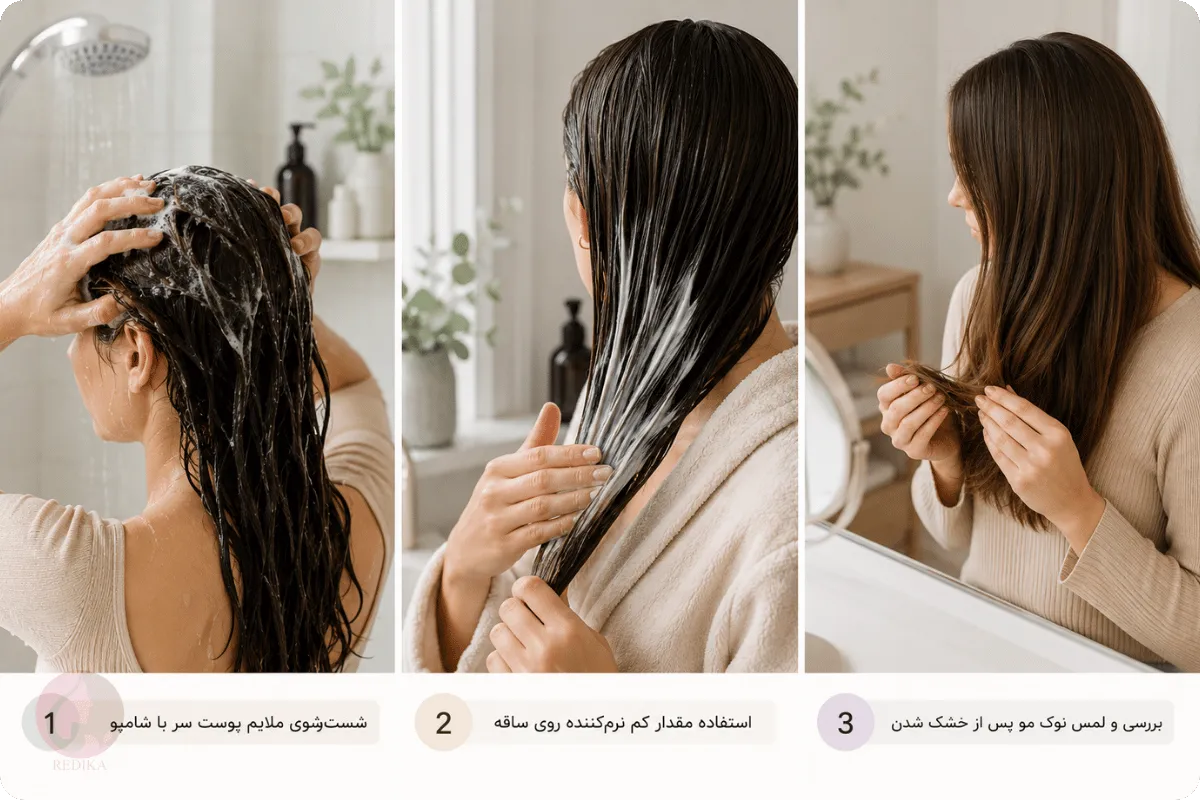
This protocol is not a medical test or a laboratory measurement. It is a practical framework designed to reduce guesswork when building a hair-care routine. Complete three washes under roughly similar conditions and record what you observe each time. Adjust the interval between washes according to how quickly your own scalp becomes oily or dirty. At the end, look for a pattern that repeats instead of focusing on one isolated sign.
| Wash | What to Do | What Should You Record? | Possible Interpretation |
|---|---|---|---|
| First wash | Use your regular shampoo on the scalp and apply a lightweight conditioner to the lengths. | How quickly the hair becomes wet, the amount of tangling, and how the hair feels after drying | This establishes a baseline for your current routine. |
| Second wash | Remove extra oils and creams and use only one lightweight leave-in product. | Lightness, volume, shine, and how long softness lasts until the following day | Noticeable improvement may suggest that the previous routine was too heavy. |
| Third wash | Slightly increase conditioning only on the drier or more damaged areas. | Differences between roots, mid-lengths, and ends, as well as tangling and breakage | This can help show whether different sections of the hair need different care. |
If your hair becomes lighter and softer after removing heavy layers of product, the main issue may have been buildup or an overly heavy routine. If only the bleached lengths still become rough and tangled quickly, greater damage and porosity may be concentrated in that area. If the entire head becomes wet normally and responds well to an ordinary conditioner, there is no need to make the routine unnecessarily complicated. This protocol can help prevent you from treating the roots and ends as though they always have identical needs.
What Can the Water Spray Test and Strand-Feel Test Tell You?
For the spray test, a small amount of water is misted onto a section of clean, dry hair. Water remaining as droplets on the surface can be associated with surface water repellency, natural oils, silicones, oils, or certain styling products and does not automatically prove that the hair has low porosity. Water spreading quickly also does not automatically indicate high porosity, because the angle of the strands and the amount of product present can alter the result. The spray test is therefore useful only when interpreted alongside the hair’s history and its behavior during washing.
For the touch test, gently hold a clean strand between your fingers without pulling hard and compare how the root and end feel. Noticeable roughness near the end may be associated with cuticle wear, split ends, hard-water deposits, or product buildup. Touch alone cannot identify the exact type of damage, but it can help show which parts of the hair need greater conditioning and less friction. If different areas behave differently, a section-specific routine is more logical than assigning one label to your entire head of hair.
How Is the Water Glass Hair Porosity Test Performed?
In the commonly shared version of the water glass test, a clean, dry strand of hair is placed on water and left for several minutes. Social-media explanations often claim that floating hair indicates low porosity, hair suspended in the middle indicates medium porosity, and hair that sinks indicates high porosity. The simple reasoning is that more porous hair absorbs more water, becomes heavier, and sinks. The problem is that the behavior of an extremely lightweight hair fiber on the surface of water is not determined by water absorption alone.
Practical takeaway: The water glass test is a non-standardized home method and is not reliable enough to determine hair porosity with certainty. Its result should not be used as the sole reason to buy an entirely new product range or suddenly abandon your current routine.
Why Is the Water Glass Test Limited and Inconclusive?
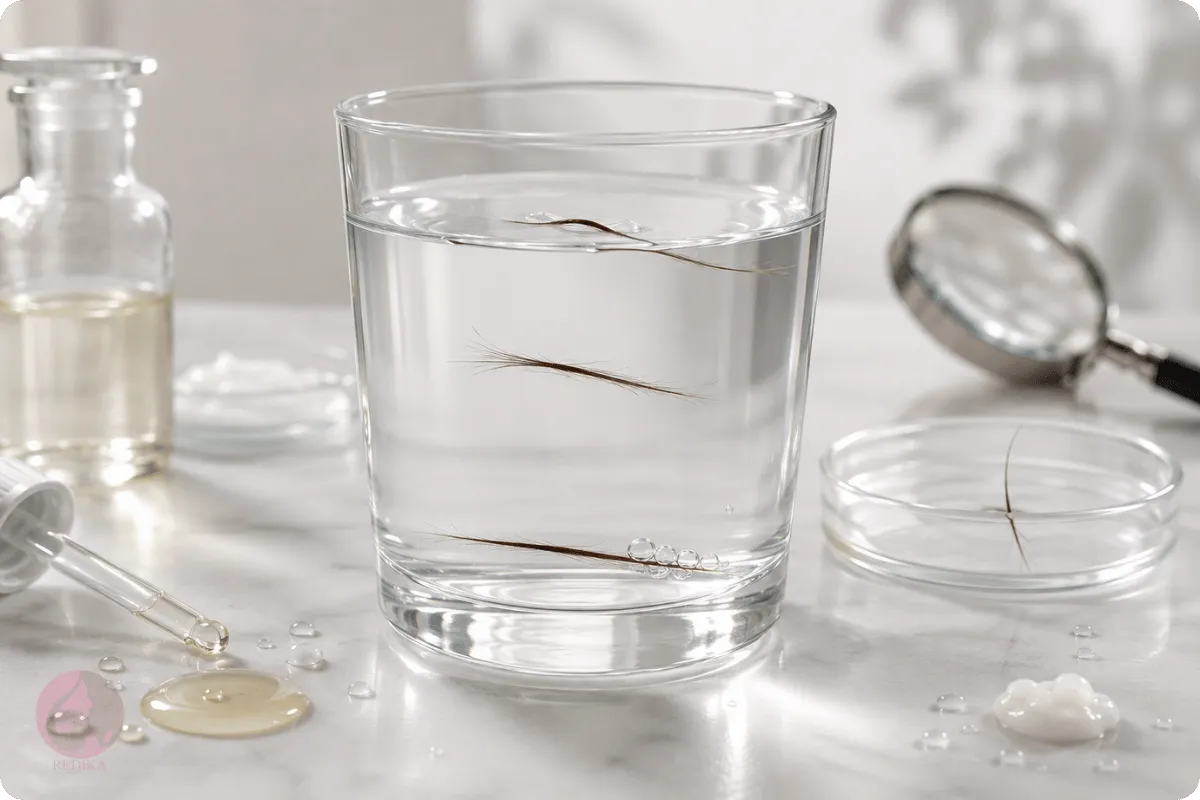
The first limitation is water surface tension. A hair strand has very little mass and may remain floating because of forces at the surface of the water rather than because the shaft is resistant to water penetration. Pushing the strand under the water, moving the glass, or wetting the hair beforehand can also change the result. Because the test procedure is not standardized, results from different people cannot be compared reliably.
- Sebum and oils: They can make the surface of the strand more water-repellent.
- Conditioners and silicones: They may alter the way water contacts the surface of the hair.
- Air bubbles: They can attach to the strand and increase flotation.
- Strand diameter and shape: These can affect how the hair sits on the water surface.
- Differences between roots and ends: One final floating position cannot reveal differences along the length of the strand.
- How the test is performed: Waiting time, water temperature, and the way the strand is placed are not standardized.
Scientific investigations of hair damage and porosity can use methods such as microscopy, pore-volume measurements, water-absorption analysis, changes in fiber diameter, tensile testing, and measurement of protein loss. For this reason, the water glass test should be viewed as an informal observation rather than the equivalent of a laboratory measurement. If the glass test conflicts with the way your hair actually behaves, real-world hair behavior should take priority. For example, a repeatedly bleached section that tangles quickly and breaks easily needs damaged-hair care even if a strand happens to remain floating.
Low vs. Medium vs. High Hair Porosity: Comparison Table
| Comparison | Low Porosity | Medium Porosity | High Porosity |
|---|---|---|---|
| Initial wetting | May take a little longer, or droplets may remain visible on the surface | Usually becomes wet within a moderate amount of time | Often becomes wet quickly, especially in damaged areas |
| Response to heavy products | More prone to dullness, greasiness, and loss of volume | Usually manageable when used in moderation | May become temporarily softer, although too much product can still create heaviness |
| How long softness lasts | Can retain softness well once a suitable product is found | Usually balanced and predictable | Softness may disappear more quickly |
| Tangling and breakage | Can develop with buildup or unsuitable care | Usually limited and more noticeable at the ends | More common in damaged sections |
| Main routine focus | Prevent buildup and use lightweight layers | Maintain balance and prevent damage | Reduce friction, condition the hair, and prevent further damage |
| Relationship to the glass test | Floating does not provide a definitive diagnosis | Remaining suspended is not sufficient scientific evidence | Sinking alone does not prove high porosity |
This table is designed as a starting point for observation, not as a replacement for assessing how your hair actually behaves. For a better assessment, look for two or three signs that occur together and repeat over time. A single sign such as slow drying or water droplets sitting on the surface is not enough. High hair density, strand thickness, and the amount of leave-in product used can also affect drying time.
Hair-Care Routines Based on Porosity
The foundation of a routine for any hair type includes cleansing the scalp appropriately, applying conditioner to the lengths, detangling gently, and limiting unnecessary heat. The American Academy of Dermatology recommends focusing shampoo mainly on the scalp, using conditioner after washing, and avoiding rough towel drying. Choosing products without considering strand thickness and hair texture can also affect the result; fine hair often benefits from lighter products, while coarse or very curly hair may need richer conditioning. The routines below are starting points and should be adjusted according to how your own hair responds.
Low-Porosity Hair Routine
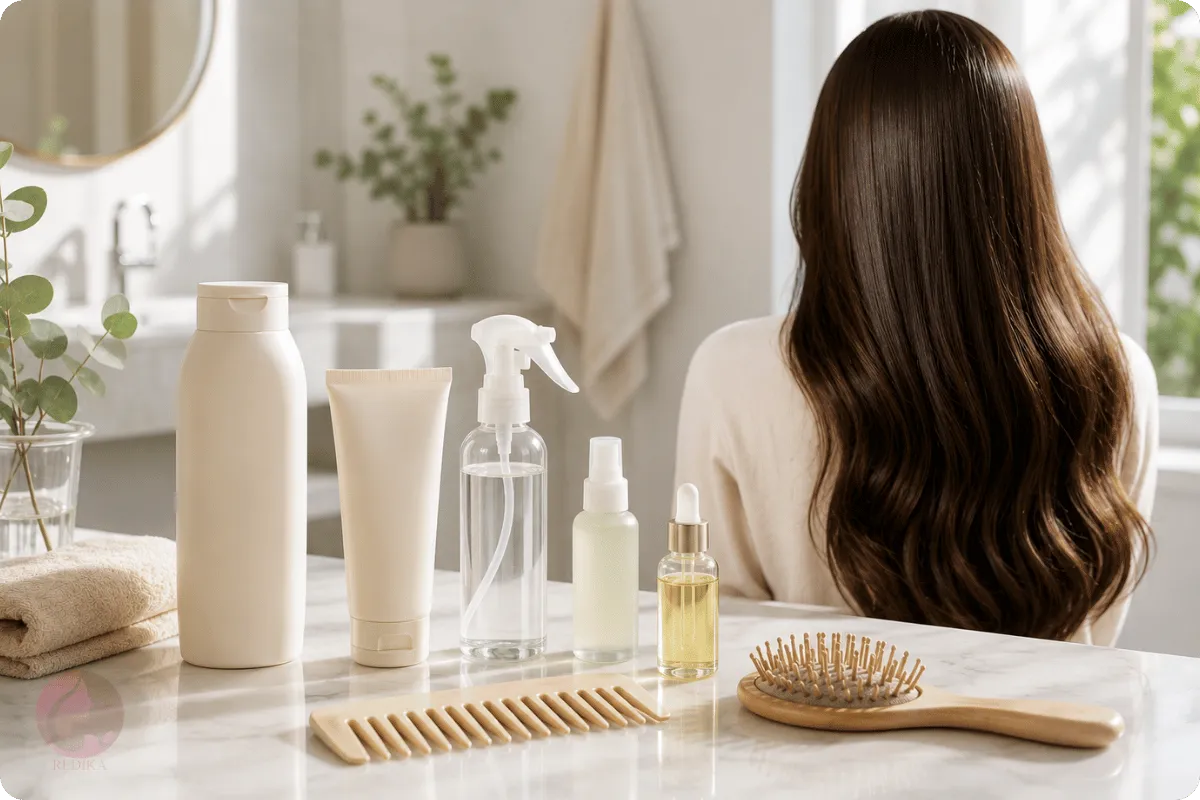
The goal for low-porosity hair is not to force the cuticle open using aggressive methods. Very hot water, baking soda, or alkaline substances can damage the hair surface and should not be used simply to increase product penetration. First make sure the scalp and hair are not overloaded with product buildup. Then apply products in light layers to hair that is thoroughly wet or damp.
- Cleansing: Choose shampoo according to scalp oiliness and buildup, and avoid aggressively rubbing shampoo foam through the lengths.
- Conditioner: Spread a small amount of lightweight conditioner over wet lengths and give it several minutes to work.
- Leave-in product: Begin with a small amount of a lightweight spray, hair milk, or cream.
- Oil: If necessary, use only one or a few drops on the ends.
- Periodic cleansing: If the hair becomes dull and heavy, adjust cleansing frequency or shampoo type according to the amount of product buildup.
A sign that the routine is working: After drying, the hair feels light, retains its natural movement, and does not require multiple layers of oil and cream to feel soft.
If products tend to sit on your hair, adding intense heat is not a good solution. The mild warmth of the shower environment and allowing conditioner enough time to spread are generally sufficient. Change the amount of only one product at a time and observe the result over two or three wash cycles. If removing a heavy oil improves your hair, the problem was more likely the weight of the routine than a lack of nourishment.
Medium-Porosity Hair Routine
For medium-porosity hair, the goal is to maintain balance and prevent new damage. A shampoo suitable for the scalp, a conditioner suited to strand thickness, and a heat protectant when using a blow-dryer or flat iron will often provide a sufficient foundation. If only the ends are dry, concentrate leave-in products on that area. There is no need to coat the entire length with a very rich mask.
- Use an appropriate conditioner after each wash.
- Use a hair mask according to actual need rather than on a rigid schedule.
- Keep heated styling tools on a low or medium setting.
- Apply a heat-protection product before using a flat iron or blow-dryer.
- Monitor the ends for increased tangling, dryness, and split ends.
If you use heated styling tools, Redika’s guide to the best heat-protection sprays for hair (in Persian) can help you understand the types of products available. Heat protectants do not reduce the risk of damage to zero, but they can form part of a protective routine when combined with lower temperatures and less frequent heat styling. Allow the hair to dry fully before using direct heat from a flat iron unless the device and product are specifically designed for use on damp hair. Repeated, prolonged contact with the same section of hair should also be avoided.
High-Porosity or Damaged Hair Routine
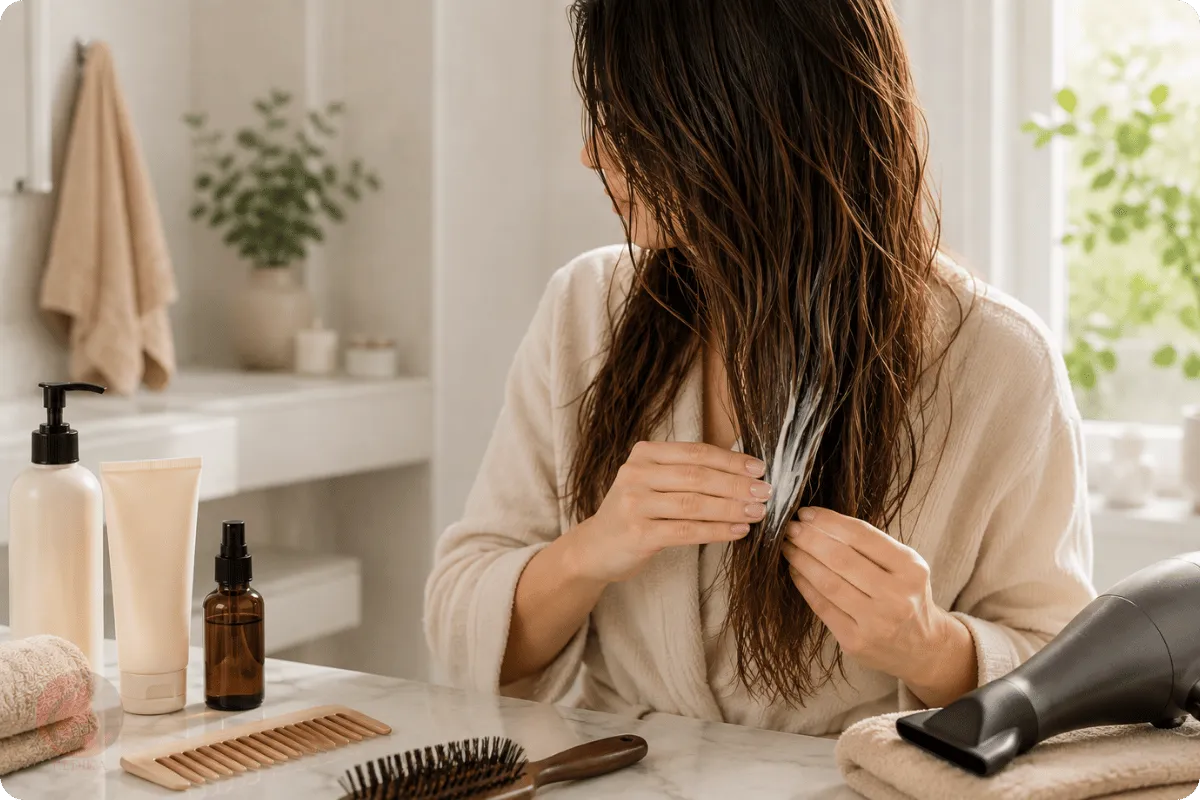
For highly porous hair, the main priorities are preventing further damage and reducing friction. The grown hair shaft is not living tissue, so products cannot permanently restore every structural change caused by bleaching or heat. Masks, serums, and conditioners can make the surface smoother, improve manageability, and reduce breakage, but these benefits usually require continued use. Claims that a product can “completely and permanently repair split ends or severely burned hair” should therefore be treated with caution.
- Shampoo: Clean the scalp without aggressively rubbing the lengths together.
- Conditioner: Apply it to the lengths after every wash and detangle gently.
- Drying: Remove excess water by gently pressing the hair with a soft fabric or suitable towel.
- Leave-in product: Apply to damp hair, concentrating on the more damaged areas.
- Heat protection: Reduce the temperature, contact time, and frequency of heated tools.
- Controlled trimming: Gradually trim severely split and fragile sections.
Conditioning ingredients such as fatty alcohols, cationic ingredients, and some silicones can reduce friction between hair fibers and improve combability. Silicone is not automatically an undesirable ingredient; what matters is whether the final formula works well with your hair and whether it creates uncomfortable buildup within your cleansing routine. Panthenol is also used in some formulas to improve softness, support moisture retention, and enhance certain mechanical properties of the hair. To learn more about this ingredient, read Redika’s guide to the benefits of panthenol for hair and skin (in Persian).
Products containing hydrolyzed proteins may make some damaged hair feel stronger or fuller, but they are not necessary for everyone. Results depend on the type of protein, molecular size, concentration, and the overall product formula. If the hair becomes stiffer, rougher, or more brittle after several uses, reduce the frequency and reassess the routine. Terms such as “protein overload” are not a specific medical diagnosis, and the signs commonly attributed to it can overlap with dryness, product buildup, or pre-existing damage.
If your hair has been bleached, post-treatment care is more important than the porosity label itself. Increasing the time between chemical services, using conditioner consistently, and reducing heat exposure can help limit further breakage. To learn more about the lightening process, read Redika’s guide to hair bleaching and choosing bleaching powder (in Persian). A “damage-free” claim on a product does not guarantee that oxidation will be harmless for every type of hair.
Common Mistakes and When to See a Dermatologist
Many routine problems begin when the result of a home test is treated as a definitive diagnosis. Porosity is a simple way to think about hair-shaft behavior, not an explanation for every hair or scalp problem. Changing several products at the same time also makes it difficult to determine what caused heaviness, dryness, or irritation. A better approach is to change one variable at a time and record how your hair responds.
| Mistake | Why Is It a Problem? | Better Approach |
|---|---|---|
| Diagnosing porosity from the water glass test | Surface tension and substances on the hair can change the result | Observe hair behavior over several washes |
| Using very hot water or baking soda | It may increase swelling and surface damage | Use appropriate cleansing and a suitable conditioner |
| Adding oil whenever hair feels dry | It may increase buildup and heaviness | First assess cleansing and water-based conditioning |
| Following a fixed protein-treatment schedule | Hair needs and product formulas vary | Evaluate the response after a limited number of uses |
| Treating roots and ends the same way | The ends are older and generally more weathered | Use section-specific care for different areas |
| Ignoring the scalp | Porosity relates to the shaft and does not explain itching or hair loss | Evaluate scalp problems separately |
See a dermatologist if:
- Hair loss is sudden, patchy, or progressively worsening.
- Your scalp has persistent itching, burning, pain, sores, or discharge.
- Dandruff or inflammation does not improve with routine care.
- Hair breaks close to the roots or visibly thinning areas appear.
- Changes to your routine produce no improvement after several weeks.
Hair-porosity tests are not designed to diagnose hypothyroidism, iron deficiency, hereditary hair loss, inflammatory disorders, or scalp infections. If you notice reduced hair density or a sudden change in hair quality, focusing only on masks and oils may delay investigation of the underlying cause. A dermatologist can assess the scalp, hair-loss pattern, and medical history. Earlier assessment can improve treatment outcomes for many hair and scalp conditions.
Conclusion
Hair porosity is a concept related to the structure of the hair shaft and the way it interacts with water and substances, while the low-, medium-, and high-porosity categories are best viewed as practical guides for adjusting a routine. Whether a strand floats or sinks in a glass does not provide a definitive diagnosis. Water surface tension, sebum, oil, conditioner, and the way the test is performed can all alter the result. For better decisions, observe your hair over several washes and compare different sections of the length.
Low-porosity hair often responds better to lightweight layers and avoiding excessive buildup. Medium-porosity hair generally benefits from a simple, balanced routine and protection from heat. For highly porous or damaged hair, conditioning, friction reduction, limiting chemical services, and preventing further damage become higher priorities. How your hair actually responds matters more than product packaging or popular online labels.
Try Redika’s three-wash protocol, make only one change at a time, and evaluate the result based on lightness, softness, tangling, and how long the hair remains manageable. If your roots and ends behave differently, use a section-specific routine. If you experience hair loss, persistent itching, sores, or sudden changes, do not assume porosity is the cause; consult a dermatologist. A good routine does not have to be complicated—it should be sustainable, appropriate, and easy to evaluate.
Frequently Asked Questions About Hair Porosity
1. Is the water glass test accurate for determining hair porosity?
No. This test is not reliable enough to provide a definitive assessment. Water surface tension, natural sebum, oils, conditioner, silicone, air bubbles, and the way the strand is placed in the water can all change the result. Treat the glass test as a secondary observation and base your main decision on how your hair behaves across several washes.
2. Is hair porosity the same at the roots and ends?
Not necessarily. Newly grown roots are generally less exposed to coloring, bleaching, sunlight, and heat, while the ends are older and more weathered. Your roots may therefore respond best to lightweight products while the ends need more conditioning.
3. Does slow drying mean that hair has low porosity?
Slow drying alone is not a reliable sign. High density, strand thickness, the amount of water left in the hair, leave-in products, and environmental conditions can all affect drying time. This sign should be considered alongside initial wetting, product buildup, and the hair’s response to conditioner.
4. Does high-porosity hair always need protein?
No. Not all damaged hair responds the same way to protein-containing products. Results depend on the type and concentration of protein and the overall product formula. Test the product with limited use, and if stiffness, roughness, or breakage increases, reduce the amount or frequency.
5. Can high hair porosity be permanently repaired?
Hair-care products can make the surface feel smoother, reduce friction, and improve the appearance of the shaft, but the grown hair fiber is not living tissue capable of fully rebuilding all structural damage. Reducing heat, spacing out chemical services, conditioning consistently, and trimming severely damaged sections are more realistic approaches.
Selected Scientific Sources and Studies
- American Academy of Dermatology, guidance on healthy hair care and reducing damage caused by washing, towel drying, and heat.
- Grosvenor et al., investigation of physical and chemical degradation of human hair fibers following bleaching, 2018.
- Lima et al., investigation of heat-induced changes in the cuticle and cortex of chemically treated hair, 2025.
- Yoon et al., evaluation of the absorption and retention of hair-care compounds within hair fibers, 2025.
- Marsh et al., investigation of the mechanism through which panthenol affects the mechanical strength of hair, 2025.
- Dias, scientific review of hair cosmetics and the mechanisms of shampoos, conditioners, and chemical hair treatments.
About the author

Join the conversation
Share your experience or question with REDIKA readers.
Your email stays private. Please avoid sharing personal or sensitive details.


