Home / Editorial guide


If you find yourself standing in front of the mirror in the morning wondering whether moisturizer, sunscreen, primer, or foundation should come first, the basic answer is simple: moisturizer → sunscreen → primer → foundation. Following this order helps maintain daily sun protection while reducing the chances of makeup layers slipping, pilling, or looking patchy. More importantly, there is no single magical waiting time that applies between every step; in most cases, you simply need to let the previous layer settle until it no longer feels obviously wet or overly slippery before moving on.
In this Redika guide, we go beyond simply listing the correct order. We explain how long to wait between sunscreen and makeup, when a separate moisturizer may not be necessary, when primer can be skipped, and why certain product combinations cause sunscreen to pill or foundation to look patchy. The sun-protection recommendations in this article have also been aligned with up-to-date guidance from the American Academy of Dermatology and Cleveland Clinic.
Quick Answer: What Is the Correct Order of Moisturizer, Sunscreen, Primer, and Foundation?
| Step | Product | Main Role | When Should You Move to the Next Step? |
|---|---|---|---|
| 1 | Moisturizer | Helps maintain hydration and prepares the skin surface | When the skin no longer feels obviously wet or excessively slippery |
| 2 | Sunscreen | The final essential step of the morning skincare routine | For makeup application, around 3 to 5 minutes is often a practical starting point; the final criterion is whether the product has settled |
| 3 | Primer | Prepares the skin surface for makeup when needed | When the thin primer layer has settled and no longer moves like freshly applied cream |
| 4 | Foundation | Helps create a more even-looking skin tone and texture | After the primer has settled; start with a small amount |
Redika’s quick answer: Apply moisturizer first, sunscreen second, primer if needed, and foundation last. The commonly recommended 15-minute sunscreen rule refers to applying sunscreen before sun exposure, not to a mandatory waiting time between sunscreen and makeup.
Why Does the Order of Products Before Makeup Matter?
The order matters for more than just how your makeup looks; each layer serves a different purpose. Moisturizer should help prepare and support the skin, sunscreen needs to form an even protective layer over exposed areas, and primer—when used—helps manage the surface on which makeup will be applied. If these roles are reversed, or if products have not had enough time to settle, the risk of slipping, patchiness, and pilling increases.
Cleveland Clinic’s guidance on skincare layering places moisturizer before sunscreen in a basic morning routine, with sunscreen as the final essential skincare step. If you also use toner, serum, or treatment products, Redika’s guide to the correct order of a morning and evening skincare routine explains where each of these products fits into a complete routine.
- Moisturizer should support the skin’s hydration needs rather than create a thick, slippery layer beneath makeup.
- Sunscreen should be applied before makeup products so its protective layer remains underneath your makeup.
- Primer is optional and is most useful when it addresses a specific concern such as shine, visible dryness, uneven-looking texture, or makeup longevity.
- Foundation should be applied over layers that have already settled, not over sunscreen or primer that is still moving on the skin.
Redika’s Four-Step Rule: Moisturize, Protect, Prime, Cover

To make the sequence easier to remember, you can use Redika’s four-step rule. Instead of memorizing a list of product names, this framework reminds you of the purpose of each step. Even if you switch brands or product textures, the underlying logic stays the same.
- Moisturize: Prepare your skin according to its actual type and hydration needs.
- Protect: Apply sunscreen as the final essential layer of your morning skincare routine.
- Prime: If you genuinely need a primer, use a small amount after your sunscreen has settled.
- Cover: Apply foundation in a controlled, thin layer over the previous products.
This rule is not an independent medical recommendation. Instead, it is Redika’s practical framework for simplifying skincare and makeup layering. Its main advantage is that it helps you identify unnecessary steps and focus on applying the products you actually need correctly rather than simply adding more layers.
Step One: How Should You Apply Moisturizer Before Sunscreen?

Moisturizer should not leave your face excessively greasy or slippery. The goal is to help the skin feel comfortable while reducing dryness or tightness. Even oily skin may benefit from moisturizer, although choosing a lighter texture and using a controlled amount is usually more important. If your moisturizer is still obviously moving around on the skin after several minutes, consider the amount you are using and whether the formula is suitable for your routine rather than simply waiting longer.
| Skin Type | Practical Choice Before Makeup | Possible Sign of Overapplication |
|---|---|---|
| Dry | A moisturizer that reduces dryness and tightness without creating an excessively thick layer | Long-lasting greasiness or slipperiness and sunscreen moving over the top |
| Oily | A lighter texture used in a controlled amount | Excess shine and subsequent layers sliding around |
| Combination | Adjust the amount of moisturizer according to drier and oilier areas | Treating the entire face the same despite different needs in different areas |
| Sensitive | A simple routine using products the skin has already tolerated well | Burning, redness, or irritation after introducing several new products |
If your routine includes several serums, essences, and a moisturizer and you frequently experience pilling, the problem may be the number of layers rather than one particular product. In that case, Redika’s guide to a minimalist skincare routine can help you identify and remove unnecessary steps.
Can Sunscreen Replace Moisturizer?
Sometimes, yes—but not for everyone. Some modern sunscreens contain hydrating ingredients and have textures that may provide enough moisture for normal, combination, or oily skin. Skincare and makeup experts also note that certain sunscreen formulas can serve a dual purpose depending on their composition and the needs of the skin.
Your decision should be based on how your skin actually behaves rather than how many steps you see in social media routines. If sunscreen alone leaves your skin comfortable, without tightness, flaking, or dryness under makeup, you may not need a separate moisturizer. However, if your skin is dry or dehydrated, skipping moisturizer may make your makeup look worse.
Practical rule: A sunscreen that keeps your skin adequately moisturized may allow you to skip a separate moisturizer. However, a moisturizer that contains SPF does not necessarily replace the correct use of a dedicated sunscreen.
Step Two: Sunscreen as the Final Skincare Step Before Makeup
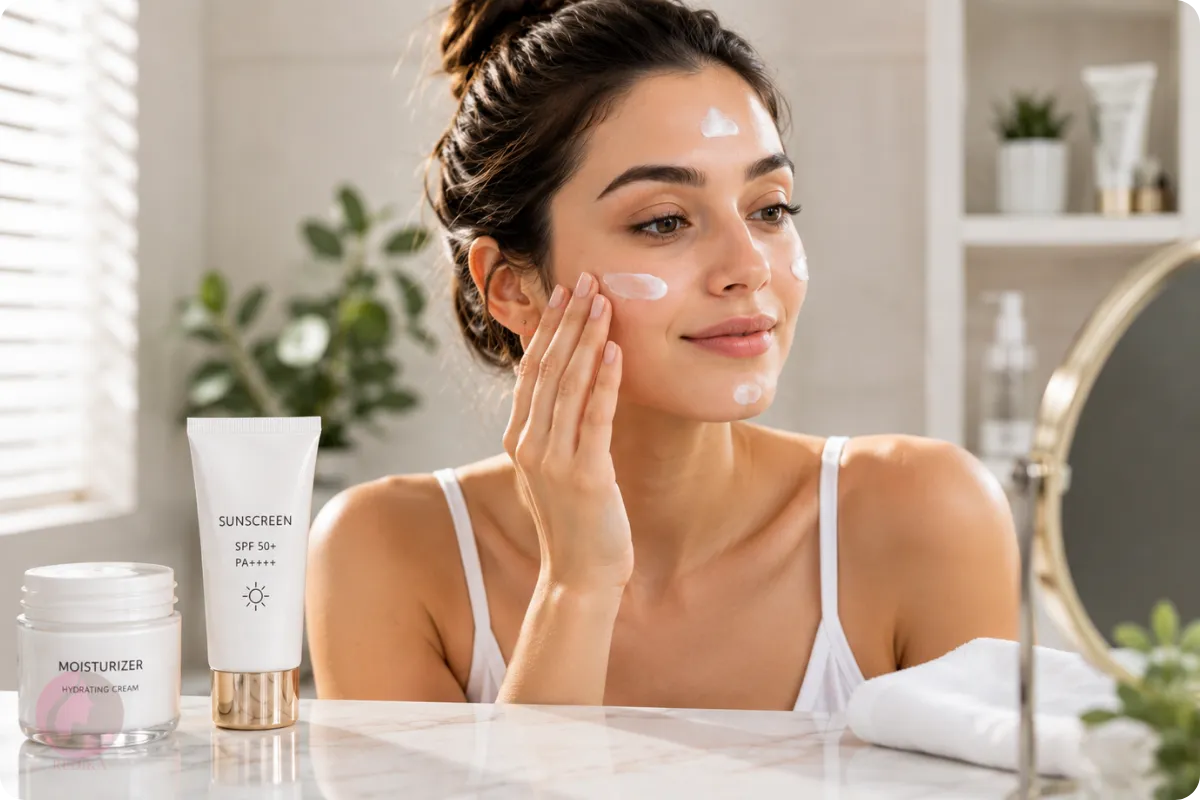
After moisturizer comes sunscreen. The American Academy of Dermatology recommends choosing a sunscreen with SPF 30 or higher, broad-spectrum protection, and water resistance when appropriate for skin that will be exposed to the sun. Sunscreen should cover exposed areas evenly, and deliberately using too little simply to make your makeup feel lighter is not a good strategy.
Cleveland Clinic also places sunscreen after moisturizer and before makeup. Foundation, concealer, and other makeup products containing SPF may provide some additional protection, but they should not generally be treated as a replacement for a separate layer of sunscreen. The amount of makeup people normally use is usually based on the desired coverage, not on the amount needed to create an even sunscreen layer.
- Apply sunscreen after moisturizer and before primer and foundation.
- For everyday use, choose a broad-spectrum sunscreen with at least SPF 30.
- Do not mix sunscreen and foundation together in your palm; apply them as separate layers.
- After sunscreen, avoid aggressively rubbing primer or foundation into the skin.
- The commonly recommended 15-minute period refers to applying sunscreen before going outdoors.
If you also use active skincare ingredients in the morning and are unsure about compatibility, Redika’s guide to skincare ingredients that should not be mixed can help you build a simpler and more manageable routine.
How Should You Apply Primer and Foundation After Sunscreen?

Primer goes after sunscreen and before foundation, but it is not mandatory. If your sunscreen creates a smooth, makeup-friendly surface, you can move directly to foundation once the sunscreen has settled. Primer is most useful when it addresses a specific concern, such as controlling shine around the forehead and nose, minimizing the appearance of dryness, or helping makeup sit more evenly.
Using too much primer can itself create another problematic layer. If your sunscreen contains film-forming ingredients, repeatedly massaging primer over it may disturb the layer underneath and create small rolled-up particles on the skin. It is generally better to use a small amount of primer only where needed and apply it with gentle pressing or light spreading motions.
With foundation, start with a small amount and build coverage gradually. Tapping motions with a sponge or brush can often create less friction than repeatedly dragging the product across the face, reducing the chance of disturbing the sunscreen and primer underneath.
- Oily skin: Use shine-controlling primer only where it is actually needed.
- Dry skin: A highly mattifying primer may emphasize dryness and fine surface lines.
- Light everyday makeup: If sunscreen already sits well under foundation, skipping primer may produce a cleaner result.
- More coverage: Instead of applying one thick layer of foundation, build coverage using several thin layers only where necessary.
How Long Should You Wait Between Moisturizer, Sunscreen, Primer, and Foundation?

There is no scientifically fixed waiting time that applies to every product. Product texture, the amount applied, skin type, temperature, and humidity can all affect how quickly each layer settles. For that reason, it is usually more useful to judge the condition of the skin surface rather than setting a timer for every step. If a product still feels obviously wet, fluid, or easy to move around, it is usually better to wait a little longer.
For the gap between sunscreen and makeup, current beauty guidance often suggests around 3 to 5 minutes as a practical starting point. This is not a medical rule that applies to every sunscreen. The goal is simply to give sunscreen enough time to settle so it is less likely to shift as soon as primer or foundation touches the skin.
| Between Which Steps? | Practical Timing Guide | A Better Indicator Than Time | What Can Happen If You Rush? |
|---|---|---|---|
| Moisturizer → Sunscreen | No fixed number is necessary; often one to a few minutes depending on the formula | The moisturizer no longer feels wet or fluid on the skin | Sunscreen may mix with or move the layer underneath |
| Sunscreen → Primer or Makeup | Around 3 to 5 minutes as a practical range | The sunscreen layer has settled and its initial wetness or tackiness has decreased | The risk of disturbing the layer, pilling, and uneven makeup may increase |
| Primer → Foundation | No universal fixed time is required | The primer has settled; gripping primers may intentionally retain some tackiness | Foundation may move the primer or create an uneven surface |
Redika’s simple test: Before moving to the next step, lightly touch a small area of the skin with a clean finger. If the product clearly moves, rolls up, or the surface still feels extremely wet and slippery, give it a little more time. This is a practical check and does not replace the usage instructions for a specific product.
Why Does Sunscreen or Foundation Pill and Look Patchy?

Pilling does not automatically mean your sunscreen is poor quality. Skincare and makeup professionals repeatedly point to several common causes: too many products, excessive amounts of each layer, incompatible textures, insufficient settling time, and too much rubbing. A sunscreen may work perfectly well in a simple routine but start pilling when combined with a rich moisturizer and a particular primer.
The best way to identify the cause is not to immediately buy another product. Start by simplifying your routine. On one day, try just moisturizer and sunscreen. On another day, add primer and compare how the skin behaves. This approach can help you determine whether the problem comes from one particular product or from the interaction between several layers.
| Problem | Possible Causes | First Adjustment to Try |
|---|---|---|
| Sunscreen pills | Too many layers, a heavy moisturizer, excessive friction, or the previous layer not settling | Remove one unnecessary product and reassess how much moisturizer you are using |
| Primer lifts the sunscreen | Too much rubbing or incompatible formulas | Give sunscreen more time to settle and gently press the primer onto the skin |
| Foundation slides around | An overly oily or wet base or too much product underneath | Reduce the amount of each layer and target oily areas more selectively |
| Makeup breaks up around the nose | Localized dryness, excess oil, or product buildup | Use less product in that area and reassess what the skin actually needs |
| Foundation looks cakey and heavy | Too much coverage, a dry base, or too many layers | Start with a thinner layer and build coverage only where needed |
| Makeup looks flaky | Dry skin, an unsuitable cleanser, or overly mattifying products | Reassess cleansing and moisturizing steps |
If your skin feels tight and dry immediately after cleansing, your makeup problem may actually begin earlier in the routine. Redika’s guide to the best facial cleanser for every skin type can help you choose a cleanser that better suits your skin.
How Should You Adjust the Order for Dry, Oily, Combination, and Sensitive Skin?
The basic order does not change for most skin types. What should change is the texture, amount, and number of products. Dry skin may look better under makeup with a suitable moisturizer and a sunscreen with a more natural finish, while oily skin may perform better with fewer and lighter layers. Instead of creating four completely different routines, keep the same basic order and customize the characteristics of each step.
| Skin Type | Moisturizer | Sunscreen Under Makeup | Primer | Key Point |
|---|---|---|---|---|
| Dry | Enough to relieve dryness and tightness | A formula that is not excessively drying or matte | Hydrating or smoothing if needed | Very matte foundation may emphasize dryness |
| Oily | Lightweight and controlled | A lightweight formula that works well with the skin | Shine control only where needed | Too many layers may make makeup feel heavy |
| Combination | Adjust according to the needs of each area | A balanced, makeup-compatible finish | Targeted use is often the best option | Do not treat the entire face as though it has identical needs |
| Sensitive | A familiar and well-tolerated product | A formula your skin has previously tolerated well | Only when genuinely needed | Avoid introducing several new products at the same time |
If you are still unsure where cleansing, toner, or micellar water fits into your routine, Redika’s guide to the difference between toner, micellar water, and face wash can help clarify the role of each product.
Common Mistakes in Sunscreen and Makeup Layering That Can Ruin the Result
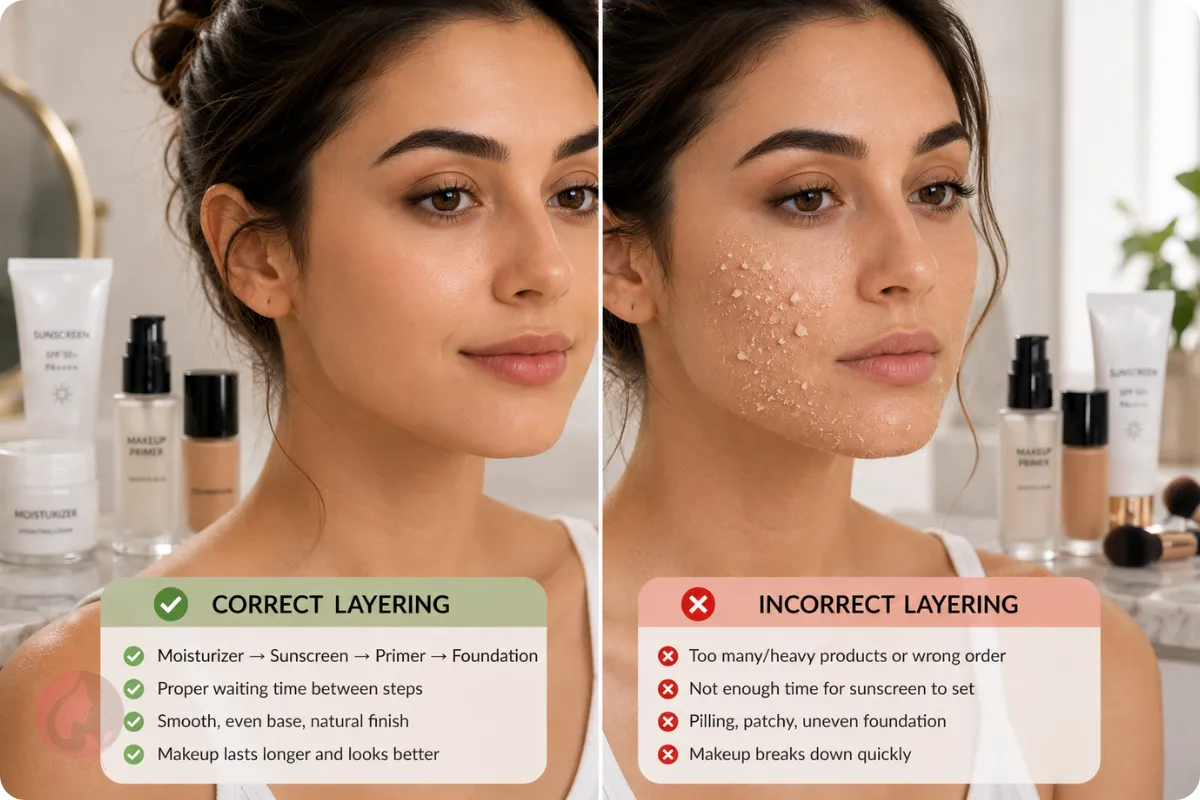
Many problems with this routine cannot be solved simply by buying more products. If you are following the basic order but your makeup still does not sit well, check the following common mistakes first.
- Applying primer before sunscreen: In a typical routine, sunscreen should come before primer.
- Applying makeup immediately over wet sunscreen: Giving sunscreen a few minutes to settle can improve the result.
- Using too much moisturizer: Simply waiting longer will not always fix a layer that is excessively heavy.
- Assuming primer is always necessary: If your sunscreen already creates a good makeup base, skipping primer may improve the routine.
- Mixing sunscreen with foundation: It is generally better to keep sunscreen as its own separate layer.
- Relying only on SPF in makeup: Treat it as additional protection rather than a guaranteed substitute for dedicated sunscreen.
- Rubbing primer and foundation too aggressively: Excessive friction can disturb the sunscreen underneath.
- Applying every product over the entire face: Sometimes only the nose and forehead need a shine-controlling primer.
- Changing several products at once: If a problem appears, you will not know which product caused it.
How Do You Reapply Sunscreen When You Are Wearing Makeup?
Wearing makeup does not eliminate the need to reapply sunscreen. The American Academy of Dermatology recommends reapplying sunscreen about every two hours while outdoors and also after swimming or sweating. The real challenge is restoring sun protection without completely disrupting your makeup.
Powdered products or sunscreen sprays designed for use over makeup may be useful for touch-ups, but you should not automatically assume that a few quick passes or a very small amount will provide the full protection stated on the product label. On days when you expect to spend a long time outdoors, keeping your base makeup lighter can make sunscreen reapplication easier.
- If you expect prolonged sun exposure, plan for sunscreen reapplication when doing your morning makeup.
- When using a product specifically designed for reapplication over makeup, follow that product’s instructions.
- Treat SPF-containing foundation or powder as additional protection, not as a reason to skip your primary sunscreen layer.
- After heavy sweating, swimming, or noticeable product removal, restoring sunscreen coverage becomes even more important.
Conclusion: The Best Order for Smoother Makeup and Better Sun Protection
For most morning routines, the best starting point is moisturizer → sunscreen → primer → foundation. If your sunscreen keeps your skin adequately moisturized, you may not need a separate moisturizer. If your sunscreen already creates a good base for makeup, you may also be able to skip primer. The sequence therefore stays consistent, but the number of actual steps should be adjusted according to your skin’s needs and how your products perform together.
Do not look for one magical waiting time between every step. Moisturizer should no longer feel extremely wet or slippery, sunscreen benefits from a few minutes to settle before makeup, and around 3 to 5 minutes is a practical starting point for many routines. Primer should also settle before foundation is applied. Separately, apply sunscreen about 15 minutes before sun exposure.
Redika’s final rule:
Moisturize → Protect → Prime if needed → Cover. If your makeup pills, check the number of layers, the amount of each product, settling time, and the amount of friction during application before buying something new.
Frequently Asked Questions About Moisturizer, Sunscreen, Primer, and Foundation Order
Should You Apply Moisturizer or Sunscreen First?
In a typical morning routine, moisturizer comes first and sunscreen comes second. Let your moisturizer settle until it no longer feels obviously wet or slippery, then apply sunscreen evenly over exposed areas. If your sunscreen itself provides enough moisture for your skin, you may be able to skip a separate moisturizer.
How Long After Sunscreen Should You Apply Primer or Foundation?
Around 3 to 5 minutes is a practical starting point for applying makeup over many sunscreens, although it is not a universal rule. The main criterion is whether the sunscreen has settled enough that it does not easily move when makeup is applied gently. The commonly recommended 15-minute guideline refers to applying sunscreen before sun exposure.
If You Use Tinted Sunscreen, Do You Still Need Foundation?
No, foundation is not mandatory. If the coverage from your tinted sunscreen is enough for the look you want, you can skip foundation and keep your routine lighter. However, use an adequate amount of sunscreen for sun protection rather than reducing the amount simply to achieve lighter color coverage.
If Your Sunscreen Is Moisturizing, Do You Still Need Moisturizer?
Not always. If your sunscreen is hydrating and emollient enough to keep your skin comfortable without dryness or tightness, especially if you have normal, combination, or oily skin, a separate moisturizer may not be necessary. For dry skin, or whenever sunscreen alone does not feel comfortable enough, moisturizer can still be useful.
Is Primer Before Foundation Always Necessary?
No, primer is optional. If your moisturizer and sunscreen already create a suitable surface and your foundation sits well without problems, you can skip primer. Primer is most useful when it addresses a specific need such as shine control, improving the appearance of texture, or helping makeup last longer.
Scientific and professional sources used to review this article:
- American Academy of Dermatology — guidance on choosing and correctly applying sunscreen and applying it before sun exposure.
- Cleveland Clinic — guidance on skincare product order, placing moisturizer before sunscreen and sunscreen as the final essential step in the morning routine.
- Cleveland Clinic — guidance on the limitations of SPF in makeup and the importance of wearing sunscreen under makeup.
- Vogue — 2026 professional guidance on sunscreen compatibility with makeup, product pilling, texture, amount, and application technique.
- Glamour — 2026 guidance on wearing sunscreen under makeup and allowing a practical few-minute interval before applying makeup.
This article is intended for general educational purposes. If you have a skin condition, severe sensitivity, or persistent reactions to skincare products, professional evaluation by a dermatologist should take priority over general advice.
About the author

Join the conversation
Share your experience or question with REDIKA readers.
Your email stays private. Please avoid sharing personal or sensitive details.


