Home / Editorial guide


Sometimes we love a fragrance, but feel it is too sweet, cool, floral, heavy, or simple. Fragrance layering is a method by which one can balance the scent of a fragrance with another fragrance, body mist, essential oil, or lotion to achieve a more personal result.
For this, you do not need to be a professional perfumer or have a large collection of fragrances. Most of the time, a simple and controllable scent serves as a base, and a second scent is enough to create warmth, freshness, sweetness, or depth. The important point is to test the blend first in small amounts and allow the scent to gradually change on your skin.
In this guide, in addition to teaching the correct principles of layering, we introduce 9 low-risk combinations in terms of scent interference so you can create your personal scent signature for sweet, cool, clean, floral, woody, and warm preferences. For more reading, you can also refer to the section Online perfume shopping and fragrance notes guide .
Short answer; where to start with fragrance layering?
- To start, do not combine more than two fragrances together.
- Choose one scent as a base and the second scent to create a change.
- Use stronger, warmer fragrances or those with heavier base notes less.
- Test the blend first on a fragrance testing paper and then on a small area of skin.
- Leave about 3 to 5 minutes between using two fragrances.
- If you are a beginner, start with combinations like vanilla and sandalwood, citrus and white musk, or rose and clean musk.
What is fragrance layering?
Fragrance layering or Fragrance Layering refers to the simultaneous and calculated use of two or more scented products. These products can include perfume, eau de parfum, eau de toilette, body mist, essential oil, body cream, or lotion.
The goal of layering is not necessarily to create a completely new fragrance. Sometimes we just want to clean up a floral scent, reduce the excessive sweetness of a fragrance, give a citrus scent more longevity, or warm up a daily scent for nighttime use.
In this method, different scents gradually blend together in the space around the body. The result may be suitable on a test paper, but it can appear differently on the skin; because body temperature, skin oiliness and moisture, weather, and even the time interval between using fragrances all affect the final result.
What does ‘safe blend’ mean in this article? The term safe here means a lower likelihood of creating a chaotic or unpleasant scent and does not guarantee the absence of skin sensitivity. If you have sensitive skin, a history of eczema or sensitivity to fragrance products, or experience redness, itching, and burning after use, stop using it.
A brief look at the history of scent blending
The simultaneous use of fragrant materials is not a new idea. In ancient civilizations, plant oils, flowers, resins, and aromatic substances were used to scent the body, clothing, ceremonial spaces, and personal items. In ancient Egypt, flowers and aromatic materials were infused in oil and pressed to produce fragrant compounds.
What is now known as fragrance layering is a simpler, consumer-oriented version of this idea. In this method, instead of formulating in a bottle, several ready-made products are harmonized on the skin or at different points on the body during use.
Before layering, get to know the notes of the fragrance

You don’t need to know all the ingredients of the fragrances to blend them, but being familiar with the overall structure of the scent helps you make a better prediction of the result. Fragrance descriptions usually introduce the notes in three groups: top, middle, and base.
This classification is a simple model to explain the process of fragrance change, and not all scents behave exactly the same way. Some modern perfumes have a linear structure and show little change from beginning to end. Such perfumes are usually more suitable for beginners in layering, as predicting their outcome is easier.
Common note; the simplest key to finding the right combination
One of the most reliable methods for selecting two perfumes is to find a common note or space between them. For example, if both perfumes contain vanilla, white musk, rose, or bergamot, this common note can act as a bridge between the two scents.
The olfactory families of the two perfumes do not need to be exactly the same. A floral perfume and a woody perfume can also create a suitable combination, provided that one of them plays a dominant role and the other a complementary role.
Golden rules for layering perfume for beginners
1. Start with two scents
Combining three or four perfumes at once may seem exciting, but it becomes difficult to determine which scent is causing the sweetness, bitterness, or chaos of the result. To start, choose a base perfume and a complementary perfume.
2. Make one perfume the main character
Instead of using both perfumes equally, determine which scent should be more prominent. If your favorite perfume is too sweet, keep it as the main character and add a small amount of woody, green, or citrus scent to it.
3. Do not judge intensity solely by the name of the concentration
Whether one product is an eau de parfum and the other an eau de toilette does not alone indicate which one feels stronger. The type of materials, the structure of the perfume, the projection, and skin characteristics are also important. Before combining, test each perfume separately on the skin.
4. Use the heavier scent less
Oud, leather, smoky, spicy, very sweet, or thick amber scents can overshadow the second perfume. In such cases, a spray of the heavier perfume alongside two sprays of the lighter perfume may create a better balance.
5. Do not judge the result immediately
The combination of two perfumes in the first few minutes may be very citrusy, alcoholic, or spicy. Allow about 15 to 30 minutes for the initial notes to settle. For a final decision, it is better to wear the combination on the skin for at least two to three hours.
6. Start with a small amount
Adding perfume is easy, but once too much is used, it is not easy to reduce the intensity of the combination. Start the experiment with one spray of each scent and adjust the ratio in subsequent applications.
The correct method for testing two perfumes before use
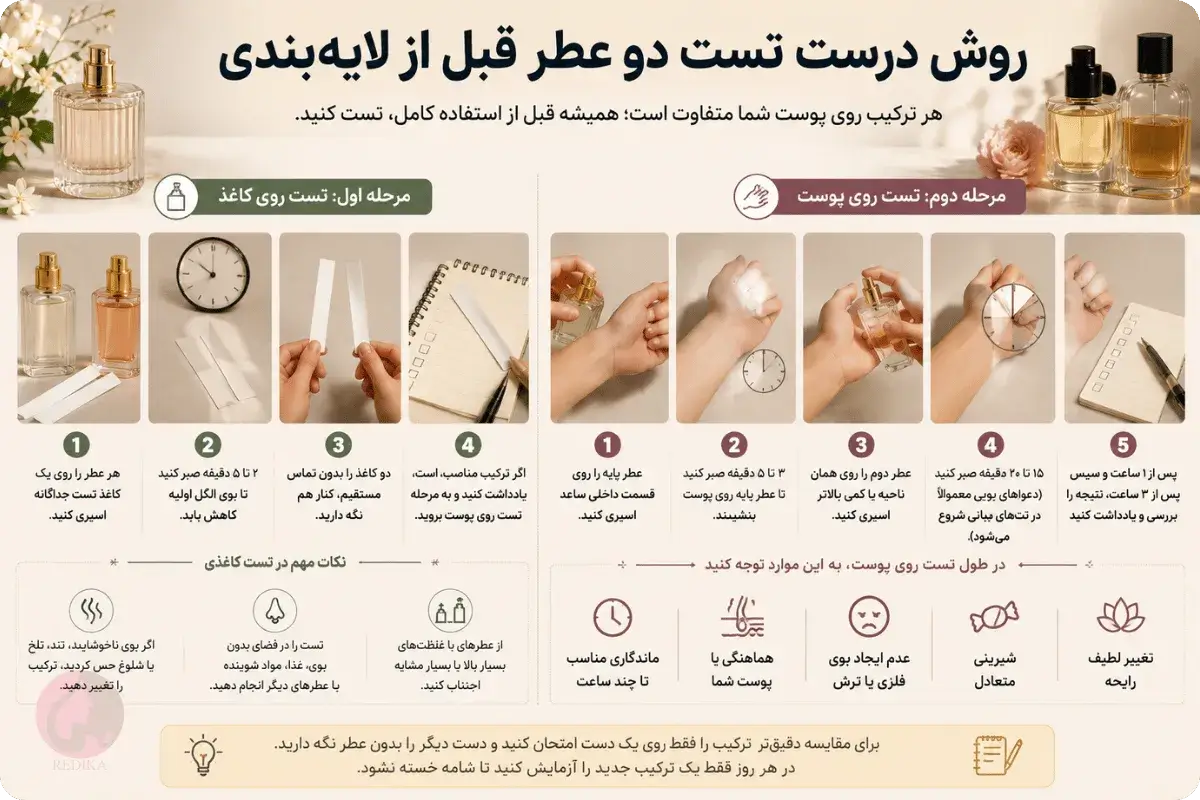
Step one; test on paper
- Spray each perfume on a separate test paper.
- Wait about two to five minutes for the initial alcohol smell to diminish.
- Hold the two papers next to each other without direct contact.
- If one of the perfumes completely overshadows the other, adjust the amount or distance between them.
Step two; testing on skin
After a successful paper test, spray the base perfume on the inner part of your forearm. Three to five minutes later, apply the second fragrance on the same area or slightly higher. Then evaluate the combination in several stages:
- After 15 minutes: Evaluate the sharpness, sweetness, and initial balance.
- After one hour: Evaluate the main character of the composition.
- After three hours: Evaluate the remaining scent and the level of satisfaction with the base notes.
For a more accurate comparison, test the combination on only one hand and keep the other hand fragrance-free. It is also better to test only one new combination each day to avoid fatigue of the sense of smell.
9 safe combinations for creating a personal scent signature

The following combinations are designed based on fragrance families, not based on the name of a specific product. Therefore, you can choose a perfume whose dominant scent aligns with the introduced notes.
First combination; vanilla and sandalwood
Vanilla can be sweet, edible, and warm; while sandalwood has a soft, woody, and sometimes creamy quality. Sandalwood reduces the direct sweetness of vanilla, making the result more mature and calm.
Suggested method: Use one spray of sandalwood perfume as a base and after a few minutes, add one spray of soft vanilla. If the vanilla scent is very thick or caramel-like, reduce the amount.
Second combination; citrus and white musk
Citrus fragrances usually have a bright and energetic start, but may become very light after a while. White musk can create a sense of cleanliness and softness, keeping the citrus scent closer to the skin.
Suggested method: Use a light puff of white musk and then two puffs of a fragrance with bergamot, lemon, orange, or tangerine. This combination is suitable for work, shopping, university, and warm days.
Third combination; rose and clean musk
If rose fragrance is too classic, powdery, or heavy for you, a white musk or clean scent can lighten it and make it more modern. The result is usually delicate, neat, and close to the scent of skin.
Suggested method: Use one puff of rose and one puff of musk at two points close to each other. For a lighter result, try applying musk on the skin and rose further away on clothing.

Fourth combination; jasmine or orange blossom and soft vanilla
White flowers like jasmine and orange blossom can be sharp or very bright in some fragrances. Soft vanilla rounds off their sharp edges and creates a warmer, sweeter, and party-appropriate atmosphere.
Suggested method: Use two puffs of floral fragrance and a maximum of one puff of vanilla. It is better if the selected vanilla is not overly caramel, chocolatey, or heavy.
Fifth combination; bergamot and vetiver
Bergamot creates a bright and citrusy scent, and vetiver gives it a dry, green, earthy, or woody character. This combination has a slight sweetness and is suitable for those who prefer clean, formal, and understated fragrances.
Suggested method: Use one puff of vetiver fragrance and two puffs of bergamot fragrance. If your vetiver fragrance is smoky or very earthy, apply it on a spot further from the nose, like inside the elbow.
Sixth combination; fig or green scent and cedar
Fig scent can be green, milky, fruity, or leaf-like. Cedar gives this space a woody structure and prevents the combination from becoming overly fruity or creamy.
Suggested method: Use one puff of cedar as a base and two puffs of fig or green scent on top. The result is very suitable for minimal styles and mild days.
Seventh combination; pear or apple and white musk
Pear and apple scents are usually juicy, bright, and youthful, but some examples may feel overly sweet or shampoo-like. White musk can soften and make them more natural.
Proposed method: First, spray one puff of musk and then two puffs of fruity scent. If the fruity perfume is too sweet, do not mix it with powdery musk and opt for a clean, neutral musk.
Eighth combination; lavender and tonka bean
Lavender has an aromatic, clean, and sometimes soapy space. Tonka bean can create a vanilla, almond, warm, and slightly powdery effect. The combination of these two scents is usually calm, balanced, and suitable for nighttime use.
Proposed method: Use two puffs of lavender scent and one puff of tonka. If the tonka is very sweet, apply it only to one pulse point.
Ninth combination; soft amber and orange or tangerine
Amber fragrances have warmth and depth, but they can be heavy for daytime or enclosed spaces. Orange, tangerine, or bergamot can make the start of the combination brighter and more refreshing.
Proposed method: Apply one puff of amber fragrance to the inside of the elbow or the back of the neck and use two puffs of citrus fragrance on the upper body. This separation helps the scents blend in the air without directly covering each other.
Correct order of layering perfume, body mist, and lotion

Layering is not limited to combining two perfumes. Sometimes using a scented cleanser, body cream, oil, body mist, and perfume from the same olfactory family creates a more harmonious and controllable result.
- Clean skin: Apply perfume to skin that has no residual scent from other products.
- Unscented or matching lotion: Apply a small amount of lotion to the skin and allow it to absorb.
- Light body mist: If desired, spray the body mist from a distance onto the body.
- Base fragrance: Use a warmer, simpler, or longer-lasting scent in small amounts.
- Complementary fragrance: After a few minutes, add a brighter or character-giving scent.
Does lotion really increase the longevity of fragrance?
Very dry skin may make the scent appear different and shorter. Using a compatible moisturizer can prepare the skin’s surface and help with a more even distribution of fragrance. However, the final longevity still depends on the fragrance formula, weather, skin type, and amount used.
To avoid unintended scent alteration, use an unscented lotion. If you choose a scented lotion, it’s better if its main note is shared with your fragrance.
Should we apply two fragrances on one spot or separate spots?
Both methods are usable, but they create different results.
- On one spot: The scents blend together faster and the result is more unified, but there is a higher chance of the lighter fragrance being overshadowed.
- On nearby spots: Each fragrance retains some of its character and blends in the space around the body.
- On distant spots: Suitable for heavy fragrances or experimental combinations; for example, a warm fragrance on the inside of the elbow and a fresh fragrance on the neck.
For beginners, using points that are close but separate usually creates more control. Once you find the right ratio, you can try both on one point.
Should we apply the perfume on the skin or on clothes?
The skin is a suitable place to check the natural change of the scent; because the body’s heat helps to gradually open the notes. However, the result of the perfume on clothes may be more stable and different from that on the skin.
For precise layering, it is better to test the main composition on the skin first. Once you are sure of the result, you can use a small amount of the lighter scent from a distance on the clothes.
- Do not spray perfume directly on silk, white clothing, delicate fabrics, or jewelry.
- Before using it on clothes, test it on a hidden part of the fabric.
- Do not use perfume on wounded, irritated, or freshly shaved skin.
- Avoid spraying near the eyes, mouth, and flames or heat sources.
Which combinations are riskier for beginners?
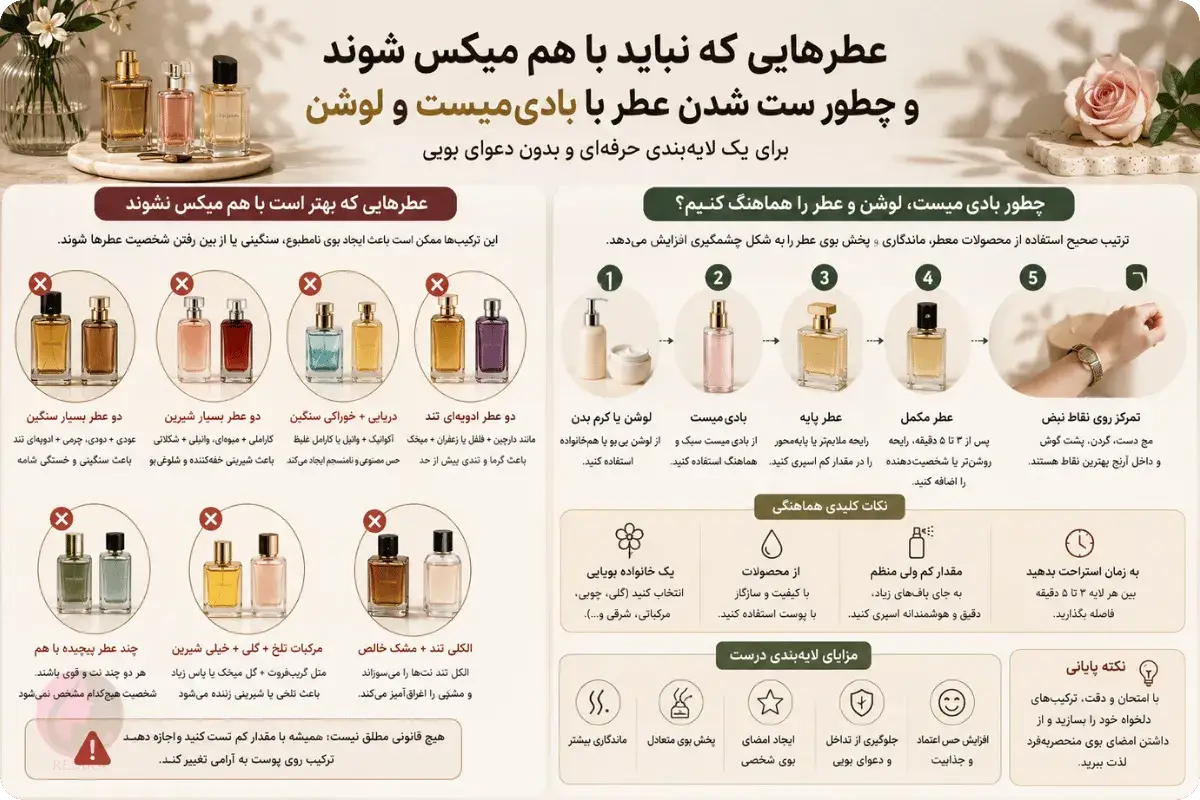
No two fragrance families can be considered absolutely incompatible. Professional perfumers even use contrasting scents to create complex compositions. However, some combinations are more difficult to start with, and the likelihood of a messy result is higher.
Common mistakes in layering perfume

- Using too many sprays: Increasing the number of sprays does not necessarily make the blend better or longer-lasting.
- Trying several combinations in succession: The nose gets tired after a while, making it difficult to distinguish the scents.
- Mixing perfumes in one bottle: This may change the ratio, stability, and performance of the products. Layering should be done during application.
- Rubbing wrists together: This is not necessary and may disrupt the initial diffusion of the perfume. Let the fragrance dry without manipulation.
- Ignoring other scented products: Shampoo, cream, deodorant, and fabric softener are also part of your olfactory space.
- Judging only by the written notes: Two perfumes with common notes may not yield the same result due to different structures.
How to fix an unsuccessful blend?
If the blend has become too sweet
In the next round, halve the amount of vanilla, caramel, or fruity scent and use a drier scent like cedar, vetiver, tea, bitter citrus, or clean musk.
If the blend has become spicy and harsh.
It is likely that the amount of spicy, leathery, smoky, or oud fragrance is too much. Use it on a more distant point or balance it with soft vanilla, sandalwood, white musk, or delicate flowers.
If none of the fragrances are distinct.
This situation usually occurs when both fragrances are very complex or their amounts are nearly equal. Make one the main character and reduce the second fragrance to a spray.
If the scent fades away too quickly.
Moisturize the skin with an unscented lotion, apply the fragrance on pulse points, and choose a base scent like musk, sandalwood, soft vanilla, or light amber. More quantity is not always the right solution.
How to create your personal scent signature?
A personal scent signature is a fragrance that aligns with your taste, lifestyle, and usual situations, and with repetition, others associate it with your presence. To create it, you don’t need to find the strangest or strongest combination.
- Identify your three favorite notes: For example, rose, vanilla, and sandalwood.
- Choose a main fragrance: A fragrance that you enjoy wearing on its own.
- Identify the need of the main fragrance: Should it be fresher, warmer, cleaner, or less sweet?
- Add a simple scent for adjustment: Like white musk, citrus, vanilla, or wood.
- Note the ratio of the blend: For example, two sprays of the main fragrance and one spray of the base fragrance.
- Test the blend in different climates: A scent that is suitable in winter may become heavy in summer.
- Give a blend a few weeks: Test it in the workplace, at parties, and for daily use before making a final choice.
Simple formula for creating a personal scent signature
Your favorite perfume + a specific change = personal scent signature
For example: your favorite rose perfume + white musk for more cleanliness, or your favorite vanilla perfume + cedar to reduce sweetness.
Safety tips and skin sensitivity
Fragrance products may cause sensitivity or skin irritation in some individuals. Using multiple scented products simultaneously can increase skin contact with fragrance materials; therefore, layering should be done with a small amount.
- Test the new product first on a small area of skin.
- Do not apply perfume on skin that is itchy, wounded, sunburned, or inflamed.
- If you experience burning, redness, swelling, or severe itching, wash the area and discontinue use.
- If the reaction persists or is severe, consult a doctor or pharmacist.
- Do not spray perfume near the eyes, mouth, and respiratory passages.
- Keep the product out of reach of children, direct sunlight, and heat sources.
Note: This article is not written by a doctor and does not replace medical diagnosis or advice for skin and respiratory sensitivities.
Frequently Asked Questions about Fragrance Layering
Is it better to layer fragrance on skin or clothing?
For a true assessment of scent change, skin is the more suitable choice. Clothing may create different scent diffusion and longevity, but there is a risk of color change or staining on some fabrics. Test the combination on skin first and only after ensuring, test a small amount on a hidden part of clothing.
How many fragrances can be layered at once?
For beginners, two fragrances are sufficient. After gaining experience, a body product like lotion or body mist can also be added to the mix. Increasing the number of layers makes controlling the result more difficult.
Should we apply the heavier fragrance first or the lighter one?
A practical method is to use the warmer or base note fragrance first and in smaller amounts, then add the lighter fragrance. However, if the first fragrance is very powerful, you can apply the two scents on separate points to avoid overshadowing the lighter fragrance.
How much time should we leave between two fragrances?
A gap of three to five minutes is suitable for an initial test. This time allows the moisture of the first spray to dissipate, enabling you to better gauge its intensity. For a final judgment, you should wait at least 15 to 30 minutes.
Can two fragrances be mixed in one bottle?
For everyday use, it is better not to do this. Directly mixing liquids in one bottle may make the ratio of fragrances uncontrollable and alter the performance, clarity, or stability of the product. Spray each fragrance separately and at the time of use.
What is the best combination to start with?
For a warm scent, vanilla and sandalwood; for a clean scent, citrus and white musk; for a floral scent, rose and musk; and for a more formal scent, bergamot and vetiver are more controllable options.
Does layering increase the longevity of fragrance?
Layering with lotion, body mist, or a fragrance with lasting base notes may extend the overall presence of the scent, but the result is not the same for all fragrances and skin types. The quality of the formula, weather, spray location, and skin characteristics also matter.
Conclusion
Fragrance layering is a way to personalize existing scents; it is not a competition to use more fragrances. The best result occurs when one scent plays the main role and the second scent adds just a specific feature like freshness, warmth, sweetness, cleanliness, or depth.
To start, limit the combination to two fragrances, test both first on paper and then on skin, and note the spray ratios. Combinations like vanilla and sandalwood, citrus and white musk, rose and musk, or bergamot and vetiver are usually simpler starting points.
Ultimately, no formula can replace your personal taste and experience. A scent that is appealing on someone else’s skin may differ on yours. Find your favorite combination, test it in various situations, and share your experience in the comments section with others.
About the author

Join the conversation
Share your experience or question with REDIKA readers.
Your email stays private. Please avoid sharing personal or sensitive details.


