Home / Editorial guide


Skincare terminology can be more confusing than the routine itself. One bottle says non-comedogenic, another promises barrier repair, and serum labels mention humectants, retinoids or BHA. Redika’s skincare glossary explains what these expressions mean when you are buying and actually using a product, without treating marketing language as scientific proof.
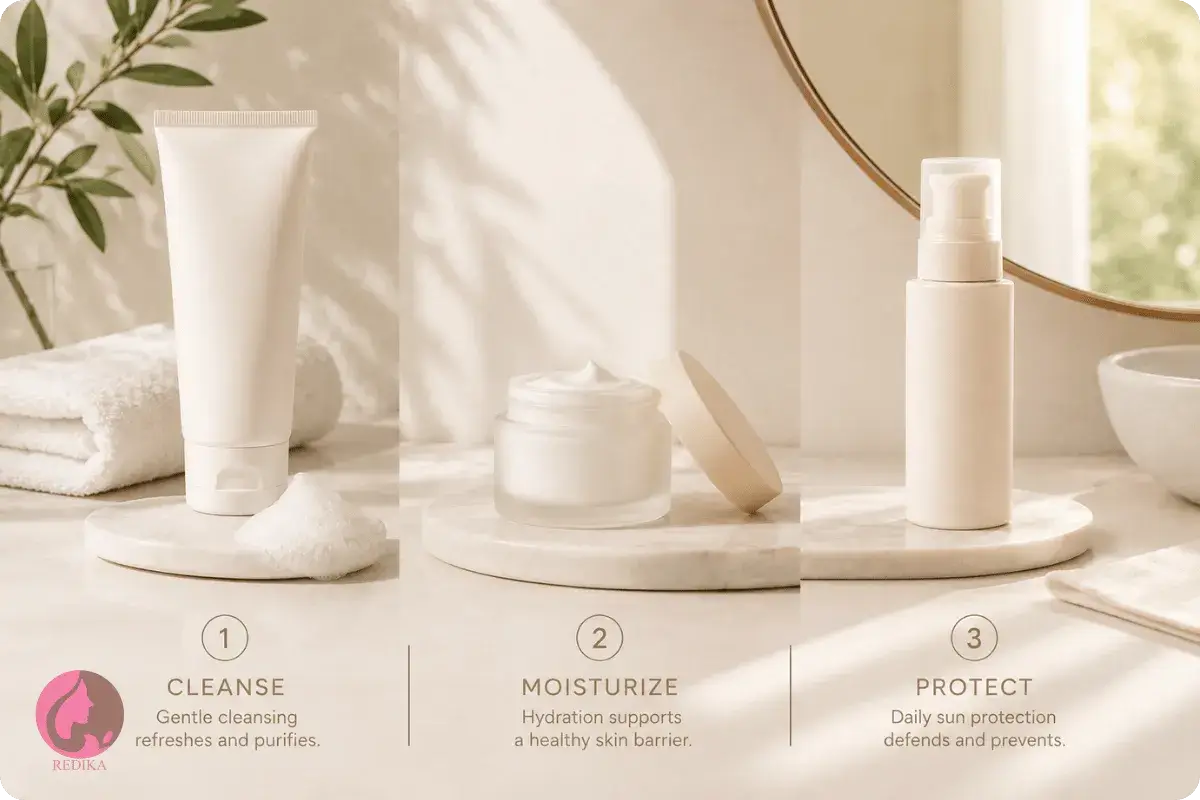
The short version of a basic routine is cleanse → targeted treatment if needed → moisturize → sunscreen in the daytime. More products are not automatically better; adding several strong ingredients at once may make irritation more likely. See Redika’s morning and evening skincare order guide for details.
What is a skincare routine? Essential English skincare terms
A skincare routine is a repeatable sequence of cleansing, caring for and protecting skin. Product names describe formats and purposes, but not every product category is required for everyone.
| Term | Plain-English meaning | Practical note |
|---|---|---|
| Skincare / skin care | Regular care of the skin | Includes cleansing, moisturizing, targeted care and protection |
| Skincare routine | The order in which products are used | Morning and evening steps can differ |
| Cleanser | Removes surface dirt, oil and product residue | Choose a gentle formula that suits your skin |
| Moisturizer | Helps maintain comfort and reduce moisture loss | May combine humectants, emollients and occlusives |
| Sunscreen | Helps protect against ultraviolet exposure | Apply as the daytime protection step |
| Serum | Usually a lighter product format | The word ‘serum’ does not identify an active ingredient |
| Toner | A liquid product applied after cleansing | Optional; may hydrate, exfoliate or calm depending on formula |
| Essence | Often a lightweight layer in multi-step routines | Brand definitions vary |
| Spot treatment | Targeted application to a specific area | Follow the product directions |
| Eye cream | Product made for the skin around the eyes | Not mandatory for every person |
The American Academy of Dermatology (AAD) recommends cleansing before treatment, then moisturizer and/or sunscreen. A complicated ten-step routine is not essential.
Active ingredients: AHA, BHA, retinoids and more
In everyday beauty conversations, an active is an ingredient included for a specific purpose such as treating acne or improving the look of discoloration. In legally regulated products, ‘active ingredient’ can have a narrower technical meaning. Concentration, formulation, skin tolerance and the local regulatory status matter.
| Ingredient or term | What it means | Important consideration |
|---|---|---|
| AHA | Alpha hydroxy acids, such as glycolic and lactic acids | Excessive exfoliation can irritate skin |
| BHA | Beta hydroxy acid; in skincare usually salicylic acid | Salicylic acid explained |
| Retinoid | The broader vitamin A derivative family | Different members differ in strength and uses |
| Retinol | A particular retinoid used in some skin routines | Read Redika’s retinol guide; introduce carefully |
| Niacinamide | Vitamin B3 used to support the skin barrier and appearance | Higher percentages are not always better |
| Hyaluronic acid | A water-binding humectant | Not an exfoliating acid |
| Vitamin C | An antioxidant ingredient or family of derivatives | Stability and formula affect performance |
| Azelaic acid | Used in some acne, redness and uneven-tone routines | Concentration and tolerability differ |
| Benzoyl peroxide | An acne-treatment ingredient | May dry skin and bleach fabrics |
| Peptides | Short amino-acid chains used in cosmetics | Effects depend on which peptide and the full formula |
Combining ingredients should be driven by skin needs rather than trends. Consult Redika’s skincare ingredient compatibility chart before layering retinol, exfoliating acids and other potent products.
Humectant, emollient and occlusive: what moisturizers contain

- Humectant: helps attract or hold water in the stratum corneum, such as glycerin or hyaluronic acid.
- Emollient: smooths and softens the skin surface to reduce a rough feeling.
- Occlusive: creates a layer that slows water evaporation, such as petrolatum.
Hydrating refers mainly to adding or retaining water. Moisturizing is broader and can include hydration, softening and protection from water loss. A moisturizer may contain all three ingredient classes.
Skin barrier and TEWL: understanding moisture loss

The skin barrier largely refers to the protective role of the stratum corneum in limiting water loss and exposure to irritants. Dryness, tightness or stinging can occur when its function is impaired, although these symptoms are not specific to one diagnosis. TEWL (transepidermal water loss) is the passive evaporation of water through the skin, often assessed with specialized instruments. Read Redika’s damaged skin barrier guide for practical background.
Non-comedogenic, hypoallergenic, fragrance-free: what labels can and cannot promise
| Label claim | Useful interpretation | What it does not guarantee |
|---|---|---|
| Non-comedogenic | Intended to be less likely to clog pores | No breakouts for every person |
| Oil-free | Formula described as free of oils | Suitability for all acne-prone skin |
| Fragrance-free | No added scent for fragrance purposes | No possible irritant or natural aromatic component |
| Unscented | Little or no noticeable smell | That masking fragrances are absent |
| Hypoallergenic | Marketing claim about lower allergy potential | No allergy ever; the FDA has no uniform federal definition for the term |
| Dermatologist tested | A testing claim involving dermatological assessment | Evidence quality without a disclosed method and results |
The FDA explains that “hypoallergenic” has no standardized federal definition for U.S. cosmetics. Check the ingredient list and your personal reactions rather than treating the label as a safety certificate.
SPF, broad spectrum, UVA, UVB and PA++++
- SPF: a standardized measure associated with protection against sunburn under test conditions, not a timer for hours outside.
- Broad spectrum: indicates protection across UVA and UVB ranges under the applicable standard.
- UVA: longer-wave ultraviolet rays associated with photoaging and skin damage.
- UVB: ultraviolet rays that strongly contribute to sunburn and DNA damage.
- PA++++: a high UVA protection tier in a rating system used in some markets; not directly interchangeable with SPF.
For the differences see Redika’s SPF 30 vs 50 and PA guide.
Exfoliation, purging and breakout are not the same
Exfoliation helps remove surface cells through physical or chemical methods. Overuse can cause redness, burning or peeling. Purging describes a possible temporary increase in acne-like lesions after some cell-turnover treatments. However, not every new spot after starting a product is purging; unusual locations, itching or persistent symptoms warrant a different assessment. Compare them in the purging versus breakout guide.
What is a patch test?
In consumer skincare, a patch test or small-area trial means trying a new cosmetic on a limited area before broad use. It can reveal an obvious reaction but does not guarantee freedom from future allergies. A formal dermatology patch test for allergic contact dermatitis is a separate medical procedure. See Redika’s skincare patch testing guide.
A simple morning and evening product-order chart
| Order | Morning | Evening | Required? |
|---|---|---|---|
| 1 | Gentle cleanse if needed | Remove makeup and sunscreen; cleanse | Basic step |
| 2 | Targeted serum or treatment if appropriate | Targeted treatment, for example suitable retinoid | Optional |
| 3 | Moisturizer | Moisturizer | As skin needs |
| 4 | Broad-spectrum sunscreen | — | Main protective morning step |
You need not add toner, essence and several serums all at once. A consistent simple routine may be easier to tolerate than a complicated one. Start with Redika’s beginner skincare routine.
Common skincare terms on product packaging
| English label | Meaning in context | What to remember |
|---|---|---|
| Anti-acne | For managing acne | Evaluate the actual formula and active |
| Anti-aging | Targets the appearance of aging | Broad marketing label; results vary |
| Brightening | Aims for a more even or radiant appearance | Does not necessarily mean bleaching |
| Hydrating | Helps add or retain water | Not always a standalone moisturizer |
| Soothing | Aims to reduce the feeling of irritation | Depends on formulation |
| Firming | Claims improved appearance of firmness | Not equivalent to a medical lift |
| Mattifying | Reduces surface shine | Mainly cosmetic finish |
| Water-resistant | Resistance to water for a tested duration | Not permanently waterproof |
| Leave-on | Intended to remain on the skin | Follow the recommended dose |
| Rinse-off | Intended to be washed away | Follow timing instructions |
| Topical | Applied to skin, not swallowed | Use only as labeled |
| pH-balanced | Formulated to a particular pH | Does not prove universal suitability |
How to distinguish science from cosmetic marketing
Not every impressive product claim has a standard scientific definition. “Glow boosting,” “detox” and “pore minimizing” may be promotional language. First identify the product category, check ingredients and concentration when disclosed, look for relevant clinical evidence, and do not equate a cosmetic claim with treatment of a disease. People with persistent eczema, rosacea, severe acne or prescription treatments should seek individualized professional advice.
Frequently asked questions about skincare terminology
What does skincare routine mean?
It is the repeatable sequence of steps used to cleanse, moisturize, protect and, when needed, treat specific skin concerns.
What is the difference between hydrating and moisturizing?
Hydrating primarily refers to water in the skin; moisturizing can also include emollients and occlusives that smooth the skin and reduce water loss.
What is an active ingredient in skincare?
In everyday use, it is an ingredient aimed at a specific benefit, such as acne control or improving pigmentation. It does not mean every active suits every skin type.
Does non-comedogenic mean guaranteed not to cause acne?
No. It suggests lower pore-clogging potential, not that every person’s skin will react the same way.
How many steps are essential in a skincare routine?
For many people, suitable cleansing, moisturizing as needed and sunscreen during the day provide a useful foundation; additional treatments are optional.
Sources and editorial approach
This Redika glossary focuses on commonly used label terms and evidence-informed skin-care guidance. See American Academy of Dermatology, Cleveland Clinic, and FDA cosmetic claim guidance. This is educational information, not medical diagnosis or treatment.
About the author

Join the conversation
Share your experience or question with REDIKA readers.
Your email stays private. Please avoid sharing personal or sensitive details.


