Home / Editorial guide


When shopping for sunscreen in a store or browsing skincare products online, a few labels will probably catch your attention more than others: SPF 30, SPF 50, SPF 50+, PA++++, and Broad Spectrum. Seeing all these numbers and symbols raises a simple question: should you choose SPF 30 or SPF 50 for daily use? Does SPF 50 protect your skin almost twice as much as SPF 30? And if a sunscreen is labeled PA++++, do you still need to look for Broad Spectrum protection?
The answer cannot be found by looking at just one number. Choosing the right sunscreen is more like reading a product’s technical specifications: you need to consider sunburn protection, UVA and UVB coverage, conditions of use, water resistance, the amount applied, and reapplication frequency together. In this guide, we explain all of these concepts in simple terms so that by the end, you can read a sunscreen label with confidence and choose an option that better suits your real-life needs.
Quick answer:
For most everyday situations, a Broad Spectrum sunscreen with SPF 30 or higher is a suitable baseline choice. If you spend long periods outdoors, exercise, go to the beach or pool, face a high UV Index, or are likely to apply less sunscreen than recommended, SPF 50 or SPF 50+ provides an additional margin of protection. PA++++ indicates a high level of UVA protection and does not replace SPF.
The article in 30 seconds:
- SPF 30: A suitable minimum level for many everyday situations.
- SPF 50: Provides an additional margin of protection when sun exposure is greater.
- PA++++: The highest rating in the four-level PA system for UVA protection.
- Broad Spectrum: Indicates that the product is designed and tested to provide protection across both UVA and UVB wavelengths.
- Reapplication: When outdoors, sunscreen generally needs to be reapplied about every two hours and after swimming or sweating according to the product instructions.
Scientific sources last reviewed: August 2026. This article is based on guidance and information published by the U.S. Food and Drug Administration, the American Academy of Dermatology, the World Health Organization, and the Japan Cosmetic Industry Association. To learn how our content is prepared and reviewed, see the Redika Magazine editorial and content transparency policy.
Quick answer: Should you choose SPF 30 or SPF 50?
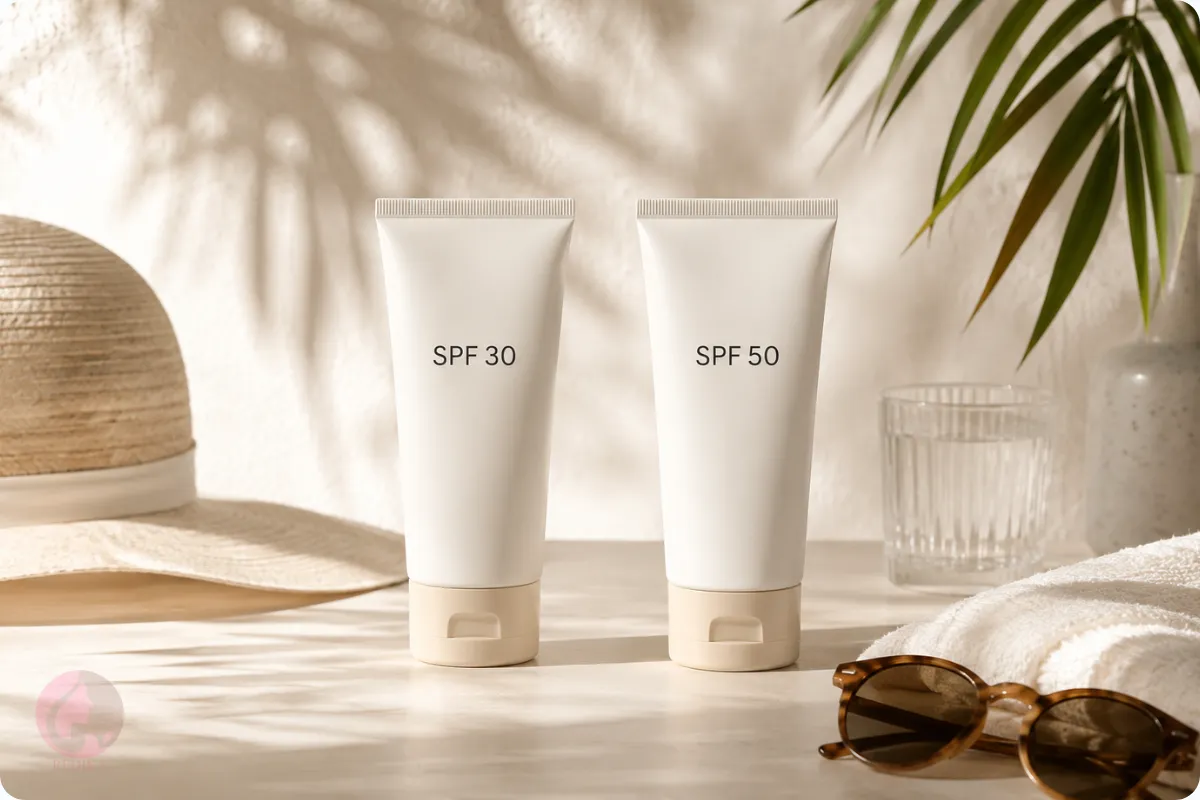
If you spend most of your day indoors and your sun exposure is mainly limited to normal urban commuting, a Broad Spectrum sunscreen with at least SPF 30 can be an appropriate choice, provided you apply enough of it. The American Academy of Dermatology also recommends choosing a Broad Spectrum sunscreen with SPF 30 or higher.
If you spend several hours outdoors, burn easily, exercise, swim, live or travel in areas with intense sunlight, or are concerned about sun-related pigmentation, choosing SPF 50 can provide a greater margin of protection. However, a higher SPF never means that you can apply less sunscreen, skip reapplication, or stay in the sun indefinitely.
| Criteria | SPF 30 | SPF 50 |
|---|---|---|
| UVB filtered under standard test conditions | About 97% | About 98% |
| Theoretical amount of UVB transmitted | About 3.3% | About 2% |
| Typical daily use | Suitable when used correctly | Suitable with a greater margin of protection |
| Extended outdoor exposure | Can be used with correct application and reapplication | Generally the more conservative choice |
| Needs reapplication | Yes | Yes |
| Does it replace UVA protection? | No | No |
So the more useful question is not simply, “Is SPF 30 or SPF 50 better?” It is: Which level of protection makes more sense for my amount of sun exposure, activities, skin concerns, and likelihood of reapplying sunscreen properly?
What is SPF and what does it actually measure?
SPF, or Sun Protection Factor, indicates how well a sunscreen protects the skin against sunburn under standardized testing conditions. UVB radiation plays a major role in sunburn, which is why SPF is primarily associated with protection against UVB.
The number printed on the package comes from controlled testing in which a specific amount of sunscreen is applied evenly to the skin. Real life is different. We may apply too little sunscreen, miss the ears or edges of the face, touch our face, sweat, or remove some of the product through contact with clothing or towels.
For this reason, the SPF printed on the package does not guarantee that you will receive exactly the same level of protection regardless of how much or how carefully you apply it. A sunscreen with a very high SPF on paper may not be the most practical option if its texture causes you to use only a small amount.
The real difference between SPF 30 and SPF 50: Is it only one percent?
One of the most common explanations of sunscreen is that SPF 30 filters about 97% of UVB radiation while SPF 50 filters about 98% under standard testing conditions. At first glance, this makes the difference look like only one percentage point, but the picture changes when we consider how much radiation passes through.
SPF 30: Theoretically, about 1/30 of the effective sunburn-producing radiation gets through, or roughly 3.3%.
SPF 50: Theoretically, about 1/50 gets through, or roughly 2%.
So if we compare the amount of radiation that gets through instead of only the percentage filtered, SPF 50 allows roughly 40% less effective radiation to pass through than SPF 30 under standardized conditions. This calculation does not guarantee the exact same difference on real skin, but it shows why saying “the difference is only one percent” can be overly simplistic.
What does SPF 50+ mean? The plus sign should be interpreted according to the labeling standard used in the market where the product is sold. For example, the Japan Cosmetic Industry Association allows SPF 50+ labeling when test results are meaningfully above SPF 50 under its applicable standard. The + symbol therefore does not mean “infinitely stronger,” and you still need to consider UVA protection, application amount, and reapplication.
Why SPF is not a measure of how long you can stay in the sun
You may have heard the claim that if your skin burns after 10 minutes without sunscreen, SPF 30 means you can safely stay in the sun for 300 minutes. This direct calculation is not accurate. The U.S. Food and Drug Administration explains that SPF should not simply be interpreted as a multiplier of time because the amount of ultraviolet energy reaching your skin is not constant throughout the day.
Sun intensity, time of day, season, altitude, latitude, weather conditions, the amount of sunscreen applied, and individual behavior can all affect exposure. In simple terms, one hour under intense midday sun is not necessarily equivalent to one hour outdoors early in the morning.
A higher SPF also does not eliminate the need for reapplication. When outdoors, expert guidance generally recommends reapplying sunscreen about every two hours and after swimming or sweating. For a detailed explanation, see Redika’s guide on how often you should reapply sunscreen.
What is the difference between UVA and UVB, and why do both matter?
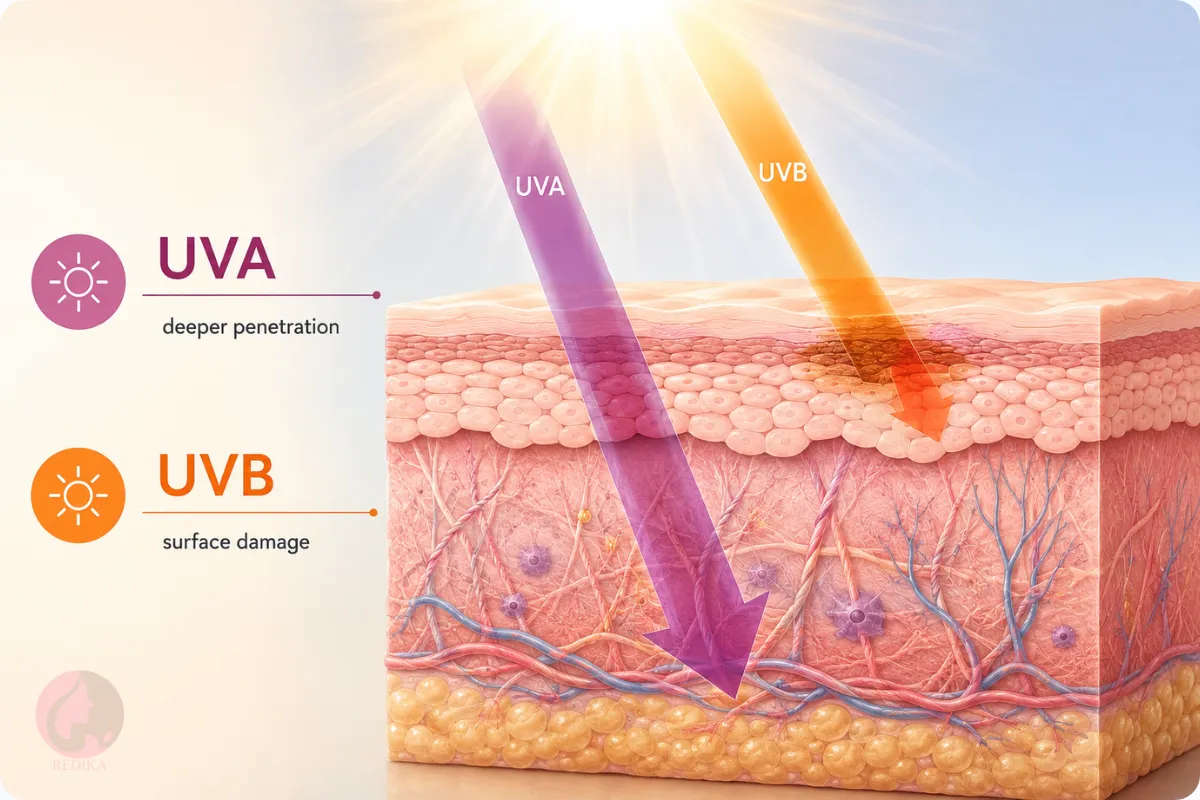
To read sunscreen labels correctly, you first need to understand the two major types of ultraviolet radiation that reach the skin. UVB is strongly associated with sunburn and can damage skin cells. UVA also contributes to photoaging, pigmentation, and long-term skin damage and can penetrate deeper into the skin than UVB.
Another important distinction is that UVA can pass through ordinary window glass to some degree, while much of UVB is blocked by standard glass. This means someone who spends many hours next to a window or inside a vehicle may still be exposed to a portion of UVA radiation.
| Feature | UVA | UVB |
|---|---|---|
| Commonly associated with | Photoaging, pigmentation, and long-term skin damage | Sunburn and skin damage |
| Skin penetration | Deeper | Primarily affects more superficial layers |
| Passes through ordinary glass | Some UVA can pass through | Most UVB is blocked by ordinary glass |
| Common label indicator | PA or other UVA protection ratings | SPF |
If you want to explore this topic in more detail, read UVA vs UVB: Differences, Skin Damage and Protection (in Persian). Understanding this distinction makes it clear why choosing sunscreen based only on the SPF number does not tell the whole story.
What is PA++++ and what do the plus signs mean?
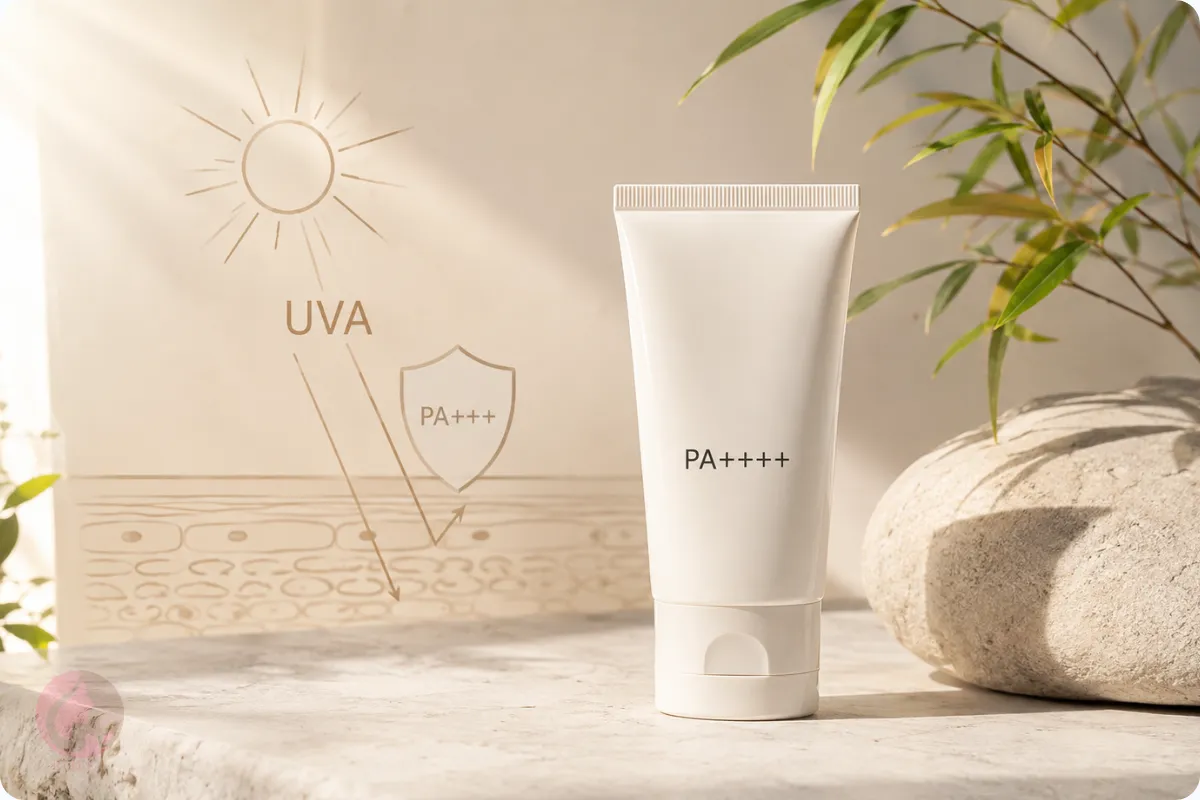
PA is one system used to communicate a sunscreen’s level of protection against UVA radiation and is commonly seen on Asian sunscreens, particularly products from Japan and South Korea. The more + symbols shown, the higher the UVA protection category.
An important point is that the + symbols should not be interpreted as percentages. PA++++ does not mean “100% UVA protection,” and PA++ does not mean a specific level of protection is exactly twice another one. The ratings are based on defined ranges of the UVA Protection Factor, or UVAPF.
PA+ to PA++++ ratings based on UVAPF
| PA Rating | UVAPF | Practical meaning |
|---|---|---|
| PA+ | 2 to less than 4 | Basic UVA protection category |
| PA++ | 4 to less than 8 | Higher than basic UVA protection |
| PA+++ | 8 to less than 16 | High UVA protection |
| PA++++ | 16 or higher | Highest category in the four-level PA system |
If pigmentation, melasma, or photoaging is a major concern, UVA protection becomes especially important. On products that use the PA rating system, PA++++ provides useful information indicating a high level of UVA protection.
Easy-to-remember answer: PA++++ means the sunscreen is in the highest category of the four-level PA system and has a UVAPF of at least 16. It does not mean complete protection from UVA radiation.
What does Broad Spectrum mean on sunscreen?
Broad Spectrum indicates that a sunscreen is not designed only to protect against UVB and has met the relevant criteria for coverage across UVA and UVB wavelengths. Under the U.S. Food and Drug Administration system, Broad Spectrum is not simply a marketing phrase; the product must meet the applicable broad-spectrum testing requirements.
The test evaluates how broadly the sunscreen absorbs ultraviolet radiation, including a technical criterion related to critical wavelength. Consumers do not need to memorize the laboratory details. The practical message is that a high SPF number alone does not provide complete information about a sunscreen’s UVA protection.
When shopping, look at the combination of characteristics: an appropriate SPF, Broad Spectrum labeling or another recognized UVA protection indicator, and Water Resistant protection if you will be swimming or sweating.
Broad Spectrum and PA++++ are not the same thing
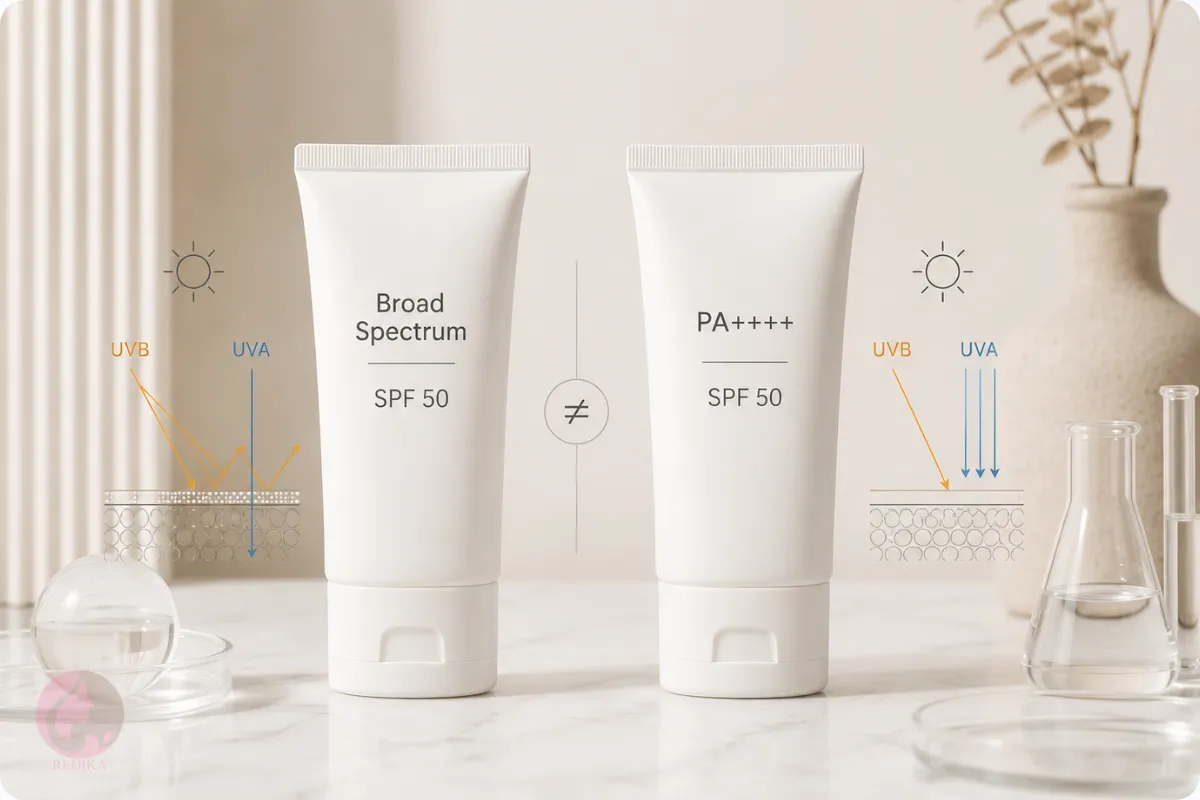
A common misunderstanding is to assume that PA++++ and Broad Spectrum are simply two names for the same thing. Both relate to UVA protection, but they communicate protection using different systems and are not directly equivalent.
| Feature | PA++++ | Broad Spectrum |
|---|---|---|
| Main focus | Rates the level of UVA protection | Coverage across UVA and UVB wavelengths |
| How it appears on the label | + symbols | “Broad Spectrum” wording |
| Can it be directly converted to the other system? | No | No |
| Does it replace SPF? | No | No |
For this reason, you cannot assume that every Broad Spectrum sunscreen is exactly equivalent to PA+++ or PA++++. It is better to interpret each product according to the protection system used on its label rather than relying on unofficial one-to-one conversions between different standards.
Who should choose SPF 30 and who may benefit from SPF 50?

Sunscreen is better chosen according to your “use scenario” rather than simply selecting the largest number on the package. Someone who spends most of the day at a desk away from windows does not have the same exposure as someone who exercises outdoors for several hours or spends the weekend at the beach.
To make the decision easier, the Redika editorial team has developed the following practical sunscreen selection framework based on the scientific recommendations discussed in this article. This table is not an independent medical standard; it is designed to translate general scientific guidance into practical everyday decisions.
| Use scenario | Suggested SPF range | UVA protection | Water resistance | Main priority |
|---|---|---|---|---|
| Normal daily commuting | 30 or higher | Broad Spectrum or another recognized UVA protection indicator | Usually not essential | A texture you can comfortably use every day |
| Driving or spending long periods next to windows | 30–50 | Good UVA protection | As needed | Greater attention to UVA protection |
| Extended outdoor activity | 50 or 50+ | Strong UVA protection | Useful when sweating | Regular reapplication |
| Pool, beach, and water sports | 50 or 50+ | Strong UVA protection | Preferably 40 or 80 minutes, according to the label | Reapplication after water exposure and towel drying |
| Pigmentation and melasma concerns | SPF 50 is often the more conservative choice | Strong UVA protection is particularly important | As needed | UVA protection and, where appropriate, tinted sunscreen |
Real-life scenario 1: If you spend most of the day in an office and only have a short commute, a Broad Spectrum sunscreen with SPF 30 or higher that works well with your skin is generally a practical choice.
Real-life scenario 2: If you drive for long periods, walk regularly, or spend a significant amount of time commuting outdoors, SPF 50 with appropriate UVA protection can provide an additional margin of protection.
Real-life scenario 3: If you will spend several hours at the beach, pool, mountains, or outdoors, SPF 50 or 50+, appropriate UVA protection, and Water Resistant protection become more important. Even then, regular reapplication and physical sun protection remain essential.
For daily use, work, and urban commuting
For many people, a daily sunscreen first needs to be easy and comfortable to use. If a product is so heavy, greasy, or incompatible with makeup that you end up applying only a very small amount, the high number on the package alone offers little practical advantage.
For everyday use, a Broad Spectrum sunscreen with SPF 30 or higher is a sensible starting point. If you spend many hours beside windows or drive for long periods, paying attention to UVA protection becomes even more important.
For many users, SPF 50 is also an excellent everyday choice, especially when it comes in a lightweight, comfortable formulation. SPF 50 is not only for beach days, and SPF 30 is not only for winter.
For outdoor activities, exercise, the beach, and a high UV Index
When you spend a long time outdoors, the situation changes. Greater UV exposure, sweating, contact with water, and the possibility of sunscreen being rubbed off all become more relevant. In these situations, SPF 50 or 50+ combined with appropriate UVA protection can be the more conservative option.
The World Health Organization recommends taking stronger protective measures when the UV Index reaches 3 or higher. These measures should not be limited to sunscreen; shade, protective clothing, hats, and sunglasses are also part of effective sun protection.
Water Resistant does not mean completely waterproof. Many sunscreens are labeled as water resistant for 40 or 80 minutes, and they should be reapplied according to the label after swimming, heavy sweating, or towel drying.
For pigmentation, melasma, and concerns about dark spots
If pigmentation and melasma are your main concerns, looking only at SPF is not enough. UVA protection becomes particularly important, and products labeled PA++++ or carrying other recognized UVA protection ratings can provide useful information about their level of coverage.
For some people with melasma or hyperpigmentation, tinted sunscreen containing iron oxides may be worth considering because visible light may also contribute to worsening certain types of hyperpigmentation. The American Academy of Dermatology includes tinted sunscreens containing iron oxides among options that may be useful for some people who are prone to dark spots.
If you have severe melasma, persistent pigmentation, a skin disorder, photosensitivity, or an unusual reaction to sunlight, it is best to discuss sunscreen selection with a dermatologist. Sunscreen is an important part of protection, but it is not a substitute for medical treatment of a skin condition.
How much sunscreen should you use and when should you reapply it?
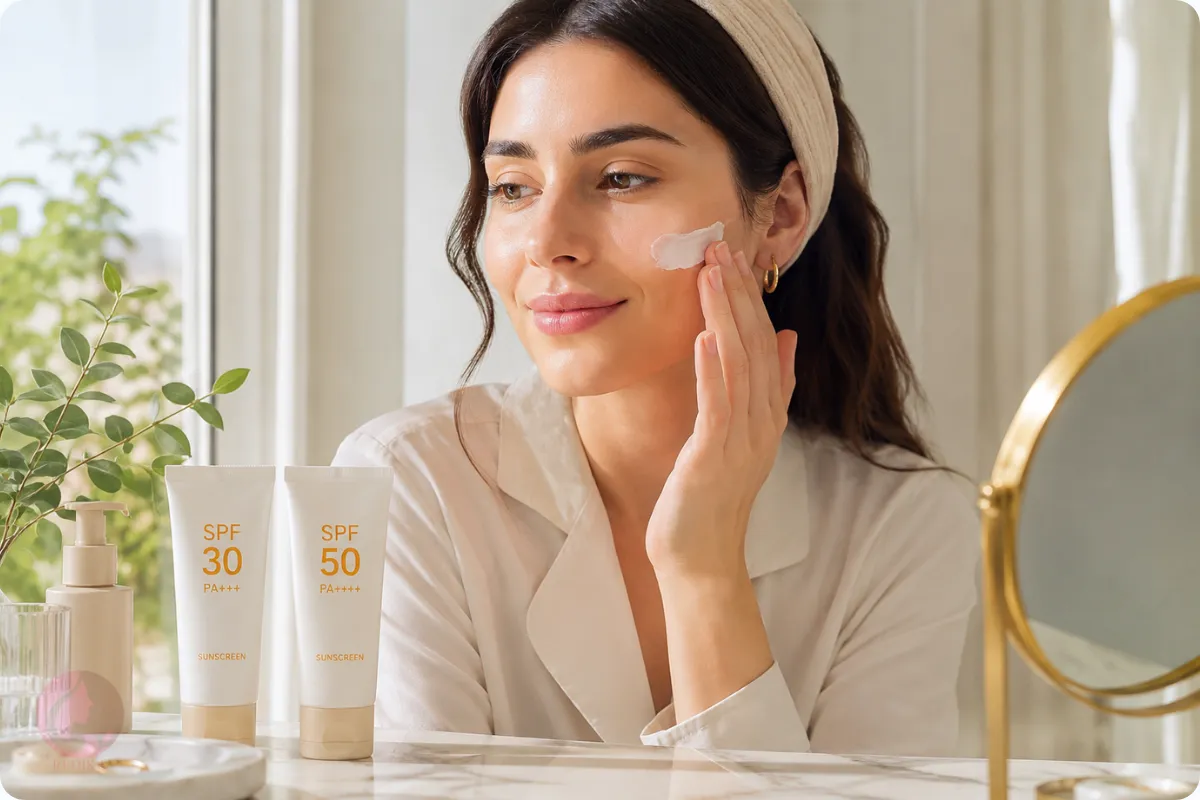
One of the main reasons real-world sunscreen protection falls below expectations is inadequate application. Sunscreens are tested using a specified amount applied evenly to the skin. If you use a very thin layer in everyday life, you should not expect to receive exactly the level of protection printed on the package.
The American Academy of Dermatology recommends applying enough sunscreen to dry skin before going outdoors. For the exposed skin of an average adult body, expert sources commonly use approximately one ounce as a practical general estimate, although the actual amount depends on body size and how much skin is exposed.
When outdoors, reapplying about every two hours is a useful general rule. If you are swimming, sweating heavily, or drying your skin with a towel, reapply sooner according to the product instructions.
- Do not forget your ears, neck, and the back of your neck.
- Cover the hairline and edges of the face.
- Apply sunscreen to the hands and other exposed areas.
- Do not use a high SPF number as a substitute for reapplication.
- For Water Resistant sunscreens, check whether the label specifies 40 or 80 minutes of water resistance.
The simple rule is: sunscreen only protects the areas where enough product has actually been applied.
How to choose sunscreen for your skin type
Your skin type does not determine whether you need sunscreen; all skin types need protection from ultraviolet radiation. The main difference is which texture and formulation you can comfortably use every day and in a sufficient amount.
If you have oily or acne-prone skin, lighter textures and products designed for skin prone to clogged pores may feel more comfortable. For more detail, read our guide to the best sunscreen for oily skin (in Persian).
For dry and sensitive skin, tolerability and moisturizing properties matter alongside the level of sun protection. See our guide to choosing sunscreen for dry and sensitive skin (in Persian) for a more detailed explanation.
If some areas of your face are oily while others are normal or dry, the best sunscreen for combination skin (in Persian) can provide more specific guidance.
| Skin type | Texture priority | Selection tip |
|---|---|---|
| Oily and acne-prone | Lightweight, fluid, or gel-cream | Choose a product you can apply generously without feeling too heavy |
| Dry | Cream or moisturizing formula | Prioritize moisture retention and skin comfort |
| Sensitive | Gentle and well-tolerated formula | If you have a history of sensitivity, review the ingredients and patch-test when appropriate |
| Combination | Balanced and lightweight | The texture should not feel too heavy on oily areas or uncomfortable on drier areas |
Ultimately, the best sunscreen for you is not simply the one with the highest number. It is a product that provides an appropriate level of protection and that you can apply regularly, evenly, and in a sufficient amount.
Sunscreen label checklist: What to check before buying
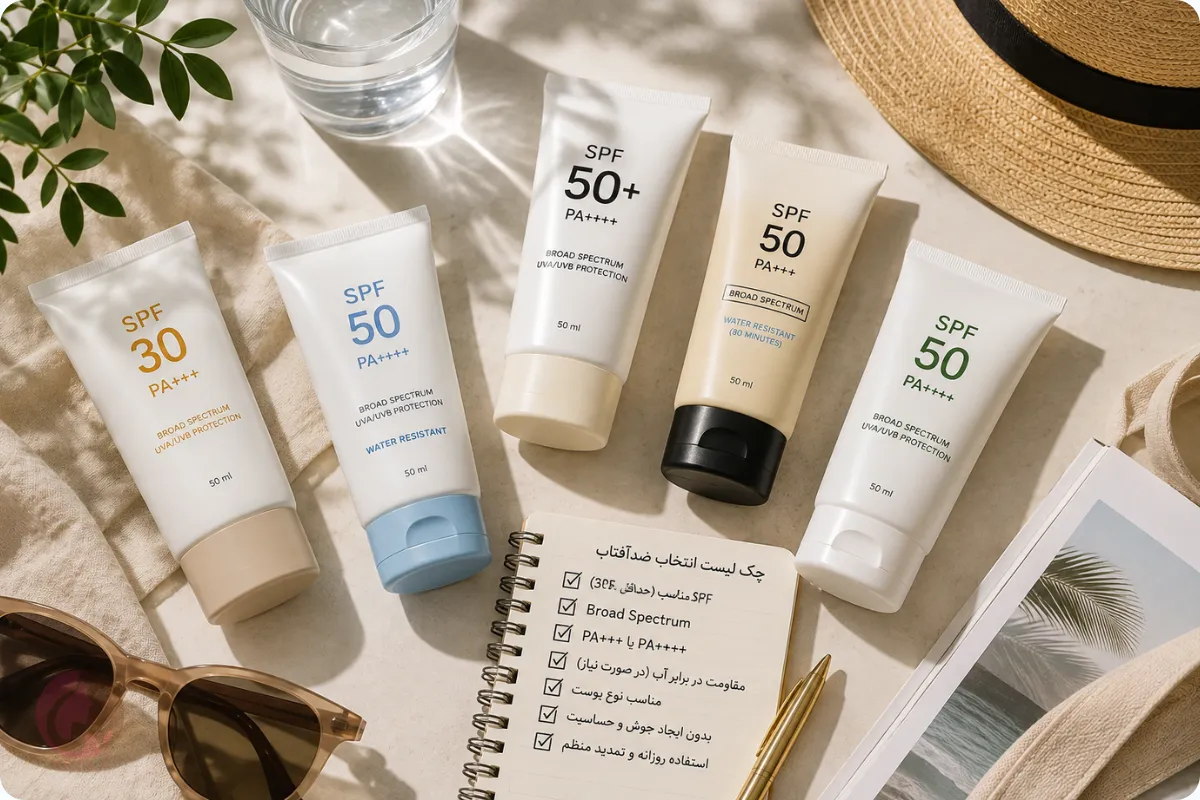
You do not need to memorize every sunscreen filter to make an informed choice. A few key pieces of information on the label can answer most of the important questions.
- SPF 30 or higher: A suitable starting point for general daily sun protection.
- Broad Spectrum: Indicates protection that addresses both UVA and UVB.
- PA: On products that use the PA system, the number of + symbols indicates the UVA protection category.
- Water Resistant: More important for exercise, sweating, swimming, and beach activities.
- Water-resistance duration: If the label states 40 or 80 minutes, reapply according to those instructions.
- Texture: Creams, fluids, gel-creams, and other formulations should suit your skin type and lifestyle.
- Application and reapplication instructions: A high SPF does not make proper use less important.
- Expiration date and storage: An expired sunscreen or one stored in excessive heat may not be a reliable choice.
- Tinted or untinted: For some people prone to melasma or hyperpigmentation, a tinted sunscreen containing iron oxides may be worth considering.
If two sunscreens provide similar SPF and UVA protection, it usually makes sense to choose the one whose texture, finish, and feel on the skin make it easier for you to apply enough every day.
Common myths about SPF, PA, and Broad Spectrum sunscreen
Much of the confusion around sunscreen comes from a few simple but inaccurate beliefs. Recognizing these myths can make it easier to separate reliable information from misleading claims when shopping or reading advice on social media.
- “SPF 50 means 50% protection.” No. SPF is not a percentage.
- “SPF 50 offers almost twice the protection of SPF 30.” No. The relationship between SPF and the percentage of UVB filtered is not linear.
- “The difference between SPF 30 and 50 is only one percent, so it does not matter.” Looking at the amount of radiation transmitted shows that the relative difference can be more meaningful than this simplified claim suggests.
- “A high SPF automatically means excellent UVA protection.” Not necessarily. UVA protection should be evaluated separately.
- “PA++++ is the same as Broad Spectrum.” No. They are not the same labeling system.
- “SPF 50 or SPF 100 does not need to be reapplied.” A higher SPF does not replace reapplication.
- “Water Resistant means completely waterproof.” No. Water resistance is limited and is generally stated for a specific period on the label.
- “You do not need sunscreen on cloudy days.” Ultraviolet radiation can still be present when the sky is cloudy.
- “Sunscreen replaces hats, clothing, and shade.” Sunscreen is one layer of sun protection and works best alongside other protective measures.
Another mistake is deliberately using sunscreen as a way to stay under intense sunlight for longer. The World Health Organization emphasizes that sunscreen should not be used to extend the amount of time spent in the sun.
Conclusion: A higher number matters, but the full sunscreen label matters more
If you remember only one thing from this guide, let it be this: do not choose sunscreen based only on the largest number printed on the package. SPF 30 or higher is a suitable starting point for many everyday situations, while SPF 50 or 50+ can provide an additional margin of protection when sun exposure is greater.
At the same time, you should consider UVA coverage. PA++++ is the highest category in the four-level PA system, while Broad Spectrum indicates protection across UVA and UVB wavelengths according to the relevant testing criteria. The two concepts are related, but they are not directly interchangeable.
For everyday use, choose a sunscreen that you can realistically apply in a sufficient amount. For exercise, the beach, swimming, or extended time outdoors, a higher SPF, appropriate UVA protection, and Water Resistant protection become more important. In every situation, remember proper reapplication, shade, clothing, and other sun-protection measures.
If you would like to compare available options, you can also browse the sunscreen category on Redika.
Scientific sources used and reviewed:
- American Academy of Dermatology — How to Select Sunscreen
- American Academy of Dermatology — How to Apply and Reapply Sunscreen
- U.S. Food and Drug Administration — Sunscreen and Sun Protection
- World Health Organization — Protecting Against Skin Cancer
- Japan Cosmetic Industry Association — SPF and PA Standards
Frequently Asked Questions About SPF 30, SPF 50, PA++++, and Broad Spectrum
1. Is SPF 30 or SPF 50 better for daily use?
For many everyday situations, a Broad Spectrum sunscreen with SPF 30 or higher is a suitable choice. If you spend more time outdoors, the UV Index is high, you exercise outside, or you are likely to apply less than the recommended amount, SPF 50 can provide an additional margin of protection.
2. Does SPF 50 provide twice the protection of SPF 30?
No. The SPF scale is not linear. Under standardized conditions, SPF 30 filters about 97% of UVB while SPF 50 filters about 98%. However, when comparing the amount of UVB that gets through, SPF 50 theoretically allows less radiation to pass, so the difference is not fully explained by simply saying “one percent.”
3. What exactly does PA++++ mean?
PA++++ is the highest category in the four-level PA rating system. Under the Japan Cosmetic Industry Association criteria, it corresponds to a UVAPF of 16 or higher. It does not mean that the sunscreen blocks 100% of UVA radiation.
4. Is Broad Spectrum the same as PA++++?
No. PA++++ is a rating for the level of UVA protection within the PA system. Broad Spectrum indicates that a product meets the relevant criteria for protection across both UVA and UVB wavelengths. The two concepts are related, but there is no direct one-to-one conversion between them.
5. How often should SPF 50 sunscreen be reapplied?
SPF 50 does not eliminate the need for reapplication. When outdoors, the general recommendation is to reapply about every two hours, and sooner after swimming, sweating, or towel drying according to the product instructions. If the sunscreen is Water Resistant, also follow the 40- or 80-minute water-resistance period stated on the label.
About the author

Join the conversation
Share your experience or question with REDIKA readers.
Your email stays private. Please avoid sharing personal or sensitive details.


