Home / Editorial guide

Author: Redika Magazine Editorial Team
Last Source Review: Shahrivar 1405 (August–September 2026)
Medical Note: This article was not written by a physician and is intended for general educational purposes. If you experience severe or sudden sweating, or sweating accompanied by other symptoms, consult a doctor or dermatologist for diagnosis and treatment.
Imagine leaving home in the morning with smooth, flawless makeup, only to notice a few hours later that your foundation has gathered around your nose, your forehead is shiny, and sweat is visible above your upper lip. This is not always the result of choosing the wrong foundation. Heat, perspiration, skin sebum, humidity, sunscreen underneath makeup, and the amount of each product can all affect how long your makeup lasts. Sweat-proof makeup does not mean stopping the face from sweating naturally. Instead, it refers to a combination of product choices and application techniques designed to help makeup resist separating, breaking apart, or fading when exposed to heat and moisture.
Research has shown that exposure to hot environments can increase sweating, surface sebum production, and transepidermal water loss. Laboratory studies of liquid foundation also suggest that sweat, sebum, light, and the drying process can affect its appearance and color. The real solution, therefore, is not simply applying heavier layers. Skin preparation, product selection, application order, and touch-up techniques all need to work with your skin and the climate.
[1]
[2]
Quick Answer: How Can You Prevent Makeup from Melting in the Heat?
To prevent makeup from melting in hot weather, keep your skincare routine lightweight, use a sunscreen that works well with your skin, and allow the surface of your skin to become less wet and slippery before starting your makeup. Apply primer only to oily areas, use foundation and concealer in thin layers, and concentrate setting powder on the center of the face. Finish with a long-wearing setting spray. When touching up your makeup, absorb sweat and excess oil first; never apply pressed powder directly over wet, sweaty skin.
The main rule of summer makeup is that every layer should be thin, compatible, and properly set. If moisturizer, sunscreen, primer, and foundation are applied heavily and one immediately after another, the layers underneath may remain mobile. As soon as you begin to sweat, the makeup is much more likely to separate from the skin.
- Cleanse your skin with a gentle cleanser.
- Apply a lightweight moisturizer suited to your skin type.
- Use a broad-spectrum, water-resistant sunscreen.
- Allow the sunscreen to settle before applying makeup.
- Apply primer only to areas prone to oiliness and sweating.
- Apply foundation in a thin layer using gentle pressing motions.
- Use powder only on the forehead, nose, chin, and upper-lip area as needed.
- Set your makeup with a setting spray and avoid touching your face until it has dried.
Why Does Makeup Melt or Separate from the Skin in Hot Weather?
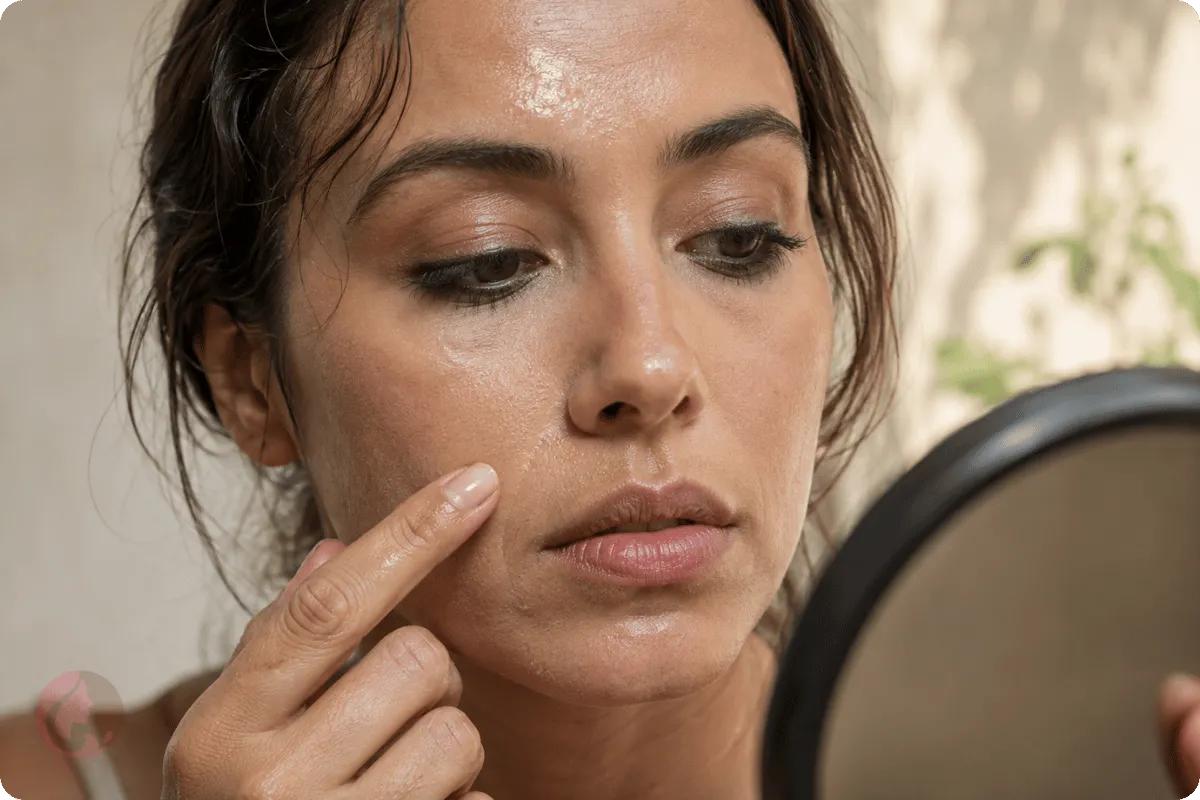
Makeup melting is usually caused by a combination of factors rather than sweating alone. Heat can increase both perspiration and sebum production, while high humidity may slow the drying of certain skincare and makeup layers. If sunscreen or moisturizer is still moving on the skin, friction from a brush or sponge can also disturb and lift the layers underneath.
Dry skin can create a similar appearance. When matte foundation or too much powder is applied over flaky skin, pigments cling to dry patches and make the surface appear uneven. This is why oily and dry skin require different approaches: one may need better sebum control, while the other needs enough hydration to keep the makeup layer flexible.
A change in foundation color does not always mean simple oxidation. Research suggests that sebum, sweat, light exposure, the drying process, and pigment characteristics may all contribute to foundation appearing darker or different over time. For this reason, it is better to evaluate a foundation shade after wearing it for several hours and viewing it in natural light rather than judging it immediately after swatching it on your hand.
[3]
The Difference Between Melting, Pilling, Caking, and Makeup Separation
Many people describe every makeup problem as “melting,” but identifying exactly what has happened makes it much easier to find the right solution. For example, makeup that forms small rolls or flakes does not necessarily need more powder. The underlying skincare and makeup layers may be incompatible, or the products may have been rubbed too aggressively during application.
| Problem | How It Looks on the Skin | Common Causes | First Solution to Try |
|---|---|---|---|
| Melting or creasing | Product collects in lines, around the nose, or around the mouth | Too much product, skin oil, movement between layers | Reduce the amount of product and set only problem areas |
| Pilling | Products form small rolls, flakes, or strings | Incompatible layers, insufficient drying time, excessive rubbing | Use fewer layers and press products into the skin |
| Caking | Makeup looks thick, chalky, or overly dry | Too much foundation or powder, dehydrated skin | Reduce coverage and improve balanced hydration |
| Separation | Patchiness, gaps, or bare areas appear in the foundation | Sweat, sebum, friction, or a slippery base | Absorb moisture and touch up only the affected area |
| Color change | Foundation appears darker, more orange, or duller | Sebum, light, drying, and formulation characteristics | Wear-test the product for several hours in natural light |
Skin Preparation: The Most Important Step in Sweat-Proof Makeup
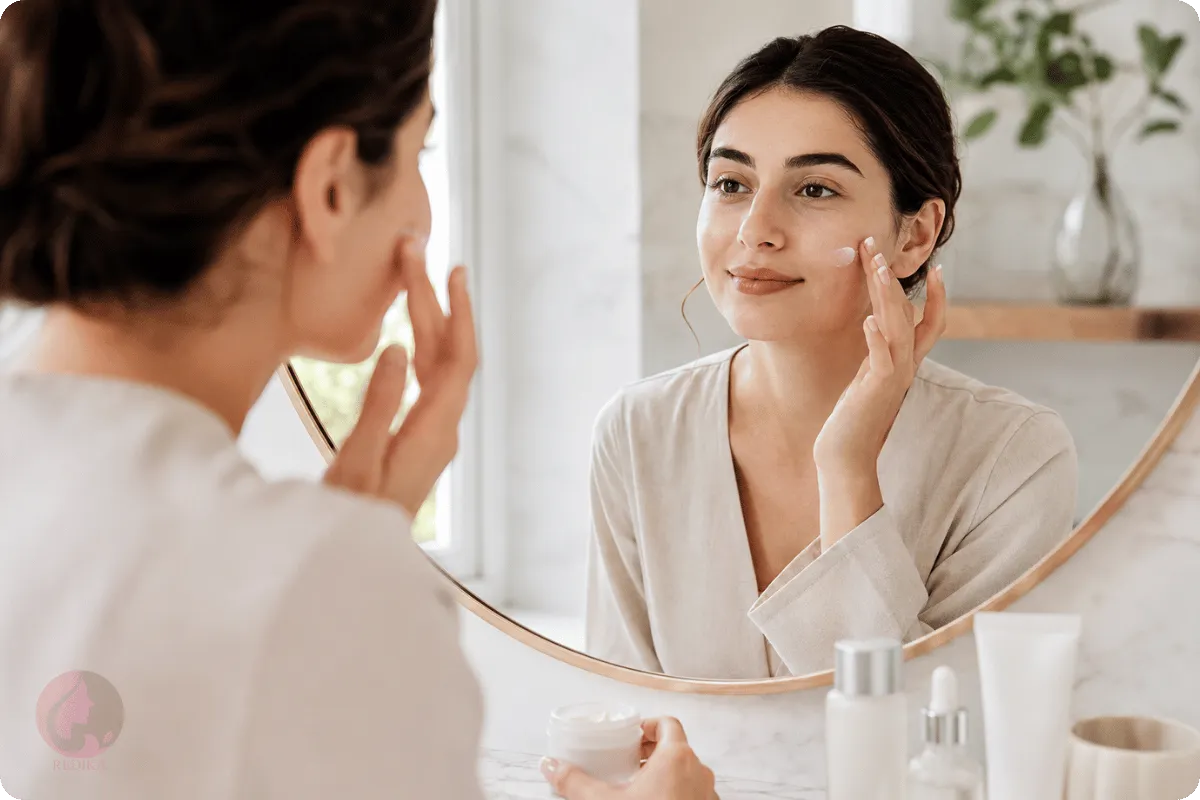
Long-lasting makeup starts with clean, balanced skin. Wash your face with a gentle cleanser that removes excess oil and impurities without leaving the skin feeling extremely tight. Harsh cleansing and aggressive exfoliation may irritate the skin and make uneven texture more noticeable.
Even oily skin needs moisturizer; the difference lies in the texture and amount. Lightweight lotions or gels are often more suitable for oily and combination skin than very rich creams. Dry skin needs a product that softens flaky areas without creating an excessively oily or slippery layer underneath makeup.
If the center of your face is oily while your cheeks are dry, do not prepare your entire face in exactly the same way. Use lighter products on the forehead, nose, and chin while giving the cheeks more balanced hydration. For a more detailed routine, read our guide to the best skincare routine for combination skin (in Persian).
Sunscreen is not an optional step. Dermatologists recommend a broad-spectrum, water-resistant sunscreen with an SPF of at least 30. Water-resistant sunscreens are not permanent and should be reapplied according to the product label, particularly after sweating, swimming, or the specified period of protection.
[4]
- Apply sunscreen to clean skin after moisturizer.
- Do not begin makeup while the surface of the skin still feels very wet or slippery.
- Press foundation onto the skin gently to minimize disruption of the sunscreen layer.
- For sweating and water exposure, check whether the sunscreen is labeled water-resistant for 40 or 80 minutes.
How Should Makeup Differ in Dry Heat and Hot, Humid Weather?
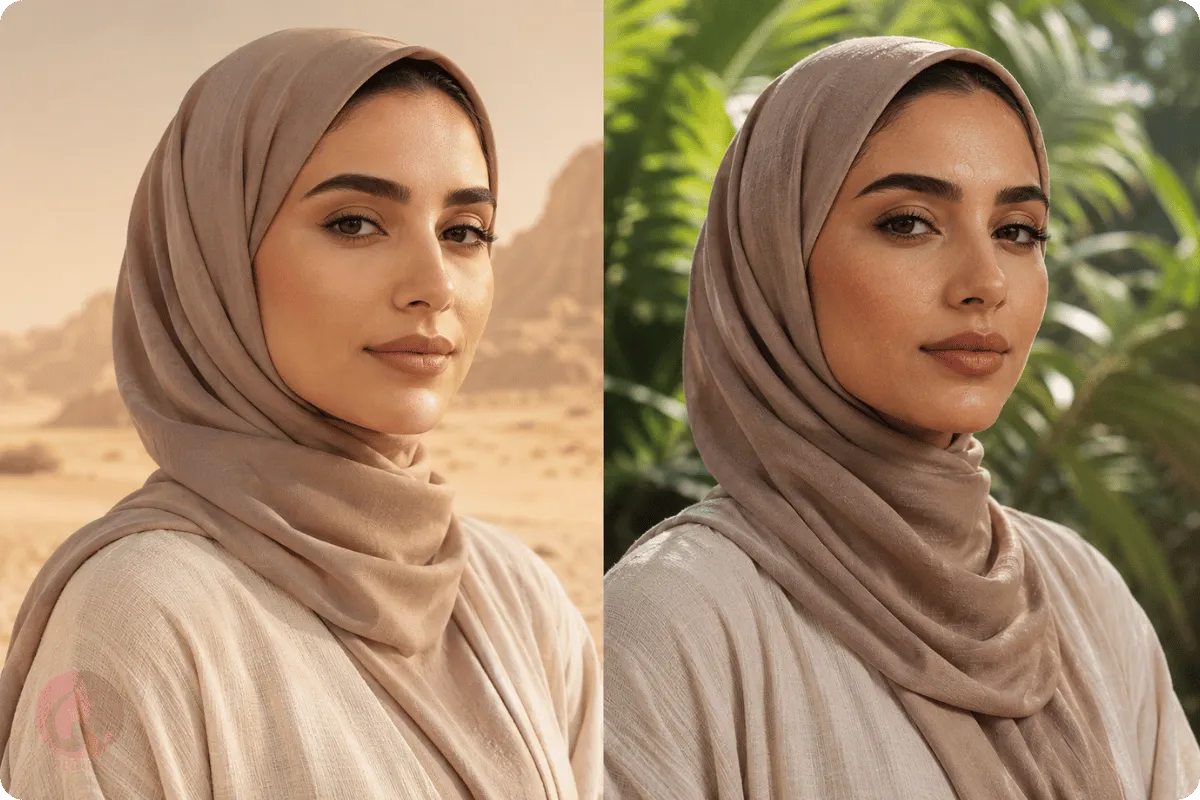
In dry heat, water can evaporate from the surface of the skin more quickly, causing the cheeks, area around the mouth, and under-eye area to feel dry or tight sooner. In these conditions, extremely matte foundation and heavy powder may make fine lines and cracks more visible. Lightweight hydration, a flexible foundation, and minimal powder are usually more sensible choices.
[5]
In humid weather, the main problems are usually stickiness, sweating, shine, and makeup layers taking longer to dry. Give sunscreen and primer more time to settle, and limit excessively rich or wet-feeling products. Buildable foundation, oil-absorbing powder in the center of the face, and a long-wearing setting spray can often provide better results.
| Weather | Main Problem | Better Choice | Best to Limit |
|---|---|---|---|
| Dry heat | Dehydration, flaking, and makeup cracking | Balanced moisturizer, natural-finish foundation, minimal powder | Ultra-matte products and heavy baking |
| Humid heat | Stickiness, sweat, sebum, and makeup transfer | Thin layers, targeted setting, more drying time | Facial oils and heavy cream layers |
Choosing the Right Products for Sweat-Resistant Makeup
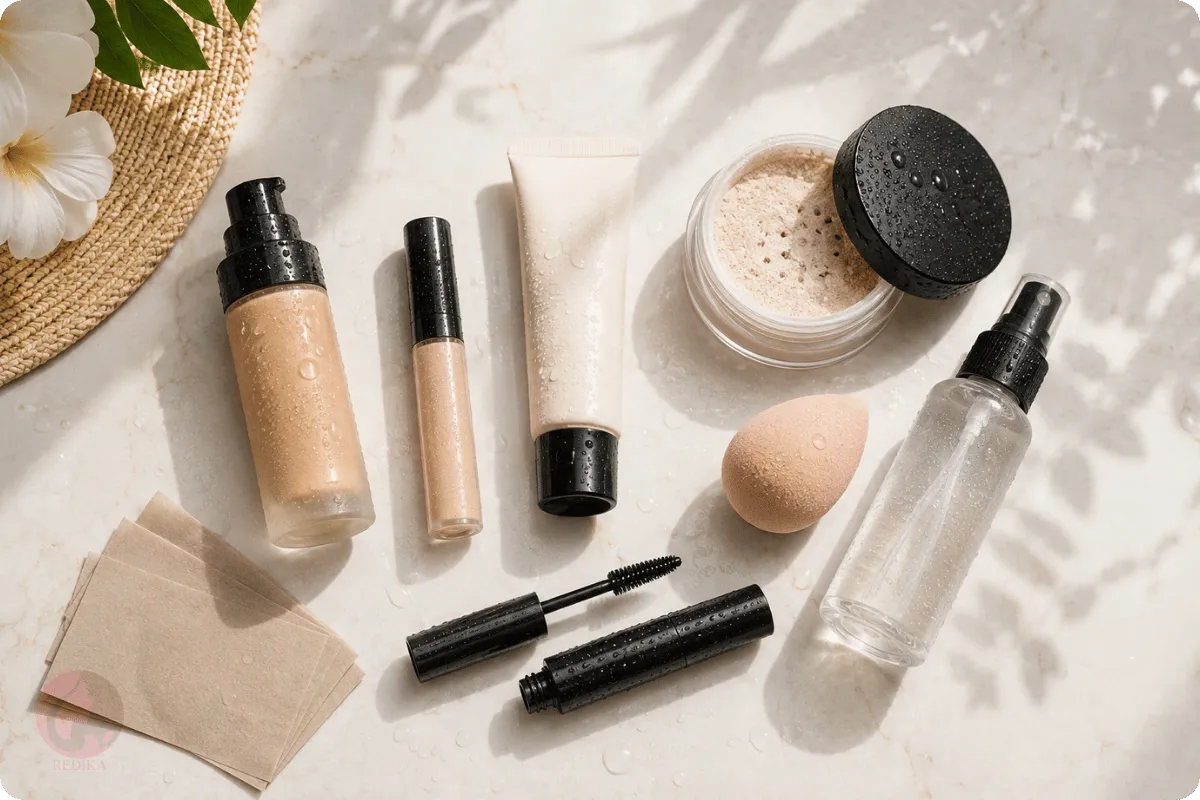
Terms such as “matte,” “water-resistant,” “long-wearing,” and “transfer-resistant” do not mean exactly the same thing. A foundation may have a matte finish but only moderate resistance to sweat. Another may resist water well but look heavy or cracked on dry skin.
Long-wearing formulas often contain film-forming ingredients that create a thin layer over makeup after drying. A 2026 study of a water-based polyurethane film former showed that the type of polymer used in a setting spray can affect makeup adhesion and resistance to water, sweat, and friction. This does not mean that every setting spray performs the same way; the final result depends on the complete formula of the product.
[6]
Which Primer Is Better: Mattifying, Hydrating, or Zone-Specific?
Primer should solve a specific problem. If your nose and forehead become oily quickly, use a small amount of mattifying primer only in those areas. If your cheeks are dry, applying the same primer all over the face may make dryness and texture more noticeable.
- Oily skin: Use an oil-controlling primer only through the center of the face.
- Dry skin: Use a smoothing or hydrating primer, or skip primer when skin preparation is already sufficient.
- Combination skin: Use different primer approaches on oily and dry areas.
- Visible pores: Use a small amount of smoothing primer and press it into the skin rather than rubbing.
A thick layer of primer may pill underneath foundation. Press the product onto the target area with your fingers and give it a little time for excessive tackiness to subside. Before an important event, test the combination of moisturizer, sunscreen, primer, and foundation on part of your face to make sure the products work well together.
Choosing a Lightweight, Long-Lasting Foundation and Concealer
A lightweight foundation does not necessarily provide poor coverage. A buildable formula can create medium coverage with a small amount of product, with extra coverage added only to areas with redness or blemishes. This prevents the entire face from being covered in a thick, vulnerable layer.
For oily skin, look for long-wearing formulas that do not feel excessively greasy and that offer some resistance to transfer. Dry skin generally works better with a natural or satin finish than with ultra-matte formulas. Combination skin needs a foundation that can last through the center of the face without cracking on the cheeks.
Use concealer only where it is needed. Under the eyes, a very thin layer usually looks more natural than multiple layers of concealer and powder. For blemishes, place a small amount of concealer directly on the spot with a small brush, allow it to sit briefly, and blend only the edges.
Setting Powder or Setting Spray: Which Is Better in Hot Weather?
Setting powder and setting spray serve different purposes. Powder helps absorb oil and reduce the movement of cream products, while a suitable setting spray can help bind makeup layers together and reduce transfer. For many people, using a controlled amount of both works better than applying a heavy layer of either one.
| Product | Main Function | Best For | Common Mistake |
|---|---|---|---|
| Setting powder | Absorbing oil and setting cream products | Forehead, nose, chin, and upper-lip area | Using too much on dry skin |
| Setting spray | Binding layers and improving makeup resistance | Final makeup step and selected intermediate layers | Making the face excessively wet |
| Pressed powder | Adding coverage and reducing shine | Limited touch-ups after absorbing oil | Applying it directly over sweat |
| Blotting paper | Removing oil without adding coverage | Daily touch-ups and oily skin | Rubbing the paper across the skin |
Shopping Checklist for Sweat-Proof Makeup Products
When shopping, do not rely only on marketing claims printed on the packaging. A product should suit your skin type, work with your usual sunscreen, provide the coverage you need, and perform well for the amount of time you expect to spend in the heat. Whenever possible, test a sample and observe how the product performs for several hours under real-life conditions.
| Product | Useful Feature for Hot Weather | What to Check Before Buying |
|---|---|---|
| Moisturizer | Lightweight, quick-absorbing, and suitable for your skin | Does it pill underneath sunscreen? |
| Sunscreen | Broad-spectrum, water-resistant, SPF 30 or higher | 40- or 80-minute water-resistance claim and reapplication instructions |
| Primer | Matched to oiliness, dryness, or visible pores | Compatibility with sunscreen and foundation |
| Foundation | Long-wearing, buildable, and transfer-resistant | Color changes or separation after several hours |
| Concealer | Good coverage with a small amount | Whether it settles into lines and how flexible it feels on the skin |
| Setting powder | Fine texture and easy targeted application | Dryness, flashback, and appearance in photographs |
| Setting spray | Fine mist and long-wearing formula | Stickiness, irritation, or a tight feeling on the skin |
For acne-prone skin, a non-comedogenic claim can be a useful clue, but it does not guarantee that a product will never trigger breakouts in any individual. To better understand the term and its limitations, read What Do Comedogenic and Non-Comedogenic Mean? (in Persian)
Step-by-Step Sweat-Proof Makeup Tutorial
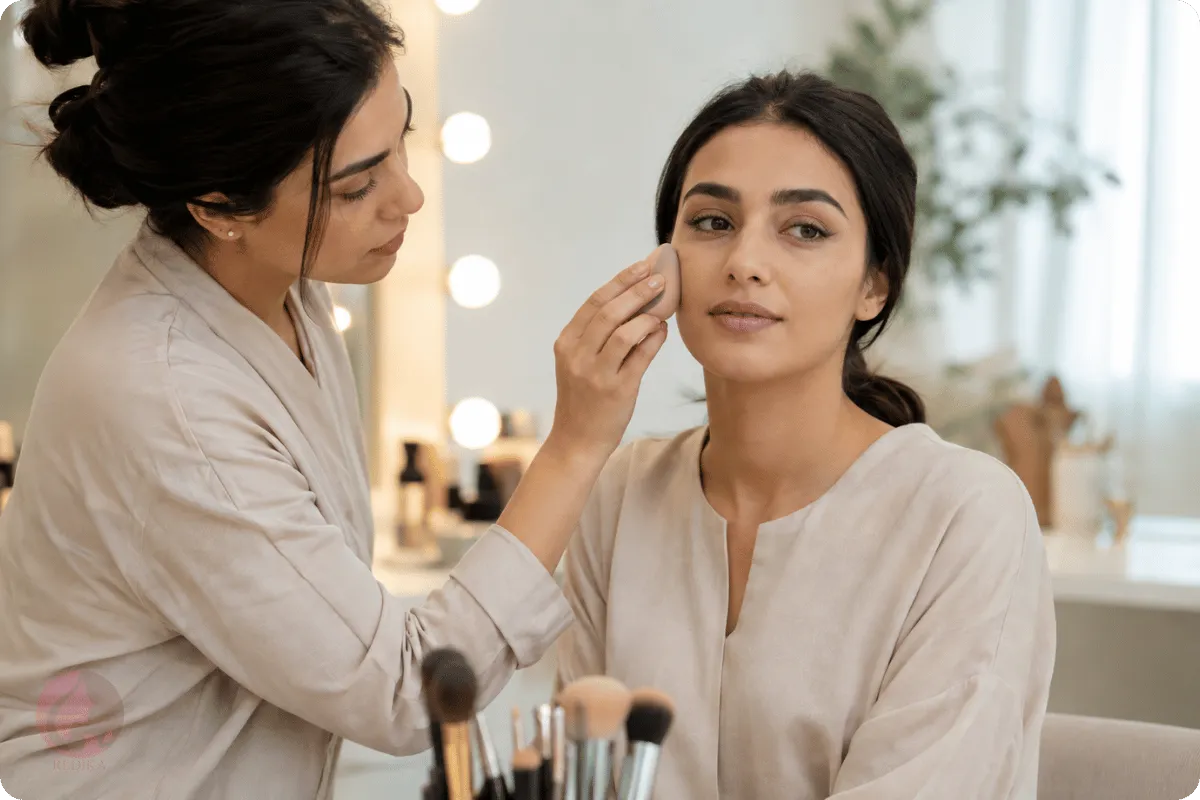
It is best to start your makeup in a cool environment. If you begin immediately after a hot shower, exercise, blow-drying your hair, or spending time in direct sun, your skin may still be warm and perspiring. Give your face a few minutes to cool down before following the steps below.
- Gentle cleansing: Wash your face with a compatible cleanser and pat it dry with a clean towel. Do not rub the towel across your skin.
- Lightweight moisturizer: Apply a small amount and add a little more only to areas that feel dry.
- Sunscreen: Apply an adequate and even layer. Do not move to the next step while the surface of the face still feels excessively slippery.
- Zone-specific primer: Apply mattifying primer to the forehead, sides of the nose, and chin. Do not cover dry cheeks with the same product unnecessarily.
- Thin foundation: Work from the center of the face outward with a sponge or brush using pressing motions. Begin with minimal coverage.
- Spot concealing: Add concealer only to blemishes and areas of redness instead of covering the entire face again.
- Color products: Apply cream blush and bronzer sparingly. For better longevity, you can add a very thin layer of a matching powder product on top.
- Targeted powder: Press a small amount of powder onto the forehead, nose, chin, and upper-lip area. Avoid over-powdering the under-eye area and dry cheeks.
- Final setting: Mist setting spray evenly from an appropriate distance. Do not touch or fan your face until it is completely dry.
The final result should still look like real skin rather than a thick, fixed mask of makeup. For a lighter and more natural style, you can also read our guide to minimal and natural makeup (in Persian).
Eye and Lip Makeup in Hot Weather
Oily eyelids and sweat around the eyes can cause eyeshadow to crease and eyeliner to smudge. Begin with a very small amount of eye primer or lightweight concealer and set it with minimal powder. Pressed powder shadows and long-wearing formulas are generally easier to manage in hot weather than very wet or creamy layers.
- For oily eyelids, choose a long-wearing liquid or gel eyeliner.
- Waterproof or tubing mascara may help reduce smudging and flaking.
- Use eyeliner on the waterline only when the product is specifically intended for that area.
- Stop using an eye makeup product if it causes burning, redness, or irritation.
The U.S. Food and Drug Administration recommends using cosmetic products only in the areas for which they are intended and discarding eye makeup that has become contaminated or has been associated with an eye infection. Adding water or saliva to mascara may also increase microbial contamination.
[7]
For the lips, apply a tint or transfer-resistant lipstick in several thin layers. If your lips are dry, blot away excess lip balm before applying lipstick so the surface is not overly slippery. For event makeup inspiration, see our guide to matching perfume and makeup for daytime, the office, and parties (in Persian).
Problem Areas: Nose, Upper Lip, Brows, and Hairline
Sweating and makeup separation do not affect every part of the face in the same way. The nose is more affected by sebum and frequent touching, the upper lip is directly exposed to perspiration, and the hairline can become damp in hot weather. Instead of applying the same amount of powder everywhere, manage each problem area separately.
| Area | Common Problem | Application Method | Touch-Up Method |
|---|---|---|---|
| Nose | Oiliness, visible pores, and makeup rubbing away | Minimal primer, thin foundation, and pressed-on powder | Absorb oil, smooth the edges, and spot-conceal |
| Upper lip | Sweat creating tracks through foundation | Very little product and limited powder | Press with a clean tissue and apply an extremely thin touch-up |
| Around the brows | Brow pencil or gel smudging | Remove excess oil and use a long-wearing brow product | Dry the area and correct with a sharp brow pencil |
| Hairline | Sweat and patchy bronzer | Use fewer cream products close to the hairline | Absorb moisture and blend with a clean brush |
| Under the eyes | Concealer collecting in fine lines | Minimal concealer and very little powder | Smooth with a clean fingertip without adding a heavy layer |
How to Touch Up Makeup During the Day and Build a Makeup Rescue Kit
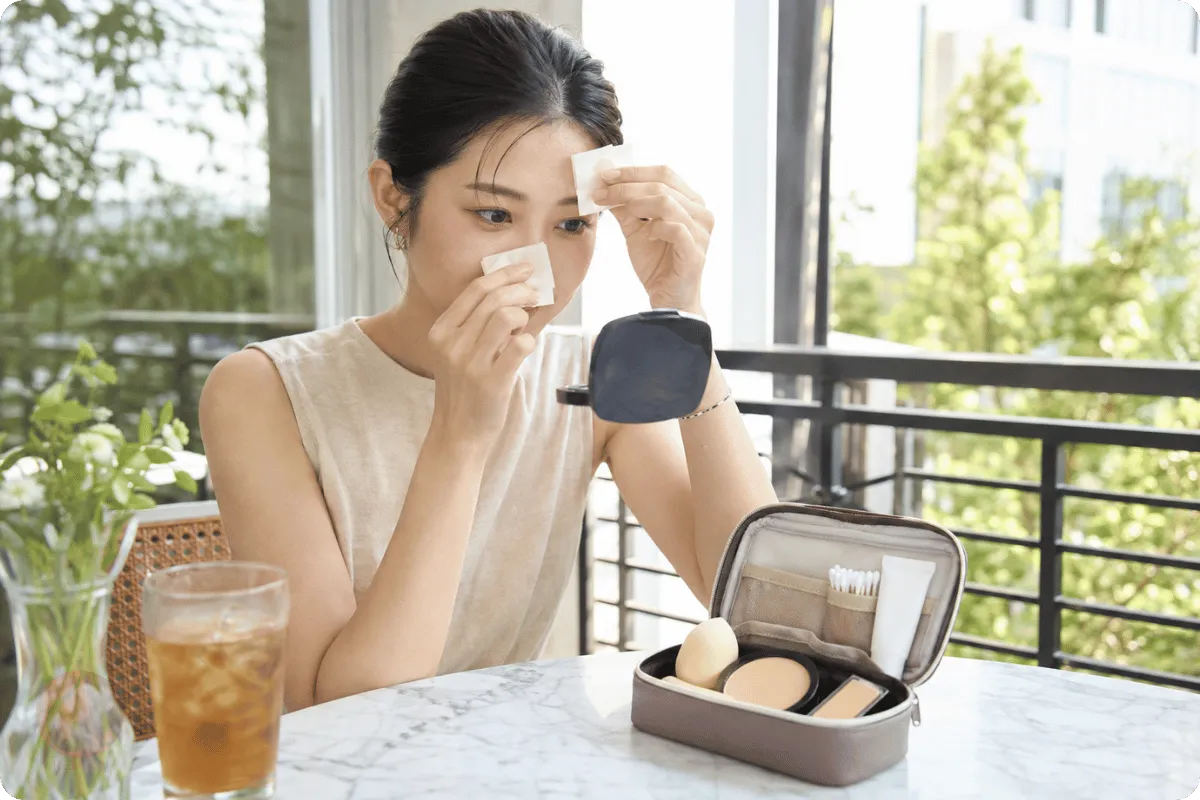
The biggest touch-up mistake is applying pressed powder or loose powder directly over sweat. Moisture, oil, and powder can combine into a thick, paste-like layer. Sweat and sebum should be absorbed first without dragging or rubbing the skin.
- Press blotting paper or a clean tissue onto the area and lift it away.
- Wait briefly for the surface of the skin to dry.
- Use a clean sponge to gently blend the edges of the separated area.
- Apply a very small amount of concealer or foundation only to the bare spot.
- Finish by setting only that area with a small amount of powder.
On hot days, carrying a small touch-up kit is more useful than taking your entire makeup collection with you. The following items cover most common problems:
- Blotting paper or a soft, clean tissue
- A small washable makeup sponge
- A small amount of concealer or foundation
- Lightweight pressed powder with a mirror
- Cotton swabs for correcting mascara and eyeliner
- Your lipstick or lip tint
- A suitable sunscreen for reapplication during the day
Three Ready-to-Use Makeup Routines for Everyday Wear, Work, and Parties
Not every situation requires the same level of coverage or longevity. Makeup for a short daytime outing is different from makeup intended to last through a long event. Choosing the right approach reduces unnecessary layers and lowers the risk of your makeup breaking down.
| Occasion | Skin Preparation | Coverage | Setting | Key Tip |
|---|---|---|---|---|
| Everyday | Lightweight moisturizer and sunscreen | Spot concealer or a lightweight tinted base | Powder only on the nose and forehead | Minimal layers and easy touch-ups |
| Work | Zone-specific primer and compatible sunscreen | Lightweight foundation with medium coverage | Targeted powder and setting spray | Carry a small touch-up kit |
| Party or event | Balanced, previously tested preparation | Thin base with extra spot coverage where needed | Controlled powder and long-wearing spray | Wear-test the complete makeup routine before the event |
If you want to coordinate your summer makeup with seasonal clothing, colors, and lifestyle trends, continue with our guide to Summer 1405 Trends: Fashion, Beauty, and Lifestyle (in Persian).
Sweat-Proof Makeup for Different Skin Types
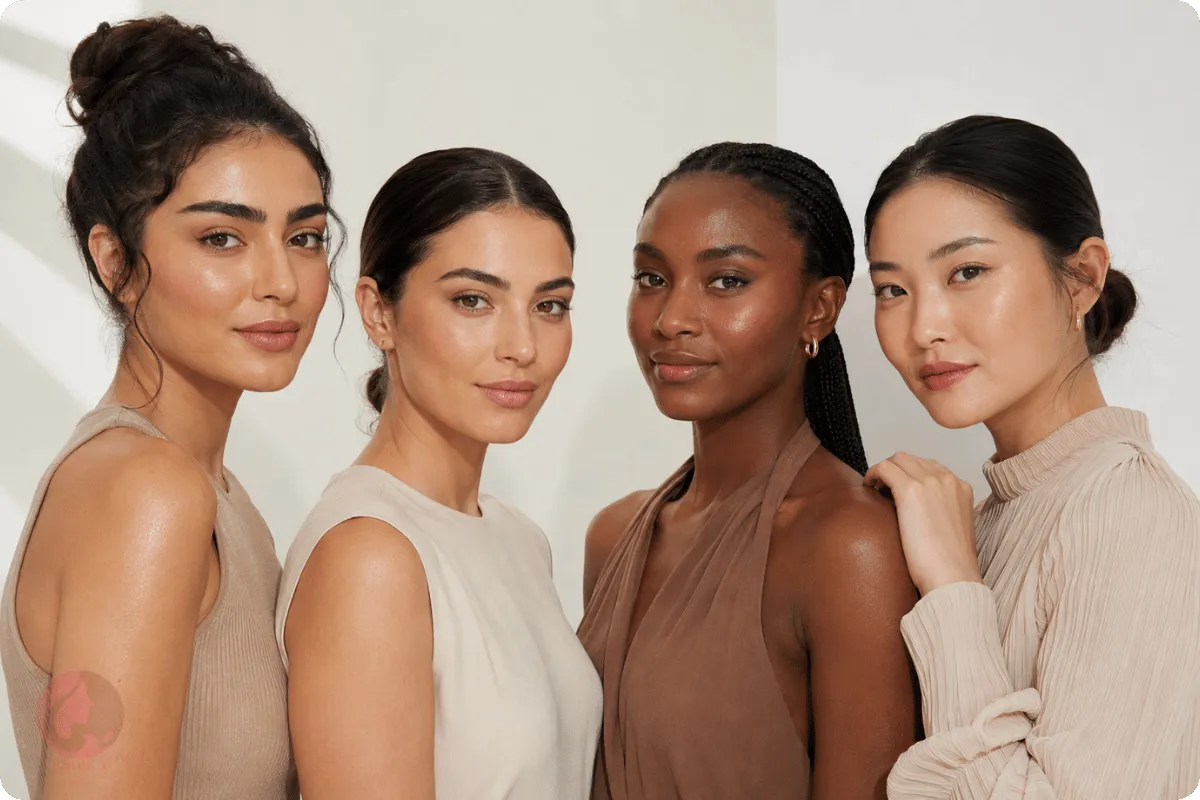
There is no single routine that works for every skin type. Oily skin usually needs more sebum control, dry skin needs flexibility and balanced hydration, and combination skin benefits from zone-specific management. Sensitive skin generally does better with fewer products that have already been tested on the individual.
| Skin Type | Preparation | Suitable Foundation | Setting Method | Mistake to Avoid |
|---|---|---|---|---|
| Oily | Lightweight moisturizer and targeted primer | Long-wearing with a natural matte finish | Powder through the center of the face plus setting spray | Over-drying the skin |
| Dry | Balanced hydration and softened flaky areas | Natural, satin, and flexible | Very limited powder | Using an ultra-matte formula |
| Combination | Different preparation for the center of the face and cheeks | Lightweight and buildable | More setting through the center of the face | Treating the entire face the same way |
| Sensitive | Fewer, previously tested products | Lightweight formulas with no history of irritation | Minimal powder and a compatible setting spray | Introducing several new products at once |
| Acne-prone | Gentle cleansing and clean tools | Lightweight and easy to remove | Limited powder and minimal touch-ups | Leaving sweat trapped under makeup for long periods |
Sensitive skin may react to fragrance, certain preservatives, or extremely long-wearing formulas. Test products before important events and discontinue use if you experience burning or redness. For basic skincare guidance, see our best skincare routine for sensitive skin (in Persian).
Common Hot-Weather Makeup Mistakes and When to See a Doctor
Many longevity problems are not solved by adding more product. Sometimes removing one heavy layer or changing the application method produces a bigger improvement than buying a new foundation. The following mistakes are among the most common reasons summer makeup breaks down:
- Starting makeup while the skin is hot and actively sweating
- Using facial oil, rich moisturizer, and heavy sunscreen together
- Applying foundation before sunscreen has settled
- Using mattifying primer on dry, flaky skin
- Applying too much foundation and concealer
- Applying powder directly over sweat
- Rubbing the face with a tissue or towel
- Frequently touching the nose, forehead, and chin
- Using dirty brushes, sponges, or powder puffs
- Sleeping in makeup after a hot day
It is generally better to remove makeup before exercising because the combination of sweat, oil, impurities, and friction may irritate acne-prone skin. When removing sweat, press a clean towel or tissue against the skin rather than rubbing aggressively.
[8]
When Does Facial Sweating Need Medical Evaluation?
If facial sweating is excessive, occurs without heat or physical activity, begins suddenly, or interferes with daily life, it may be more than a cosmetic issue. Hyperhidrosis, or excessive sweating, can affect the face and scalp and can be medically evaluated and treated.
Do not apply body antiperspirants, deodorants, or inappropriate products to the face or around the eyes without medical guidance. A dermatologist can investigate the cause of excessive sweating and recommend treatment based on its location and severity.
[9]
Conclusion
Sweat-proof makeup does not mean completely preventing the skin from sweating. The goal is to use lightweight preparation, compatible products, thin layers, and targeted setting so that makeup can better withstand heat, humidity, and skin oils. The best results usually come from using less product and managing each area of the face correctly rather than adding more coverage everywhere.
If your makeup repeatedly breaks down on the nose or above the lip, first review your sunscreen, the amount of primer you use, how long each layer is allowed to dry, and your touch-up technique. Your foundation may be perfectly suitable but may perform poorly over an overly wet base or under too much powder. Change one step at a time so you can identify the real cause.
When touching up your makeup, remember the correct order: absorb sweat and oil first, blend the edges of the affected makeup, and then replace coverage only where it has disappeared. This keeps the finish looking more natural and helps prevent a thick, cakey, or patchy appearance.
Frequently Asked Questions About Sweat-Proof Makeup
Does sweat-proof makeup actually stop your face from sweating?
No. Sweat-resistant makeup products are not designed to stop the normal activity of sweat glands. These products and techniques simply help foundation, concealer, and other makeup layers resist separating or fading when exposed to sweat and oil. If facial sweating is unusually severe, the underlying cause should be evaluated by a doctor.
What is the difference between waterproof makeup and sweat-resistant makeup?
Waterproof makeup is designed to resist direct contact with water, while sweat-resistant makeup needs to cope with a combination of moisture, sweat salts, sebum, heat, and friction. Both properties may exist in the same product, but they are not identical. The 40- or 80-minute water-resistance claims used for sunscreen should also not be automatically applied to other cosmetic products.
Why does foundation cake or separate on the nose?
The nose usually produces more oil and is more frequently touched by the hands, glasses, or tissues. Applying too much moisturizer, sunscreen, primer, and foundation may also overload this area. Use less product, press foundation onto the skin instead of rubbing it, and apply a limited amount of powder after absorbing excess oil.
How can you fix melted makeup without removing everything?
First absorb sweat and excess oil using blotting paper or a clean tissue without rubbing the skin. Then gently smooth the edges of the separated area with a clean sponge. Apply a very small amount of concealer or foundation to the bare spot and finish by setting only that area with powder. Do not apply pressed powder directly over wet skin.
Can you use setting powder on dry skin in summer?
Yes, but it should be applied sparingly and only where needed. Dry skin can still sweat around the nose, forehead, or upper lip, but covering the entire face with too much powder may emphasize flakes and fine lines. Hydrate the skin in a balanced way first, then apply powder only to areas that genuinely need extra setting.
About the author

Join the conversation
Share your experience or question with REDIKA readers.
Your email stays private. Please avoid sharing personal or sensitive details.


