Home / Editorial guide

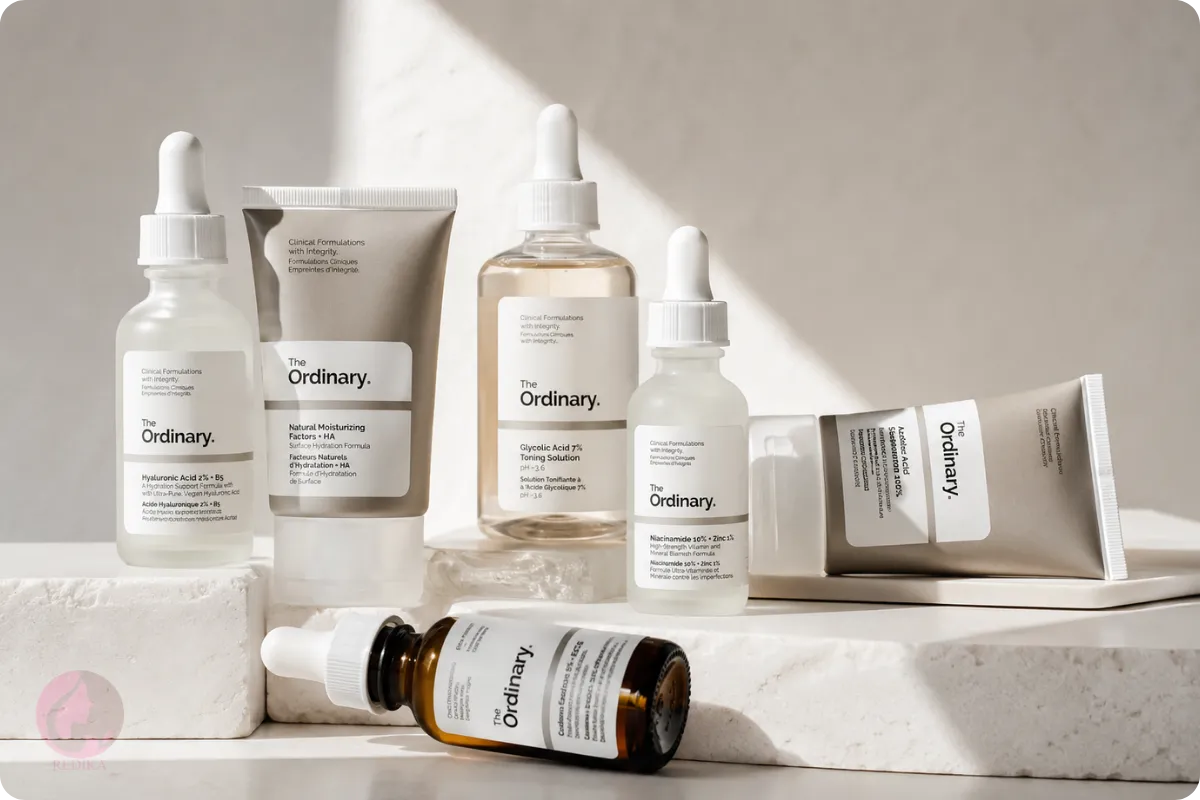
Someone with clogged pores and blackheads has very different needs from someone dealing only with dehydrated skin or post-acne dark spots. Even a product that works beautifully for one person may be too strong for sensitive skin or a compromised skin barrier. That is why, instead of simply listing popular products, this guide evaluates The Ordinary based on skin concern, experience level, irritation potential, real-world use, and overall value.
This article is designed to help you make more informed skincare choices and is not a substitute for medical diagnosis or treatment. If you have severe acne, persistent melasma, rosacea, eczema, ongoing sensitivity, or another skin condition, it is best to discuss active ingredients with a dermatologist.
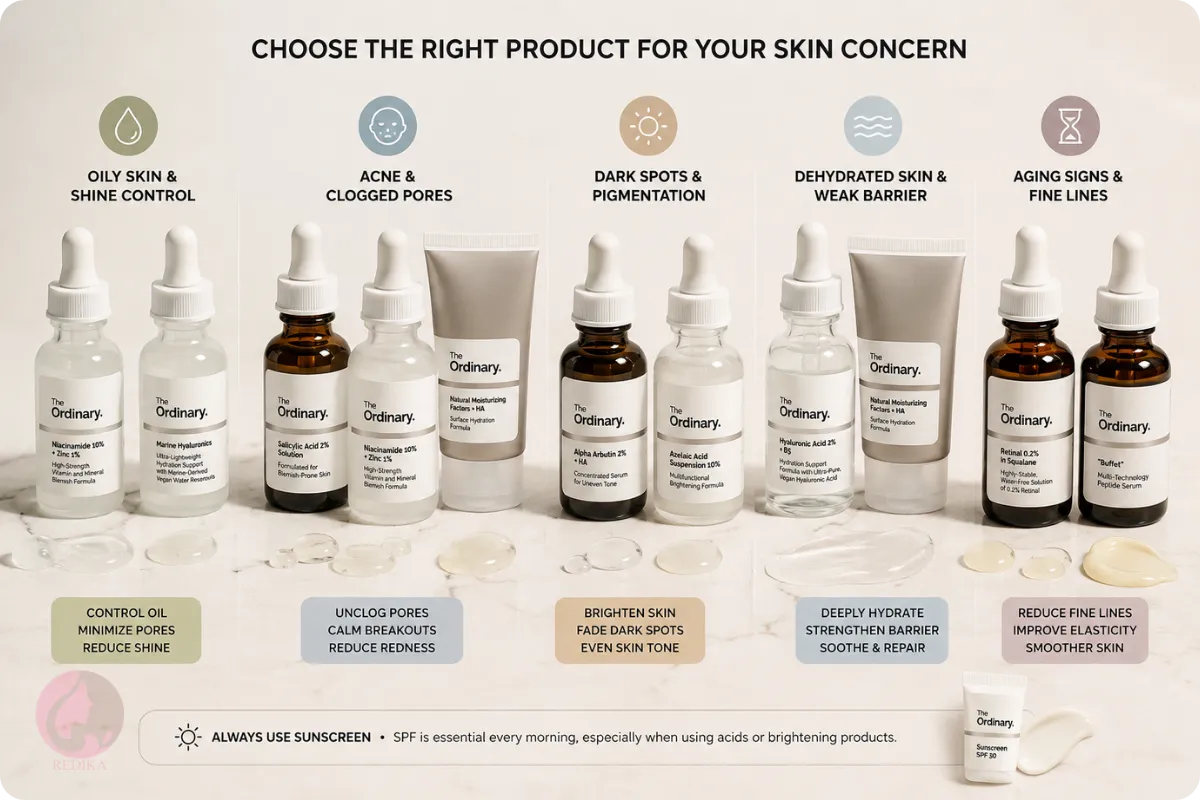
Quick Answer: Which The Ordinary Product Is Best for My Skin Concern?
If you just want a quick starting point in under a minute:
- Oily skin and visible pores: Niacinamide 10% + Zinc 1%.
- Blackheads and clogged pores: Salicylic Acid 2% Solution.
- Dark spots and post-acne marks: Alpha Arbutin 2% + HA or Azelaic Acid Suspension 10%.
- Dehydrated skin: Hyaluronic Acid 2% + B5 with Ceramides.
- Dryness and a weakened skin barrier: Natural Moisturizing Factors + PhytoCeramides.
- Irritated skin barrier: Soothing & Barrier Support Serum.
- Early fine lines: Multi-Peptide + HA Serum.
- More advanced signs of aging: Retinal 0.2% Emulsion, primarily for more experienced users.
- Under-eye puffiness: Caffeine Solution 5% + EGCG.
If you are a beginner, starting several powerful active ingredients at the same time is not a good idea. Begin by identifying one main skin concern and add only one targeted treatment alongside a gentle cleanser, moisturizer, and sunscreen. This approach reduces the risk of irritation and makes it much easier to understand which product is actually making a difference.
What Is The Ordinary, and How Were the Products in This Guide Evaluated?
The Ordinary was launched in 2016 by Brandon Truaxe under DECIEM. The brand’s core idea was to make well-known skincare ingredients available through relatively transparent naming, targeted formulations, and more accessible pricing. In May 2024, Estée Lauder completed its acquisition of the remaining shares of DECIEM, making DECIEM and brands such as The Ordinary fully owned by the group.
Do not let the minimalist packaging create the impression that these are automatically gentle products. A formula with a straightforward name such as “Salicylic Acid 2%” is still an active treatment and may cause dryness or irritation when used on unsuitable skin. For this reason, the products in this article were not selected merely because they are popular or viral.
Redika’s editorial evaluation criteria for this guide include:
- How well the active ingredient matches the targeted skin concern;
- The concentration and strength of the formula and its potential for irritation;
- Whether the product is suitable for beginners;
- How easily it can fit into a realistic skincare routine;
- Potential conflicts with other active ingredients;
- Whether the product is versatile or highly specialized;
- Usage instructions and restrictions provided by the brand;
- Cross-checking claims related to acne, exfoliation, and pregnancy against reputable dermatology sources.
The ratings and recommendations in this article are not based on independent clinical testing by Redika or on personal-use claims. They represent an editorial assessment based on formulation, available evidence, the role of each active ingredient, and official usage guidance. This distinction matters because a reliable review should never present an experience that did not actually take place as hands-on testing.
An Honest Review of The Ordinary: Pros, Cons, and Is It Really Worth Buying?
One of The Ordinary’s biggest strengths is that it helps consumers understand active ingredients. Instead of selling a product under a vague promise such as a “miracle youth serum,” the brand usually makes the key ingredient and its concentration clear. This approach can make product selection easier for informed consumers and allows formulas to be compared more directly.
However, the same characteristic can also become one of the brand’s main weaknesses. Seeing concentrations of 10%, 20%, or 30% may create the impression that a higher percentage automatically means better results. In skincare, however, skin tolerance and routine compatibility can matter more than choosing the highest concentration. The Ordinary’s 30% peeling solution is an obvious example: it is powerful, but the brand itself positions it for experienced users of exfoliating acids.
| Strength | Weakness |
|---|---|
| Clear focus on active ingredients | The large number of actives can confuse beginners |
| Targeted formulas for different skin concerns | Some concentrations may be too strong for sensitive skin |
| Relatively clear guidance on product conflicts | Building a multi-product routine can become complicated without enough knowledge |
| Options ranging from beginner-friendly to more advanced treatments | Social-media popularity can encourage people to buy unsuitable products |
| Products can be selected according to a specific skin concern | The brand’s most famous product is not always the best option in its category |
Redika’s verdict: The Ordinary is a highly practical brand for people who understand their main skin concern and want to introduce one or two targeted active ingredients into their routine. For someone who is completely new to skincare and plans to combine five serums at once, however, the brand can quickly become overly complicated. The real value of The Ordinary lies in choosing precisely—not in collecting as many bottles as possible.
Best The Ordinary Products by Skin Concern and Experience Level
| Skin Concern | Recommended Product | Experience Level | Main Use | Caution / Who Should Avoid It |
|---|---|---|---|---|
| Oiliness and visible pores | Niacinamide 10% + Zinc 1% | Beginner | Helps manage the appearance of excess oil, texture, and pores | A 10% concentration may feel irritating on sensitive skin |
| Blackheads and clogged pores | Salicylic Acid 2% Solution | Beginner to intermediate | Exfoliates inside pores and helps with comedonal congestion | Not ideal for a compromised skin barrier or very dry skin |
| Dark spots and post-acne marks | Alpha Arbutin 2% + HA | Beginner | Helps improve the appearance of dark spots and uneven tone | Results are limited without daily sun protection |
| Dark spots with acne and uneven texture | Azelaic Acid Suspension 10% | Beginner to intermediate | Helps address discoloration, texture, and acne-prone skin | May initially cause mild stinging or dryness |
| Dehydration | Hyaluronic Acid 2% + B5 with Ceramides | Beginner | Hydration and support for the skin’s moisture barrier | May not be sufficient on its own for severely dry skin |
| Noticeable dryness | Natural Moisturizing Factors + PhytoCeramides | Beginner | Richer moisturization | May feel heavy on very oily skin |
| Irritated skin barrier | Soothing & Barrier Support Serum | Beginner | Helps reduce the appearance of redness and support the skin barrier | Limit acids while the skin is actively irritated |
| Early fine lines | Multi-Peptide + HA Serum | Beginner to intermediate | Fine lines, texture, and support for a firmer-looking complexion | Check the product’s official compatibility guidance |
| More advanced signs of aging | Retinal 0.2% Emulsion | Advanced | Fine lines, texture, discoloration, and the appearance of firmness | Not suitable for beginners, pregnancy, or routines overloaded with acids |
| Under-eye puffiness | Caffeine Solution 5% + EGCG | Beginner | Helps improve the appearance of puffiness and some types of dark circles | Cannot correct structural hollows or genetically determined dark circles |
This table is a starting point, not a treatment prescription. If your skin has several concerns at the same time, identify the most important one first. For example, if your skin is both oily and dehydrated, removing hydration and continuously adding acids simply because of the oiliness may make the skin barrier worse.
Best The Ordinary Products for Acne, Pores, and Oily Skin
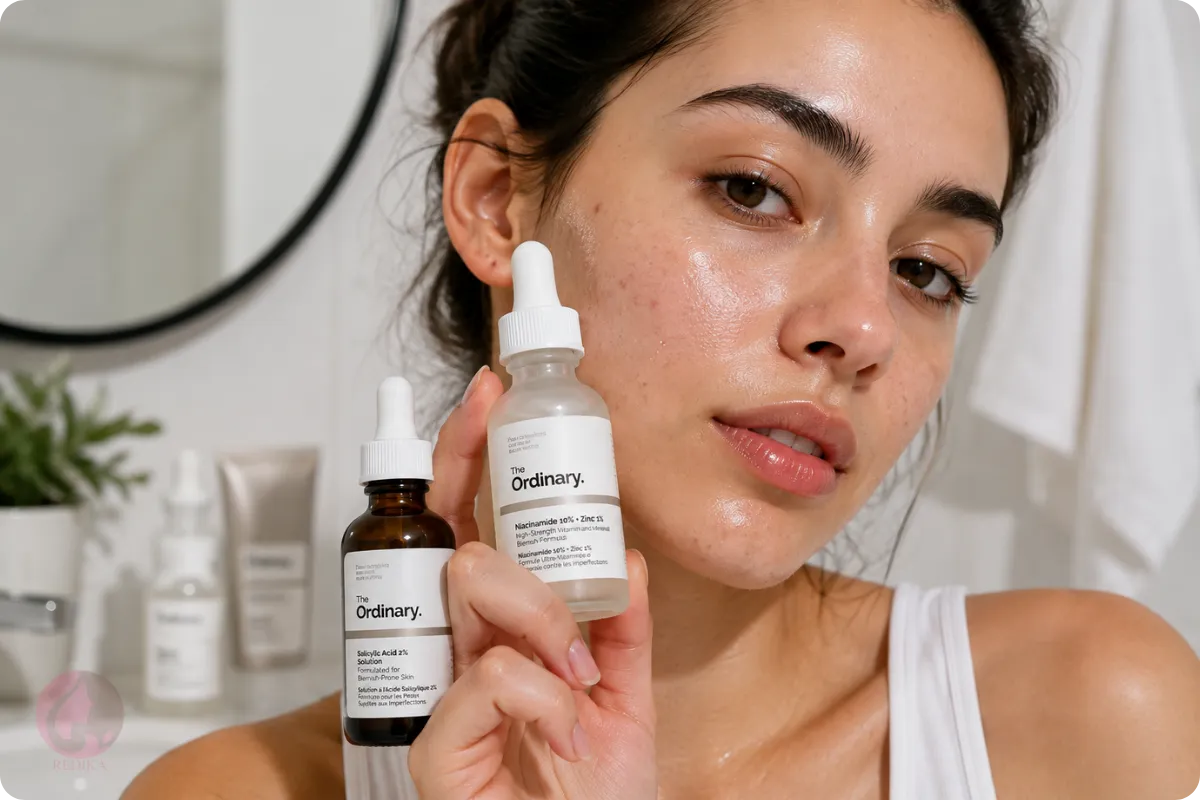
For oily skin, it is important to distinguish between excess oil and genuinely clogged pores. Niacinamide is more relevant to the appearance of oiliness, texture, and pores, while salicylic acid is a more targeted choice for blackheads, whiteheads, and pore congestion. The American Academy of Dermatology also recognizes salicylic acid as an ingredient that can help unclog pores and exfoliate the skin.
A common mistake is to introduce niacinamide, salicylic acid, glycolic acid, azelaic acid, and a strong peeling solution all at once in an attempt to treat acne. If irritation develops, it becomes difficult to identify which product caused it. For many people, one main active ingredient supported by a simple skincare routine is a more practical approach.
Niacinamide 10% + Zinc 1%: Best for Oiliness and the Appearance of Pores
The Ordinary Niacinamide serum is one of the brand’s best-known products. Its formula makes the most sense for people concerned about facial shine, visible oiliness, uneven texture, or the appearance of enlarged pores. Niacinamide is also a multifunctional ingredient that can play a role in supporting the skin barrier.
However, a 10% concentration is not necessary for everyone. Some sensitive skin types may experience redness, stinging, or discomfort at higher concentrations. If your skin does not tolerate the product, increasing the frequency of use is not the solution; reduce usage or choose a gentler alternative.
To learn more about this active ingredient, read our guide to niacinamide benefits and how to use it (in Persian). For a more focused look at this specific formula, see our The Ordinary Niacinamide Serum review.
Salicylic Acid 2% Solution: Best for Blackheads and Clogged Pores
Salicylic acid is an oil-soluble beta hydroxy acid, which makes it particularly relevant to skin where pores become clogged with sebum and dead skin cells. If your main concern is blackheads, whiteheads, or persistent pore congestion, this product is usually a more targeted option than niacinamide alone.
Beginners should avoid starting with excessive use. Combining several exfoliating products or a strong retinoid in the same evening can increase dryness and irritation. When the skin begins to sting, peel, or feel extremely tight, adding even more acid is almost always the wrong move.
To understand the differences between exfoliating acids in more detail, read our AHA and BHA exfoliation guide (in Persian).
Best The Ordinary Products for Dark Spots, Post-Acne Marks, and Uneven Skin Tone
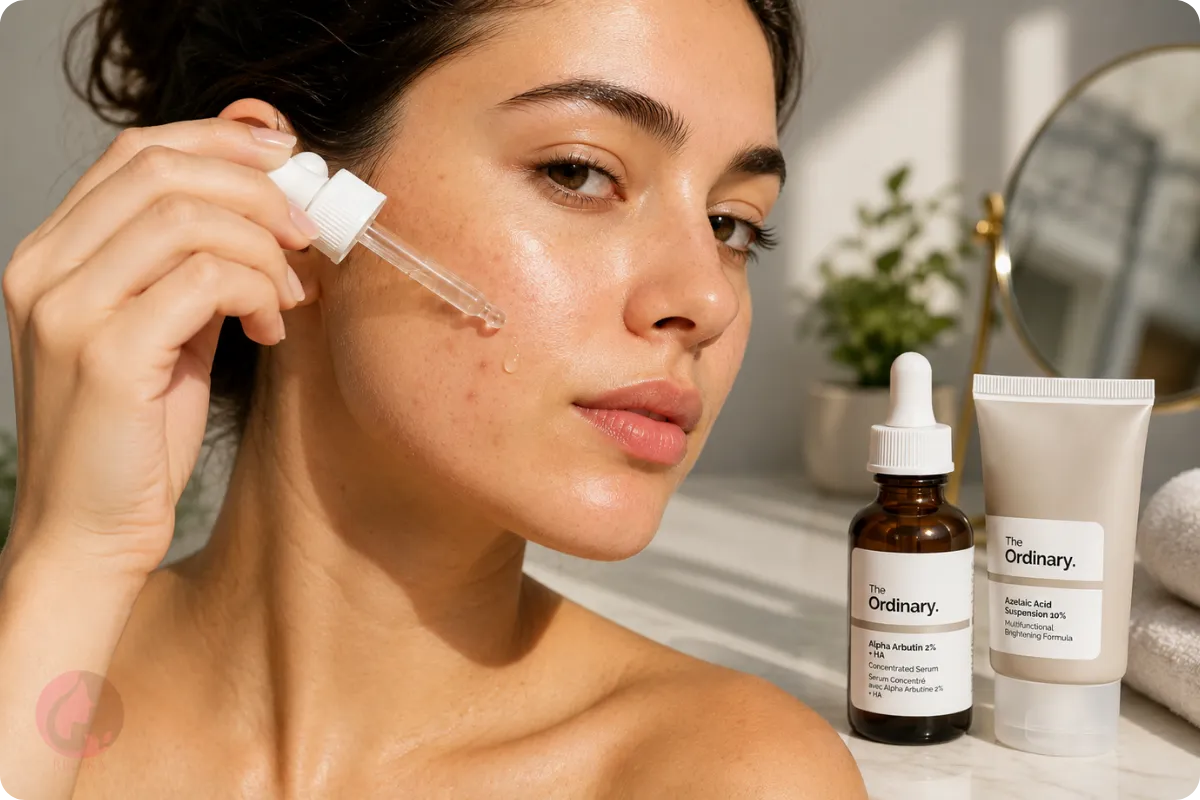
When managing dark spots, a brightening serum is only half of the strategy. If the skin is repeatedly exposed to sunlight without appropriate protection, discoloration can become more difficult to control. Sunscreen is therefore part of a dark-spot routine, not an optional extra.
The Ordinary now also offers UV Filters SPF 45 Serum. According to the brand’s current information, it provides broad-spectrum UVA and UVB protection, has a serum-like texture, and is designed for daily use. The fact that a sunscreen carries The Ordinary name does not automatically make it the best option for every type of pigmentation; sunscreen should still be selected according to your skin type, lifestyle, and level of sun exposure.
For discoloration itself, two of the brand’s popular options are Alpha Arbutin and Azelaic Acid. If your main concern is uneven tone and lingering dark spots, Alpha Arbutin is the more direct option. If pigmentation appears alongside acne, uneven texture, or visible redness, Azelaic Acid offers a more versatile approach.
Alpha Arbutin 2% + HA or Azelaic Acid Suspension 10%: Which Is Better?
| Criteria | Alpha Arbutin 2% + HA | Azelaic Acid Suspension 10% |
|---|---|---|
| Main target | Dark spots and uneven skin tone | Dark spots, texture, and acne-prone skin |
| Post-acne marks | Suitable | Suitable, especially if you are still acne-prone |
| Irritation potential | Generally lower | May initially cause stinging or dryness |
| Beginner-friendly | Yes | Yes, but it is better to start gradually |
| Redika’s pick | When discoloration is the primary concern | When dark spots appear alongside acne or uneven texture |
If your pigmentation is deep, widespread, persistent, or resembles melasma, simply switching between cosmetic serums may not be enough. In these situations, identifying the underlying cause with a dermatologist is more valuable than adding a fourth or fifth serum to your routine.
Best The Ordinary Products for Dry, Dehydrated Skin and a Compromised Skin Barrier
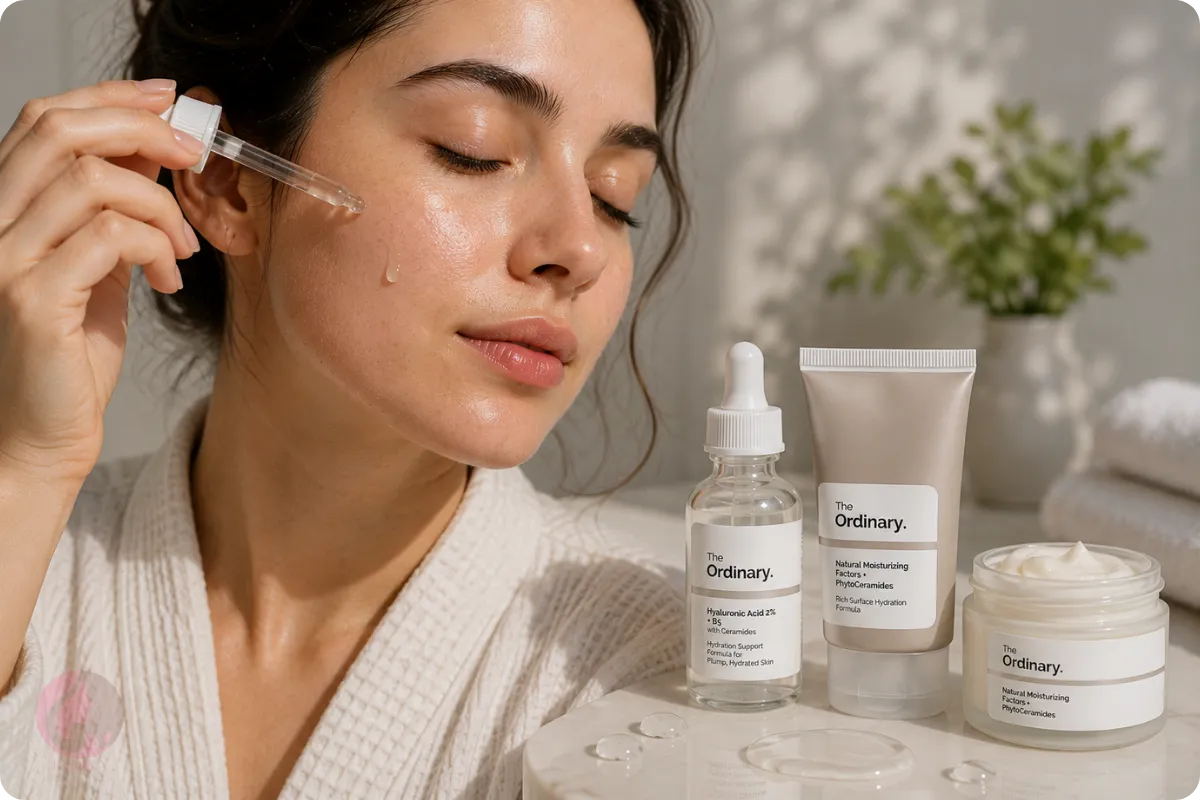
Dry skin and dehydrated skin are not exactly the same thing. Dehydrated skin lacks water and can even be oily, while dry skin generally produces less natural oil. This is why a hydrating serum can help with dehydration, but genuinely dry skin usually also needs a moisturizer that helps retain that moisture.
The newer Hyaluronic Acid 2% + B5 with Ceramides formula, according to the brand’s current official information, contains five forms of hyaluronic acid, vitamin B5, and ceramides. Compared with the older formula, it has a lighter texture and provides additional moisture-barrier support. For someone dealing with tightness, dehydration, or dehydration-related fine lines, it is a lower-risk starting point than acids or retinoids.
For more noticeable dryness, Natural Moisturizing Factors + PhytoCeramides has a richer texture and is better suited to dry skin. On the other hand, if your skin has become red, uncomfortable, or sensitive from overusing exfoliants, Soothing & Barrier Support Serum is a more sensible choice than introducing another active treatment.
Important: If your skin burns after active products, is visibly peeling, or even hurts when water touches it, your priority should be simplifying the routine and supporting the skin barrier—not finding a stronger acid.
Best The Ordinary Products for Fine Lines, Wrinkles, the Eye Area, and Loss of Volume
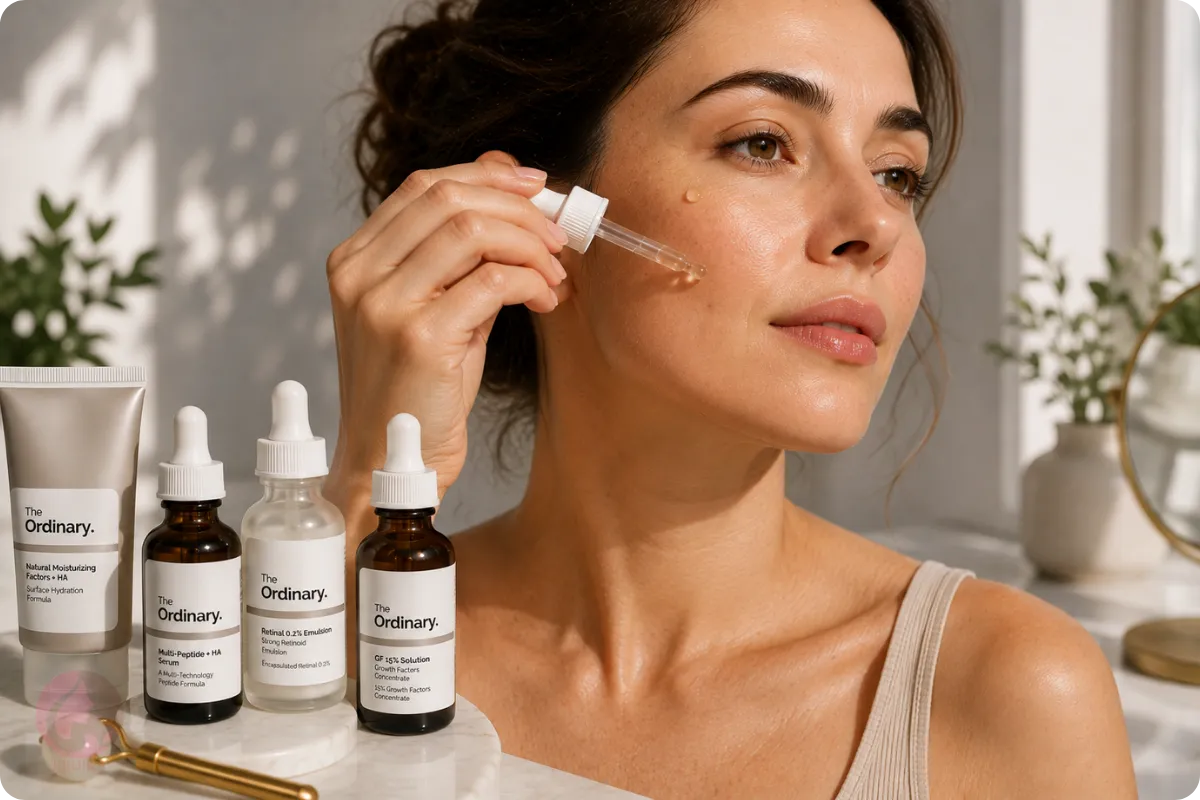
When choosing anti-aging products from The Ordinary, your level of experience matters. For early fine lines and users who are not yet ready for a strong retinoid, Multi-Peptide + HA Serum is a simpler option. It is primarily designed to target the appearance of fine lines, skin texture, elasticity, and firmness.
At a more advanced level, GF 15% Solution is one of the newer additions to the brand’s range. The Ordinary positions it for fine lines, loss of firmness, reduced elasticity, rough texture, and dullness, using a blend of growth-factor-mimicking peptides. These claims are largely based on data and testing reported by the brand itself, so it is better viewed as a promising anti-aging skincare product rather than an alternative to medical treatments.
Retinal 0.2% Emulsion is a considerably more advanced option. The Ordinary categorizes this formula as a high-strength retinoid and recommends it primarily for people who already have experience with retinoids. If you have never used retinol before, jumping directly to this product simply because it is stronger is not necessarily the better choice.
The newer Volufiline 92% + Pal-Isoleucine 1% is marketed for areas that appear hollow or have visible volume loss, such as the temples, eye contour, and cheeks. Expectations should remain realistic: a cosmetic product may help an area look plumper or smoother, but it should not be treated as equivalent to dermal filler, true restoration of facial fat, or structural correction of volume loss.
For under-eye puffiness, Caffeine Solution 5% + EGCG remains one of the brand’s simpler options. If dark circles are primarily caused by structural hollows, genetics, or shadows created by facial anatomy, a caffeine serum cannot change the underlying structure. For a more detailed look at this product, read our The Ordinary Caffeine Solution review.
The Ordinary Exfoliators, Routine Order, Product Conflicts, and How to Identify Authentic Products
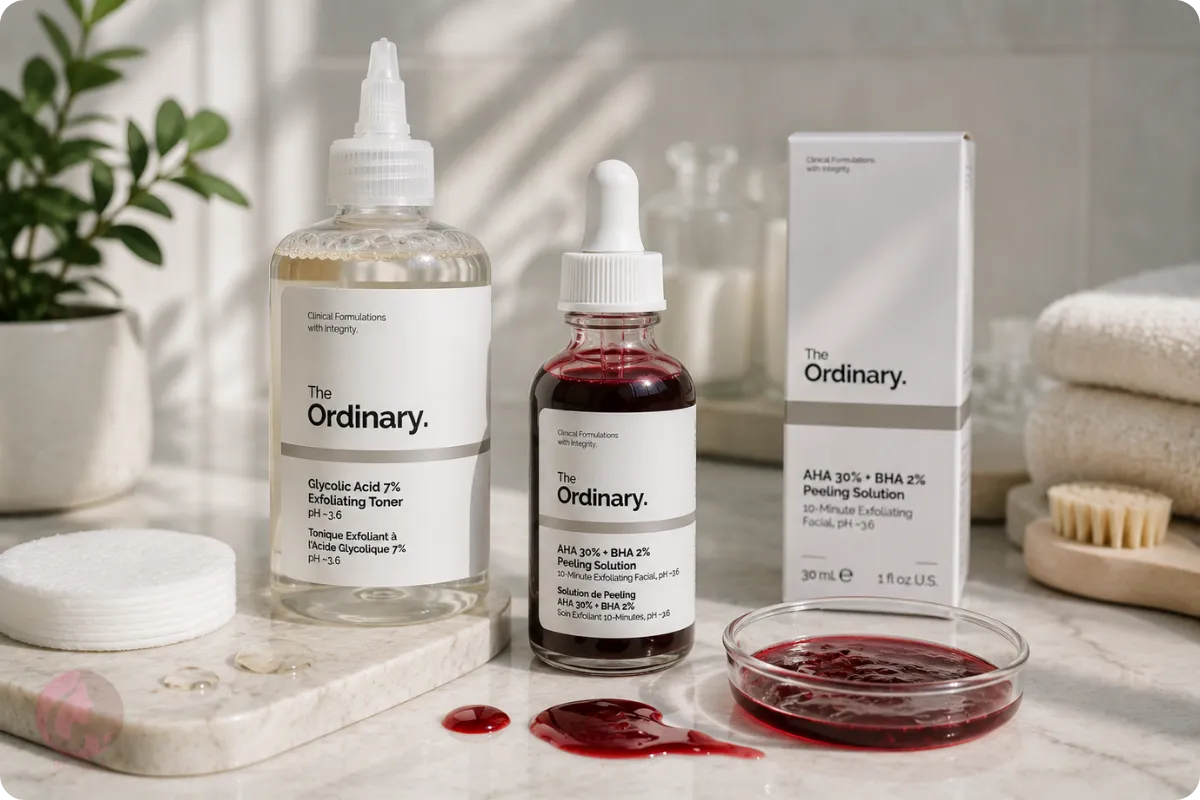
The Ordinary’s two famous exfoliating products should not be treated as equivalent. Glycolic Acid 7% Exfoliating Toner is designed for surface exfoliation and improving the appearance of texture and radiance. By comparison, AHA 30% + BHA 2% Peeling Solution is a significantly stronger exfoliating treatment.
The Ordinary itself recommends the red peeling solution for experienced users of exfoliating acids. It should be applied only to healthy, dry skin, should not remain on the skin for more than 10 minutes, and excessive use may increase the risk of irritation. If you are a beginner or have sensitive skin, its popularity alone is not a good reason to start with it.
For a complete breakdown, see our The Ordinary Peeling Solution review and our AHA and BHA exfoliation guide (in Persian).
A simple The Ordinary routine is usually better than an overloaded one. A basic structure can include a cleanser, one main treatment, a hydrating product or moisturizer, and sunscreen during the day. But product texture is not the only consideration; compatibility between active ingredients also matters.
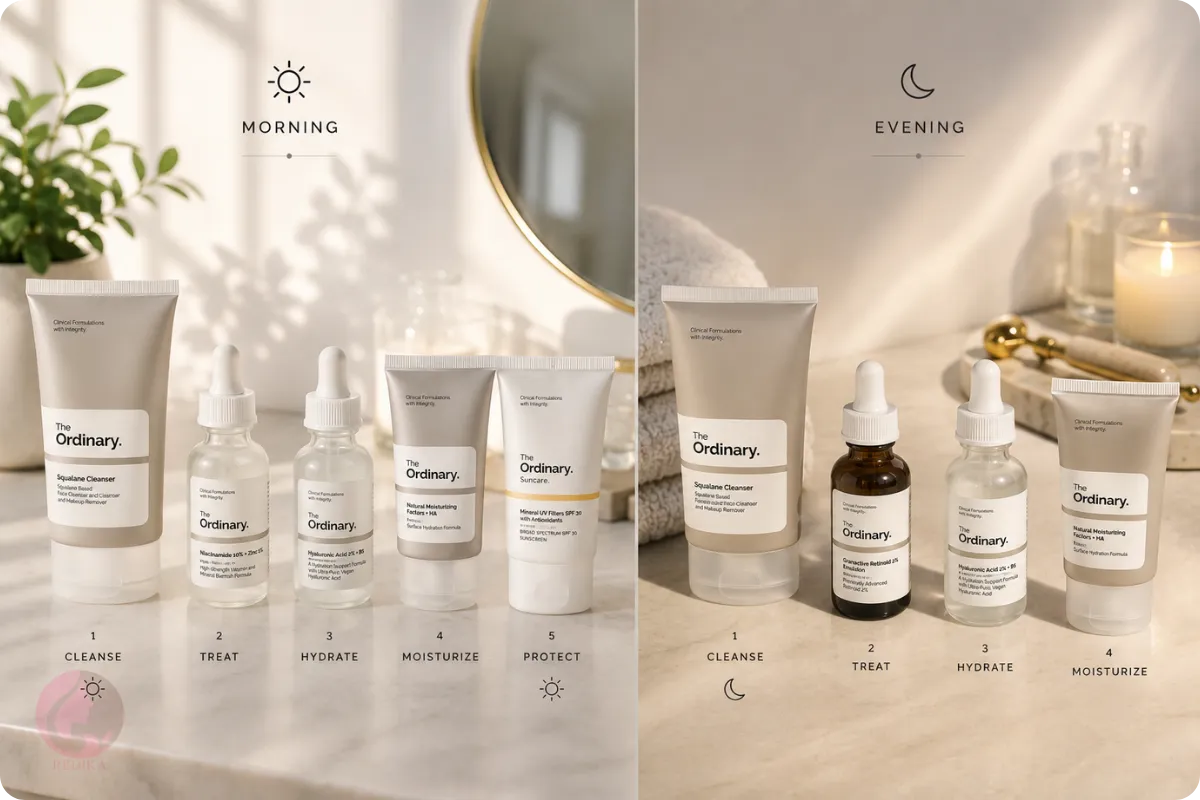
| Routine Type | Simple Example | Key Point |
|---|---|---|
| Oily skin — morning | Cleanser → Niacinamide → Moisturizer → Sunscreen | There is no need to layer several acids in the morning |
| Clogged pores — evening | Cleanser → Salicylic Acid on selected nights → Moisturizer | Do not use several strong exfoliants in the same evening |
| Dark spots — morning | Cleanser → Alpha Arbutin → Moisturizer → Sunscreen | Sun protection is a core part of managing pigmentation |
| Anti-aging — evening | Cleanser → Retinoid appropriate for your experience level → Moisturizer | Do not combine a strong retinoid with direct acids in the same routine |
| Dehydrated skin | Gentle cleanser → Hyaluronic Acid → Moisturizer | Focus on hydration rather than increasing the number of actives |
According to The Ordinary’s current guidance, some ingredients are better kept out of the same routine. For example, Retinal 0.2% has listed conflicts with direct acids, direct vitamin C, copper peptides, and other retinoids. It is better to check the compatibility guidance for each individual formula because there is no single rule that applies to every serum in the range.
Before introducing a new product, a patch test on a small area of skin can help identify an initial incompatibility. If you experience severe redness, burning, itching, or blistering, discontinue use.
When checking whether The Ordinary is authentic, do not rely on one visual sign alone. Small differences in fonts, liquid color, bubble formation, or dropper length are not reliable enough to confirm authenticity by themselves. Packaging and even some formulations may change over time or differ between markets.
The safest approach is to buy from the official store, an authorized retailer, or another traceable and trustworthy supply chain. An unusually low price, an unknown seller, or no way to verify the product’s source is a more meaningful warning sign than a minor packaging variation.
Conclusion: Which The Ordinary Products Are Actually Worth Buying?
If we had to summarize this The Ordinary review in one sentence, the brand works best when you know exactly which skin concern you want to target. Buying several serums simply because they are affordable or popular on social media is not necessary and may make your routine unnecessarily complicated while increasing the risk of irritation.
For oily skin, niacinamide is a simple starting option, while salicylic acid is more targeted for clogged pores. For dark spots, Alpha Arbutin or Azelaic Acid can be selected depending on whether acne is also present. For dehydration, the newer Hyaluronic Acid formula with ceramides is a straightforward choice, while drier skin may benefit more from the richer moisturizer with PhytoCeramides.
Anti-aging routines require more caution. Peptides are generally a simpler place to start, while Retinal 0.2% belongs in the stronger, more advanced category. The famous red peeling solution is also not something every beginner needs.
If you remember only three principles from this guide, make them these:
- Target one main skin concern at a time.
- Higher strength does not automatically mean a better choice.
- A gentle cleanser, moisturizer, and sun protection form the foundation of a routine; serums should be added on top of that foundation.
Frequently Asked Questions About The Ordinary and Its Products
Do The Ordinary products really work?
Yes, many The Ordinary products are built around active ingredients with well-established roles in skincare, but results depend heavily on choosing the right formula for your concern. Salicylic acid makes sense for clogged pores, while hyaluronic acid is used for dehydration. No single serum is the best option for every skin concern.
If I am buying only one The Ordinary product, which one should I start with?
Your first product should be selected according to your main skin concern. Niacinamide can be a reasonable option for oily skin, Salicylic Acid for blackheads, Alpha Arbutin for dark spots, and Hyaluronic Acid for dehydration. Beginners are generally better off avoiding the 30% peeling solution or Retinal 0.2% as their first active treatment.
Can I use several The Ordinary serums at the same time?
Yes, but ingredient compatibility matters more than the number of products. Some hydrating serums can fit easily into the same routine, while direct acids and strong retinoids come with more restrictions. If your routine contains several active ingredients, separating them between morning, evening, or different nights is often easier and lower-risk.
How can I tell if The Ordinary is authentic or fake?
No single visual feature can prove authenticity with 100% certainty. The most reliable factor is the source of purchase. An official store, authorized retailer, or traceable importer is more meaningful than small differences in fonts, bubbles, or droppers.
Which The Ordinary products should be avoided during pregnancy?
Retinoids are among the most important ingredient groups to avoid during pregnancy. Products such as Retinal 0.2% Emulsion and The Ordinary’s retinol formulas fall into this category. Salicylic acid and other active ingredients should also be discussed with your obstetrician or dermatologist in terms of concentration, frequency, and area of application; the American Academy of Dermatology recommends caution with higher concentrations of salicylic acid during pregnancy.
Official and scientific sources used to update this article:
- The Ordinary official About Us page
- The Ordinary official beginner skincare regimen guide
- The Ordinary official skincare routine and product compatibility guide
- The Ordinary Retinal 0.2% Emulsion official product page
- The Ordinary Hyaluronic Acid 2% + B5 with Ceramides official product page
- The Ordinary GF 15% Solution official product page
- The Ordinary Volufiline 92% + Pal-Isoleucine 1% official product page
- The Ordinary UV Filters SPF 45 Serum official product page
- American Academy of Dermatology acne treatment guide
- American Academy of Dermatology pregnancy skincare guide
- Estée Lauder Companies announcement on completing the DECIEM acquisition
About the author

Join the conversation
Share your experience or question with REDIKA readers.
Your email stays private. Please avoid sharing personal or sensitive details.