Home / Editorial guide

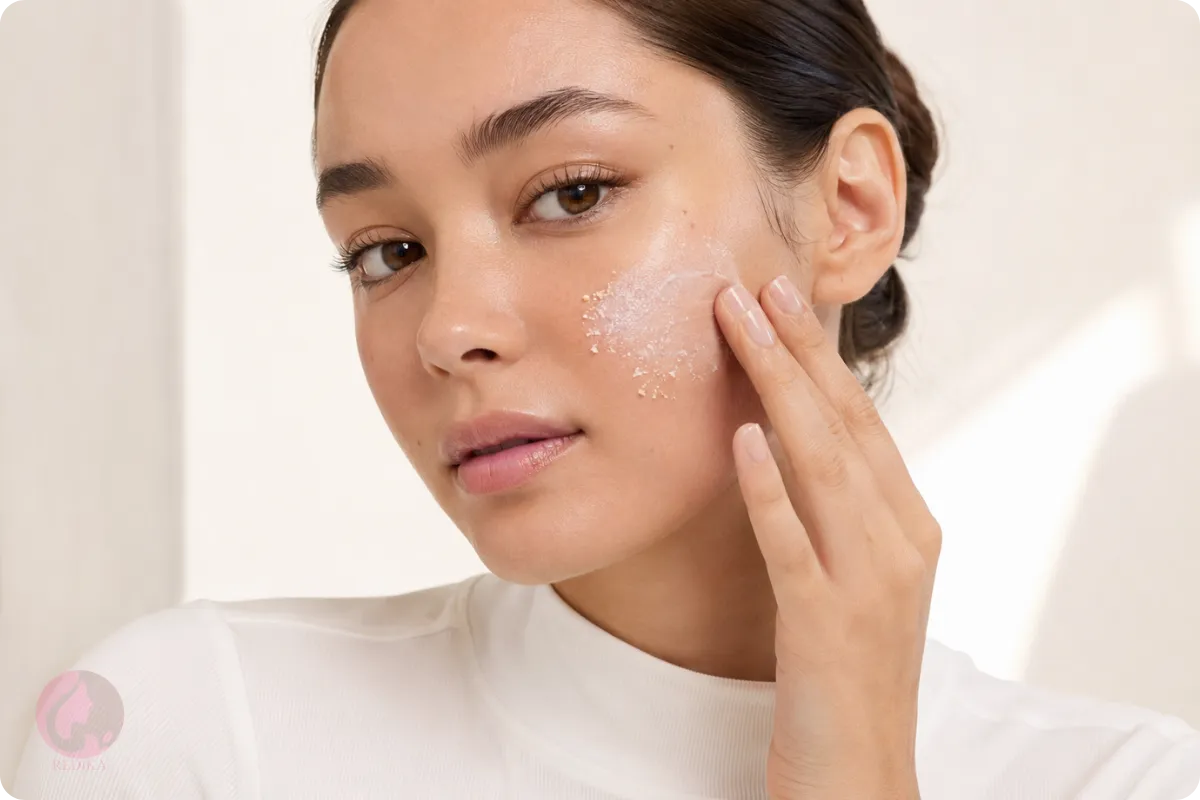
If your sunscreen pills, it is better to identify the cause step by step before immediately buying a new product. In many cases, simplifying your morning routine, reducing rubbing, adjusting the amount or order of products underneath sunscreen, and changing your makeup application technique can solve the problem. One important point to remember is that drastically reducing the amount of sunscreen to prevent pilling is not a good solution. The goal is to help sunscreen sit comfortably on the skin while still maintaining adequate coverage for sun protection.
Quick answer: Why does sunscreen pill?
The most common causes include too many skincare layers, excessive rubbing, applying too much product at once, applying sunscreen over a wet or slippery base, dry or dehydrated skin, incompatibility between certain formulas, and friction caused by primer or foundation. If you are not sure which factor is responsible, test your sunscreen once on clean skin by itself, then gradually add the other products back into your routine one at a time.
What Is Sunscreen Pilling and How Is It Different From Flaky Skin?
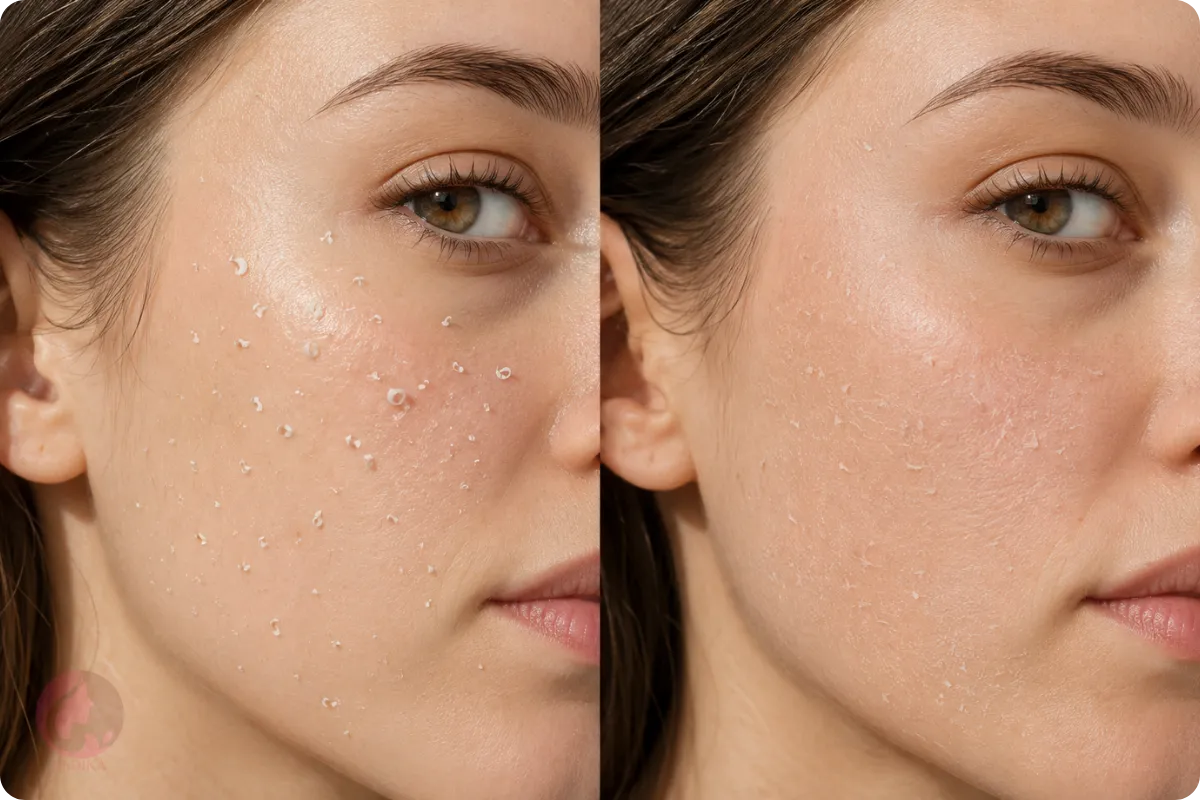
Sunscreen pilling occurs when part of a product, or a combination of several products, gathers on the surface of the skin and rolls into tiny balls, strings, or flakes. If these particles appear immediately after applying sunscreen or while rubbing your face and become more noticeable with continued friction, you are probably dealing with product pilling. True skin flaking, on the other hand, is usually visible even before sunscreen is applied and may be accompanied by dryness, tightness, sensitivity, or actual shedding of surface skin cells. Distinguishing between the two matters because the solutions are not the same.
A common misconception is that sunscreen pilling automatically means your skin needs exfoliation. This conclusion cannot be applied to everyone. Research directly investigating product pilling has shown that physiological characteristics of the skin surface, including hydration and sebum levels, may be associated with a tendency to pill, which means the problem is not always simply “too many dead skin cells.” If your skin is genuinely dry or sensitive, instead of immediately increasing the use of acids or scrubs, first evaluate your skin barrier and hydration. You can also read our guide to choosing sunscreen for dry and sensitive skin (in Persian).
| Sign | Product Pilling | Flaky Skin |
|---|---|---|
| When it appears | Usually during or shortly after applying products | May already be visible before starting your skincare routine |
| Appearance | Small balls, strings, or soft product residue | Irregular dry flakes on the skin surface |
| Effect of rubbing | Often becomes worse with continued rubbing | May be associated with dryness or irritation |
| How to check | Test sunscreen alone on clean skin | Check the skin before applying your routine |
9 Main Reasons Sunscreen Pills or Balls Up on Your Skin
To find the real cause, it helps to think of sunscreen as part of an entire skincare system rather than a completely independent product. Your morning routine may include serum, hydrating products, and moisturizer underneath sunscreen, while primer, foundation, or concealer may be layered over it. The more layers involved, the greater the chance that formulas will interact or move around when rubbed. The table below can help you quickly identify where to begin troubleshooting.
| What You Notice | Possible Cause | First Test | Recommended Action |
|---|---|---|---|
| Sunscreen rolls up while you massage it | Too much rubbing and friction | Reduce circular and back-and-forth movements | Use short, controlled application movements |
| It only pills over moisturizer | Formula interaction or an overly thick base layer | Test sunscreen without moisturizer | Use less moisturizer or switch to a lighter texture |
| It only pills under makeup | Primer, foundation, or friction from makeup tools | Temporarily remove primer | Apply makeup using controlled pressing motions |
| Several different sunscreens behave the same way | Skin condition or products underneath | Completely simplify your routine | Check dryness, underlying products, and application technique |
| Sunscreen pills even on clean skin | The formula itself or the application method | Try less rubbing and a two-layer application | If the problem continues, change the product |
| The problem gets worse in hot weather | Sweat and surface moisture | Apply on cool, dry skin | Choose a texture better suited to the climate |
1. Too Many Heavy Layers in Your Morning Skincare Routine
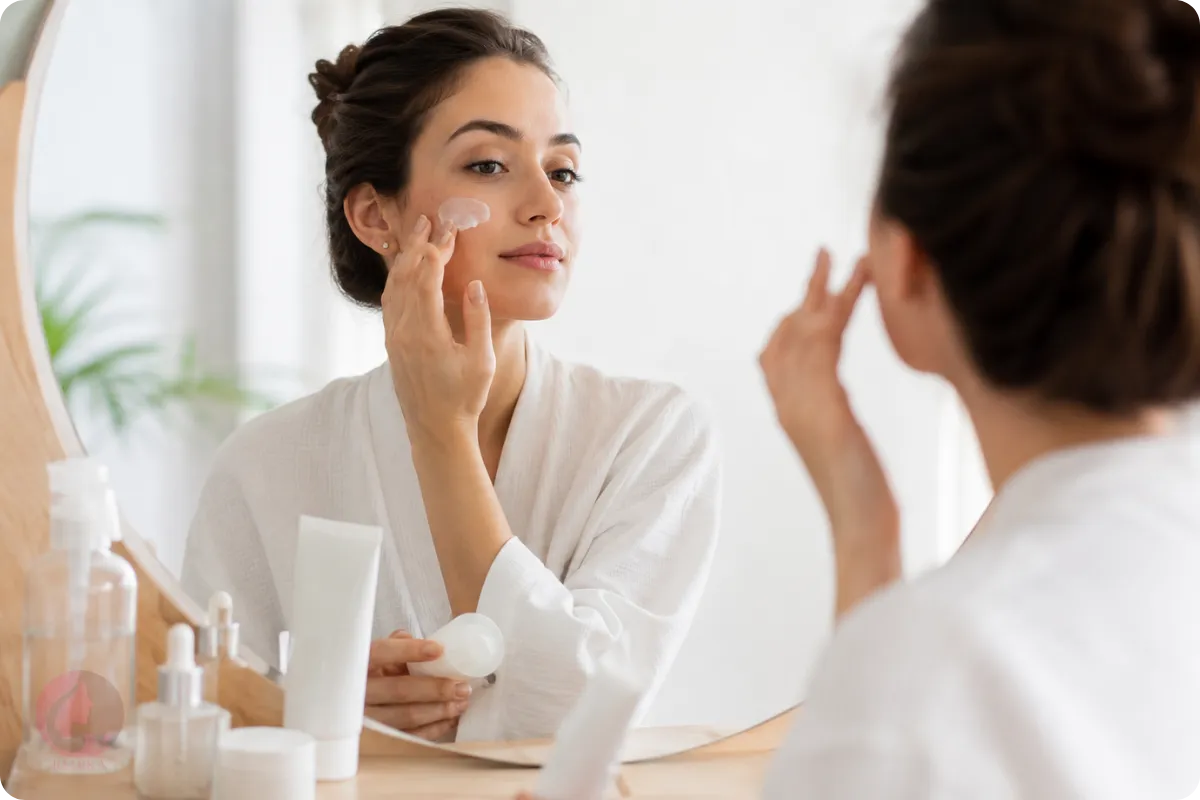
When you apply several serums, hydrating products, creams, oils, and treatment products one after another, some of the ingredients remain on the skin surface. Adding sunscreen over this dense layer can increase the likelihood of products rolling up when you move your fingers across the skin. The problem is not that using several products together is always wrong; it becomes an issue when their number, amount, or texture exceeds what your skin and sunscreen can comfortably tolerate. If your morning routine is crowded, simplifying it is one of the first experiments worth trying.
Start by keeping only the essential steps and move non-essential treatment products to your evening routine when appropriate. If you are unsure which products really belong in the morning, our guide to the correct order of a morning and evening skincare routine is a useful starting point. The concept of skinimalism and minimalist skincare is based on the same principle: more products do not automatically mean better results. For many people, a shorter routine is easier to manage and may also reduce interactions between layers.
2. Rubbing or Massaging Sunscreen Too Much
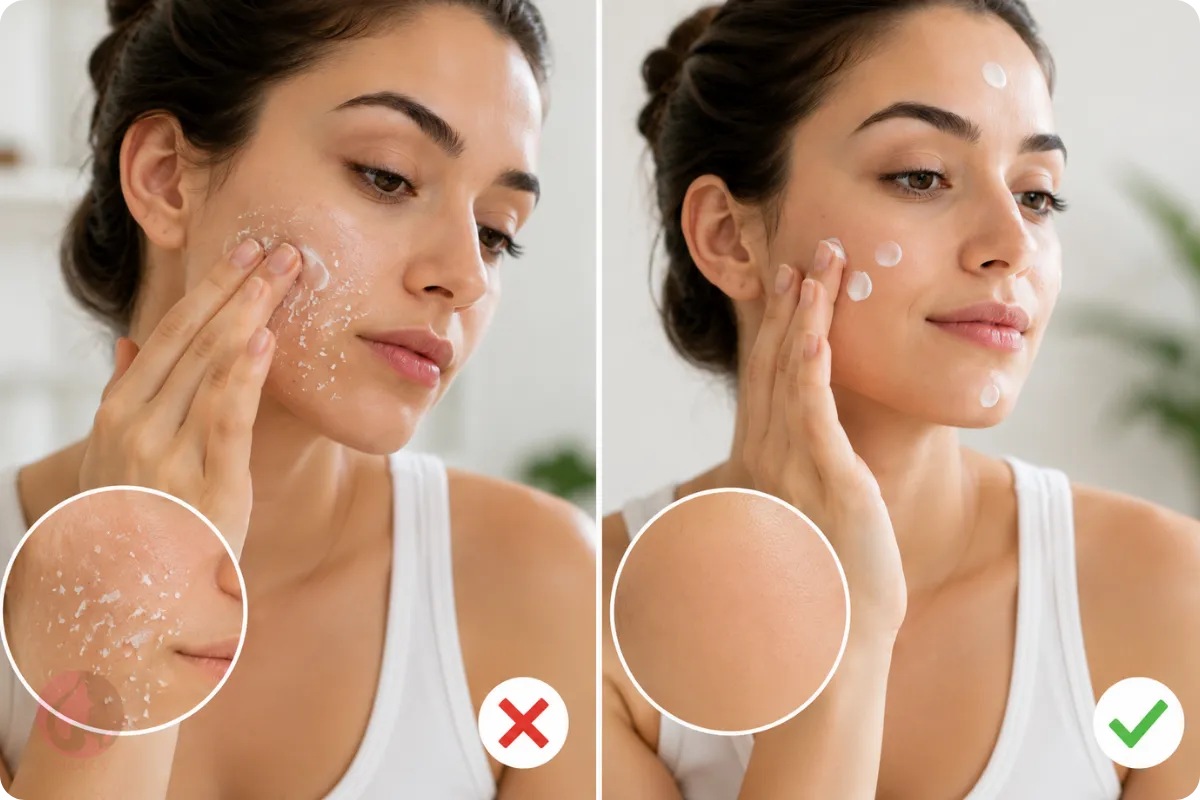
More rubbing does not necessarily help sunscreen sit better on the skin. In a study that directly examined product pilling, application technique was associated with the likelihood of surface particles forming, and circular as well as back-and-forth rubbing movements were among the techniques associated with more pilling. When a film is beginning to form on the skin, continued rubbing can cause surface ingredients to collect together. If your sunscreen looks fine during the first few seconds but starts forming particles the longer you massage it, your application technique may be an important factor.
- Distribute the product across several areas of the face first so you do not have to drag a large amount from one spot across your entire face.
- Use short, controlled movements instead of prolonged massaging.
- Stop rubbing once you have achieved an even layer.
- If the full amount is difficult to spread at once, apply it in two consecutive layers.
3. Certain Formulas Do Not Work Well Together
Sometimes none of your products causes a problem on its own, yet pilling begins when they are layered together. Sunscreens, moisturizers, and makeup products contain different combinations of water, oils, powders, polymers, and film-forming ingredients, so the behavior of the complete formula on the skin matters more than any single ingredient. This is why simply reading the ingredient list cannot always tell you with certainty which two products will pill when combined. The most practical approach is to test how the actual products perform together on your own skin.
Myth: “If one product is water-based and the other is silicone-based, they will always pill.” This rule cannot be applied to every formula. The presence of silicone alone does not mean a product will necessarily be incompatible with your sunscreen; the behavior of the complete formula and the way the products are layered matters more.
4. Dryness, Dehydration, and the Condition of the Skin Surface
Everyone’s skin surface behaves differently. Hydration, oil levels, roughness, flaking, and the condition of the skin barrier can all influence how creams spread across the skin. Research investigating pilling has also found that certain physiological skin characteristics are associated with a greater tendency to experience the problem, although this does not mean there is one universal cause for everyone. If several different sunscreens pill on your skin, it becomes more important to examine the condition of your skin itself.
Instead of continuously scrubbing or exfoliating, first consider whether your skin feels tight after cleansing, whether true flakes are visible, and whether you are using an appropriate moisturizer. A study examining the simultaneous use of moisturizer and sunscreen found that the moisturizers tested did not significantly interfere with sunscreen protection, so completely removing moisturizer is not a logical recommendation for everyone. If your skin needs additional moisture, aim for a lightweight, compatible moisturizer. Well-balanced skin can often provide a better surface for layering skincare products.
5. Applying Too Much Product at Once or Distributing It Incorrectly
There is an important difference between using enough sunscreen and placing a large amount of sunscreen in one spot. If you put the full amount on one small area of your face at once, you may have to rub for much longer to distribute it, which can make pilling more likely. The solution should not be to cut your sunscreen amount in half; instead, distribute the same final amount more efficiently. Research on consecutive sunscreen applications has also suggested that applying sunscreen twice can improve coverage of areas that may have been missed during the first application.
In one study, participants missed a median of approximately 20% of the available skin area after the first sunscreen application. After a second application, this dropped to approximately 9%. The study was not specifically designed as a “treatment for pilling,” but it does show that a two-step application can be useful for practical coverage. If applying the necessary amount all at once feels too heavy on your skin, divide it into two portions. Apply the first layer evenly, then add the second without excessive rubbing.
6. Applying Sunscreen While Moisturizer Is Still Wet or Slippery
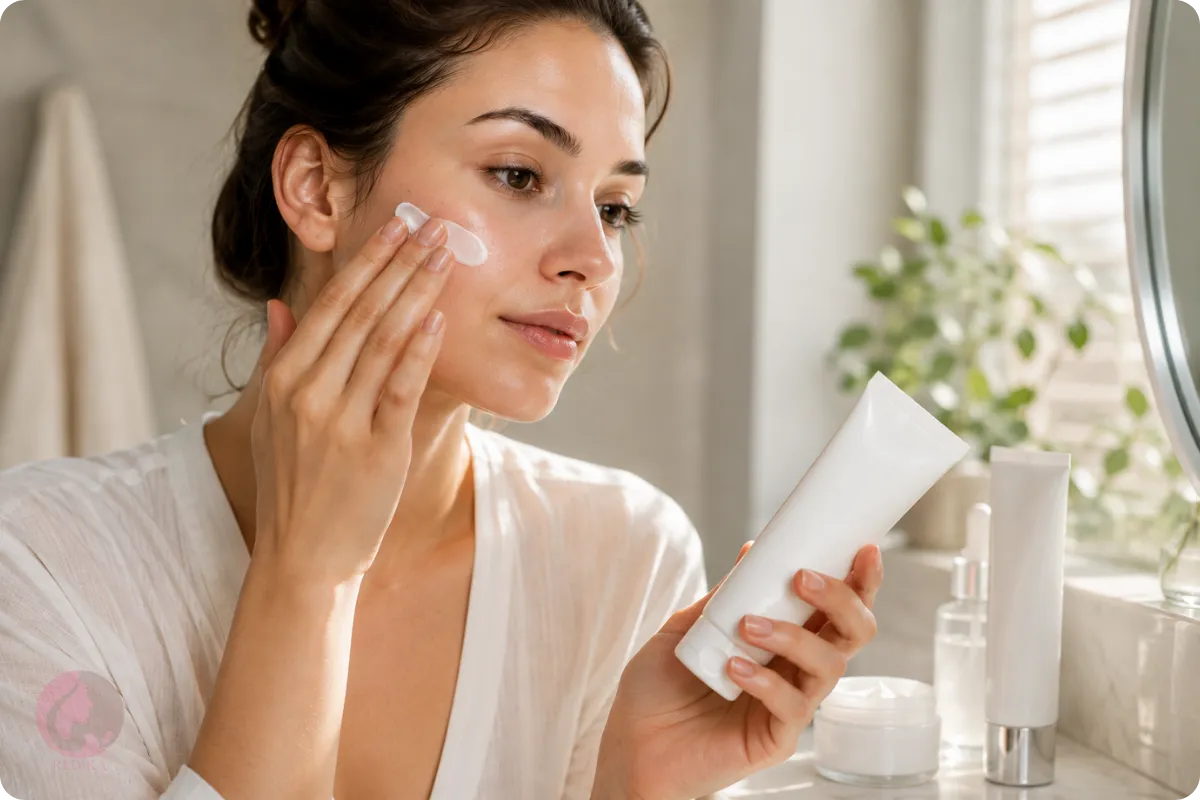
There is no single magical waiting time such as “exactly five minutes” that works for every product. A lightweight gel behaves differently from a rich cream, and oily, dry, or damp skin does not allow products to settle at exactly the same speed. A more useful guideline is to wait until the layer underneath is no longer extremely wet, slippery, or mobile. If you gently touch your skin and a large amount of moisturizer is still moving across the surface, immediately adding sunscreen may make both layers harder to spread evenly.
Do not confuse this with waiting for every ingredient to be “completely and deeply absorbed.” You do not need a long, fixed waiting time between every skincare step; simply give the previous layer enough time to settle appropriately on the surface. If you consistently experience pilling after one specific moisturizer, first try using a smaller amount and test again. If the problem continues, changing the moisturizer texture or its combination with your sunscreen may be more practical than removing moisturizing altogether.
7. Sunscreen Does Not Work Well With Your Primer, Foundation, or Makeup Technique
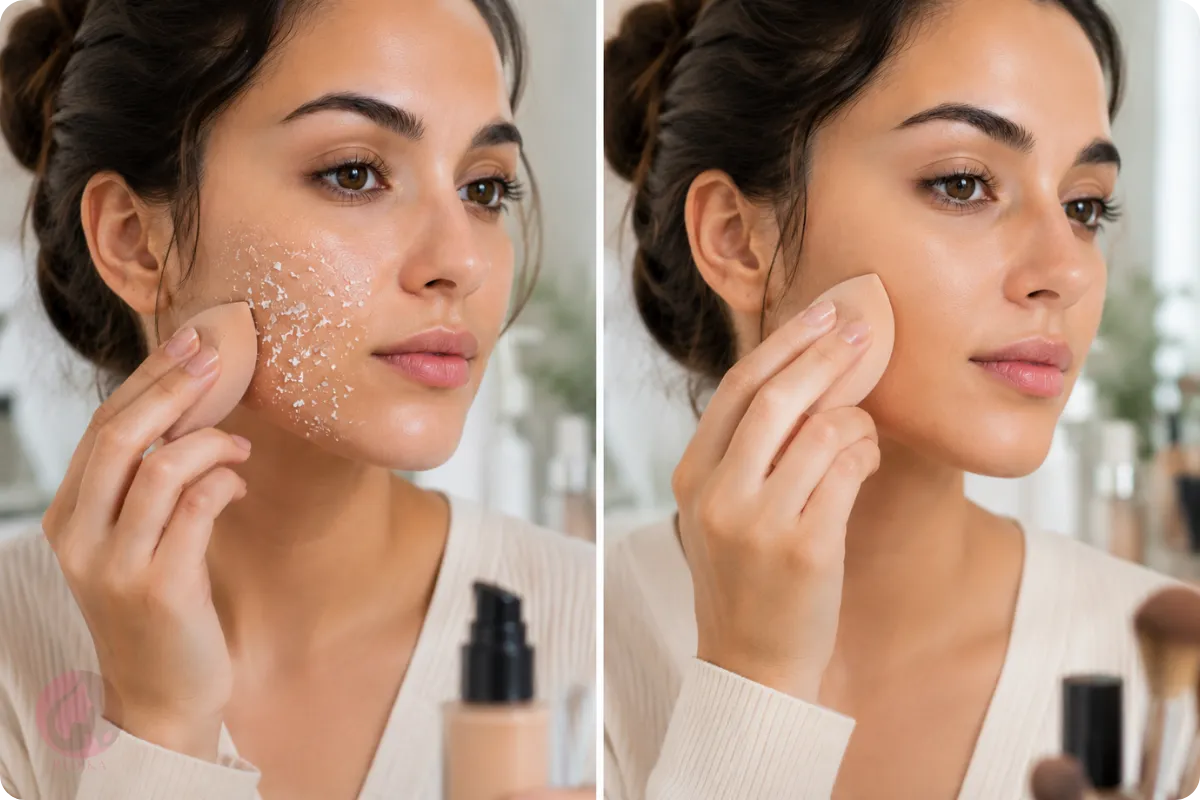
If your sunscreen looks perfectly smooth without makeup but begins to pill as soon as you apply primer or foundation, the issue is likely related to the makeup step or interaction between the layers. Repeatedly dragging a brush, sponge, or fingers over freshly applied sunscreen can create friction and disturb the surface film. This may become more noticeable when your primer or foundation also has a rich or film-forming texture. In this situation, try removing your primer for one day before deciding to replace your sunscreen.
When applying foundation, try pressing or tapping the product onto the skin rather than continuously dragging it back and forth. If removing the primer solves the problem, that primer-and-sunscreen combination may simply not work well for your routine. If only one particular foundation causes the issue, that makeup product should be investigated. So the statement “my sunscreen is bad under makeup” is not always completely accurate; sometimes the sunscreen itself works well, but the combination of products layered over it does not.
8. Sweat, Humidity, or Wet Skin
Hot weather, exercise, and damp skin create different conditions for sunscreen application. Water and sweat on the surface can make it more difficult to distribute products evenly, and rubbing the skin at the same time can cause layers to shift more easily. If pilling mainly occurs during summer or when you are sweating, this pattern itself provides an important clue. Before applying or reapplying sunscreen, remove excess sweat from the surface and apply the product with as little friction as possible.
Water resistance does not mean that one sunscreen application will protect you all day. The American Academy of Dermatology recommends reapplying sunscreen approximately every two hours while outdoors and again after swimming or sweating. For more details about different situations such as staying at home, working indoors, driving, and spending time outside, read our complete guide on how often you should reapply sunscreen. Reapplication should be done in a way that avoids unnecessarily disturbing or rolling up the existing layers.
9. The Sunscreen Formula Is Simply Not Compatible With Your Skin
Sometimes you remove every extra step and your sunscreen still pills even on completely clean skin. If you have corrected your application technique and tried applying the product in two layers but the problem remains, the formula itself may simply not suit your skin. Two people can use exactly the same sunscreen and have completely different experiences because their skin hydration, oil levels, application amount, underlying products, and application technique are not identical. In this situation, continuing to use a product that constantly forces you to reduce the amount of sunscreen is not practical.
A good sunscreen is not just one that has impressive specifications on its packaging; it should also be a product you can comfortably use in an adequate amount in everyday life. If a formula consistently pills, disrupts your makeup, or encourages you to use less sunscreen, trying a different texture may be a better choice. Dry skin generally has different needs from very oily skin, and choosing the right texture is an important part of the daily sunscreen experience. Ultimately, look for a product that you can use regularly, adequately, and without unnecessary difficulty.
Redika’s 4-Step Test: Which Product Is Actually Causing the Pilling?
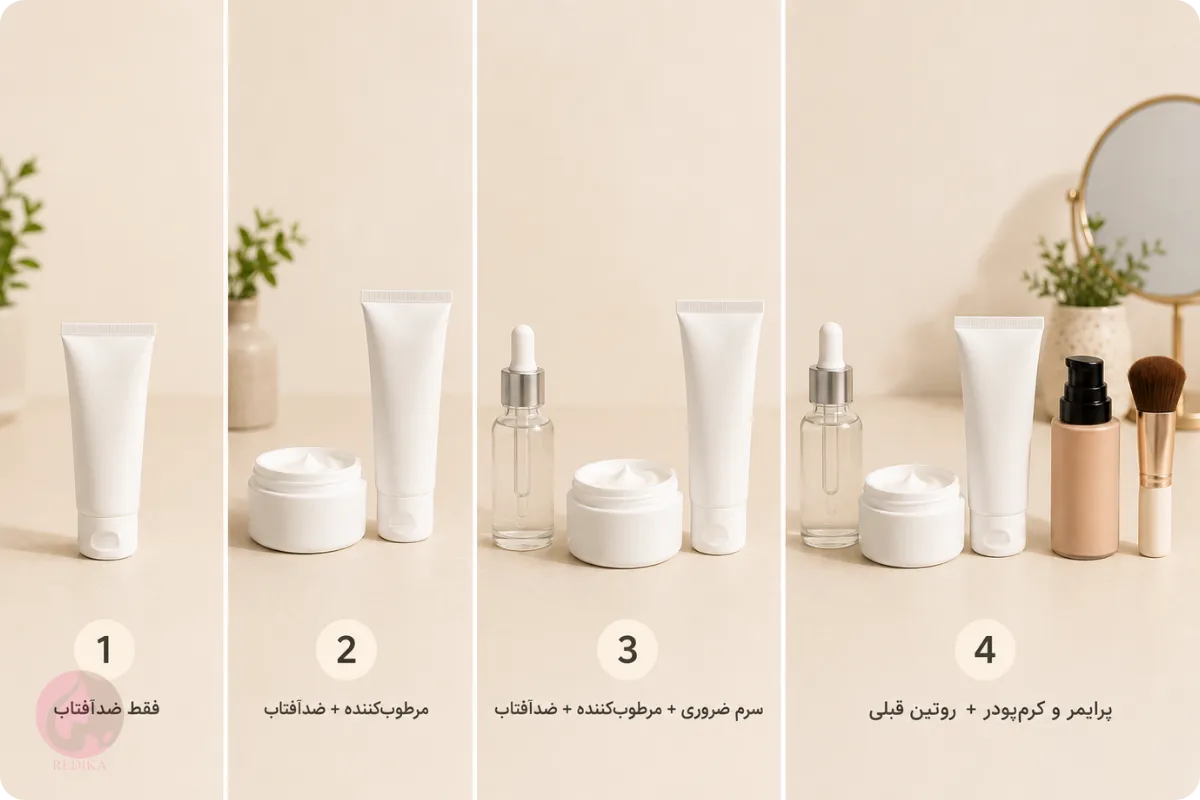
If you use several products in your routine, changing all of them at the same time is a mistake because you will not know which change actually solved the problem. A better method is to rebuild your routine from scratch. This test is a practical at-home troubleshooting tool and is not intended to diagnose a skin condition; its purpose is simply to identify the step at which your products begin to pill. Try to change only one variable at a time.
| Step | What Should You Use? | If Pilling Occurs | Next Step |
|---|---|---|---|
| Step 1 | Clean skin + sunscreen only | The sunscreen, your application method, or skin condition may be responsible | Try a two-layer application with less rubbing |
| Step 2 | Moisturizer + sunscreen | Investigate the moisturizer and sunscreen combination | Change the amount or texture of the moisturizer |
| Step 3 | Essential serum + moisturizer + sunscreen | The serum or the overall number of layers may be responsible | Temporarily remove the serum or move it to your evening routine |
| Step 4 | Morning skincare routine + primer and makeup | A makeup product or application method may be contributing | Remove primer and apply foundation with tapping motions |
For example, if your sunscreen performs perfectly in steps one and two but starts pilling as soon as you add your serum, there is no reason to immediately replace the sunscreen. You may be using too much serum, the serum may leave a sticky film on the skin, or the combination of serum and moisturizer may create an overly heavy layer. If you are new to skincare and find it difficult to identify the essential steps, our beginner skincare routine guide can help you simplify your routine. When troubleshooting, changing one factor at a time always provides more useful information than replacing several products simultaneously.
What Not to Do When Trying to Prevent Sunscreen Pilling
- Do not drastically reduce the amount of sunscreen. A smoother-looking finish is not worth sacrificing adequate sunscreen coverage.
- Do not immediately start scrubbing or exfoliating more simply because of pilling. Product pilling does not automatically mean dead skin cells are building up.
- Do not replace every product in your routine at once. You will no longer know which product caused the problem.
- Do not try to fix sunscreen that has started rolling up by rubbing it more. Extra friction may make pilling worse.
- Do not automatically blame a single ingredient such as silicone. The complete formula and interaction between products matter more.
- Do not keep adding multiple layers over sweaty or wet skin. Stabilize the skin surface first whenever possible.
- Do not impose an unnecessarily long, fixed waiting time between every layer. The actual condition of your skin surface matters more than an arbitrary number.
A Practical Plan for Tomorrow Morning: How to Apply Sunscreen With Less Pilling
If you do not want to get into the details of cosmetic formulation and simply want a practical routine, simplify your skincare tomorrow morning. The goal is to reduce controllable factors such as the number of layers, the amount of each product, and unnecessary friction. If this method completely solves the problem, your sunscreen itself may not have been the main issue and the way your products were layered probably played a larger role. If pilling continues, the four-step test above can help identify the cause more precisely.
- Cleanse your face according to your skin’s needs and allow excess water to leave the skin surface.
- Use only the serum or treatment product that is genuinely necessary in the morning.
- If needed, apply an appropriate amount of moisturizer with a texture suited to your skin.
- Wait until the skin surface is no longer extremely wet or slippery.
- Instead of placing one large amount in one area, distribute sunscreen across several points of the face.
- If applying the full amount at once is difficult, divide it into two layers.
- Once coverage is even, stop massaging and avoid continued back-and-forth movements.
- If you wear makeup, allow the sunscreen layer to settle and then apply foundation with as little friction as possible.
Does Sunscreen Pilling Reduce Sun Protection?
There is no fixed percentage showing exactly how much protection is lost every time sunscreen pills, because the effect will vary between products and circumstances. However, when some sunscreen rolls off the skin or gathers in certain areas, you can no longer be completely confident that the protective layer remains evenly distributed. Using an adequate amount and achieving sufficient coverage are important parts of correct sunscreen application. For this reason, significant pilling should not be treated as purely a cosmetic problem.
If you only notice a few tiny particles after touching one small area of your face, that does not mean all of your sunscreen protection has disappeared. But if a large amount of product is rolling off, parts of your face appear nearly uncovered, or you have to wipe the sunscreen away, it is better to address the cause and restore coverage. Reapplication also remains important when spending time outdoors. The American Academy of Dermatology recommends reapplying sunscreen about every two hours outdoors and again after swimming or sweating.
How Long Should You Wait Between Moisturizer and Sunscreen?
There is no universal waiting time that applies to every moisturizer and every sunscreen. Instead of relying on an exact number of minutes, pay attention to the condition of your skin surface. Once your moisturizer is no longer extremely wet, slippery, or mobile, it is generally a better time to add sunscreen. Lightweight gel textures often behave differently from rich creams, so the real-world behavior of your own products matters.
If the same two products always pill together, start by reviewing how much moisturizer you apply. A very thick layer may need more time to settle. If the problem continues despite using a reasonable amount and giving it enough time, changing the combination of products may produce better results. A typical morning skincare order generally includes essential serums, moisturizer, and sunscreen as the final skincare step, which we explain in detail in our guide to the correct skincare routine order.
Why Does Sunscreen Look Fine Alone but Pill Under Makeup?
If the problem starts only after makeup, the makeup step should be your first suspect rather than the sunscreen itself. Primer, foundation, concealer, and makeup tools can create friction as they move across the sunscreen layer. Some formulas also do not perform well together even though each product looks excellent when used alone. The easiest test is to temporarily remove primer and use the same sunscreen and foundation.
If the problem disappears, primer was probably contributing to the issue. If pilling continues, apply foundation with gentler tapping motions instead of repeatedly dragging it across the skin. If the problem still persists, try wearing the sunscreen without makeup for a day to confirm that your sunscreen base remains stable. This simple troubleshooting process generally provides more useful information than trying to guess the cause from an ingredient list alone.
Myth: Is Silicone the Main Cause of Sunscreen Pilling?
No. The presence of silicone alone cannot be considered a definite cause of pilling. Makeup and skincare products contain complex formulas, and their behavior results from the interaction of many different ingredients. Two products containing silicone ingredients may layer perfectly well together, while two other formulas may pill. Therefore, the simple rule that “every silicone-based product causes pilling” is not reliable.
If your sunscreen pills only when combined with one particular primer, that specific combination is problematic for you, not necessarily every product containing silicone. Pay attention to how the actual formulas behave together and change only one variable at a time. This approach helps prevent unnecessary product elimination and makes it easier to identify the real cause. In most situations, systematic product testing is more practical than blaming one ingredient in the ingredient list.
Myth: Does Pilling Mean Your Skin Definitely Needs Exfoliation?
No. Sunscreen pilling alone does not mean your skin needs more scrubs or exfoliating acids. Pilling may result from the product itself, friction, layering, or interactions between formulas. If your skin looks smooth before sunscreen but particles only appear while you rub the product, increasing exfoliation may not address the actual cause at all. On sensitive skin, over-exfoliation can even increase dryness and irritation.
Exfoliation becomes a separate issue when you genuinely have visible flaking, roughness, or another skin concern for which appropriate exfoliation has been recommended. To address product pilling, first correct your application method and then test your routine step by step. If your skin is persistently red, painful, inflamed, itchy, or flaky, the issue may no longer be purely cosmetic and the underlying skin condition should be evaluated. The purpose of this article is to troubleshoot product pilling, not to provide medical treatment for skin conditions.
When Should You Replace Your Sunscreen?

Replacing your sunscreen should come after a few simple tests rather than at the first sign of pilling. If the product pills even on clean skin, reducing friction has not helped, applying it in two layers makes no difference, and the issue remains after removing moisturizer and makeup, choosing another formula becomes reasonable. Likewise, if you have to reduce the amount so dramatically that you can no longer achieve adequate coverage, that sunscreen is not a practical choice for your daily routine. Ease of use is an important part of choosing a suitable sunscreen.
| Situation | Does Replacing the Sunscreen Make Sense? |
|---|---|
| It pills only with one particular serum | Not yet; investigate the serum or layering combination first |
| It pills only with primer | Not yet; change or remove the primer first |
| It pills heavily even on clean skin | Yes, if correcting your application method has not helped |
| It only pills after prolonged rubbing | Correct the application method first |
| You have to use a very small amount to prevent pilling | A more compatible formula may be a better choice |
Final Takeaway: How Can You Prevent Sunscreen From Pilling?
Sunscreen pilling is usually caused by several interacting factors rather than one single problem. Too many skincare layers, rich moisturizer, prolonged rubbing, poor product distribution, dry or dehydrated skin, sweat, and makeup can all contribute under different circumstances. Most importantly, do not make reducing your sunscreen amount your first solution, and do not automatically blame one ingredient such as silicone without testing. Step-by-step troubleshooting is a more reliable way to identify the actual problem.
Tomorrow morning, simplify your routine, allow the products underneath to settle, distribute sunscreen without prolonged rubbing and, if necessary, apply it in two layers. Then add makeup using as little friction as possible. If the problem continues, use the “Redika 4-Step Test” to identify exactly where the pilling begins. A suitable sunscreen is one that you can use regularly and in an adequate amount without unnecessary difficulty. If a formula continues to pill despite correcting all of these factors, switching sunscreens is a reasonable decision.
Frequently Asked Questions About Sunscreen Pilling
Should I Apply Less Sunscreen to Prevent Pilling?
No. Drastically reducing the amount of sunscreen may prevent adequate coverage across all exposed areas. If the necessary amount is difficult to spread in a single application, divide it into two portions and apply each layer with less rubbing. Research on consecutive sunscreen applications has shown that the second application can reduce areas that were missed during the first. The goal should be to improve distribution rather than sacrifice the amount needed for protection.
Why Does Sunscreen Pill After Niacinamide or Hydrating Serum?
It is usually not accurate to blame a single ingredient such as niacinamide. The serum’s texture, the amount used, thickening agents, and the film it leaves on the skin after drying may matter more. Try your sunscreen once without that serum. If the problem disappears, use less serum or give it more time to settle. If the two products still do not work well together, using the serum in your evening routine may be a simpler solution.
Do I Really Need to Wait 10 Minutes Between Moisturizer and Sunscreen?
No. Ten minutes is not a universal rule. Product textures and skin types differ, and what matters more than an exact number is whether the moisturizer is still very wet or mobile on the skin. Some lightweight products settle quickly, while richer creams may need more time. If a very short interval causes pilling, wait a little longer and compare the result using the same two products.
Why Does Sunscreen Pill More on Certain Areas of My Face?
The amount of underlying skincare, oiliness, dryness, and the amount of rubbing can vary across different areas of the face. You may create more friction around the nose, jawline, or forehead, or more moisturizer may remain in one particular area. Pay attention to whether the pilling consistently appears in the same location. A repeated pattern can provide a useful clue for adjusting the amount or application technique in that area.
What Should I Do If Sunscreen Pills When I Reapply It Over the Previous Layer?
First remove excess sweat or surface moisture, then reapply sunscreen without excessive rubbing. If you are wearing makeup, your reapplication technique should be compatible with your makeup and sunscreen because excessive friction can disturb the existing layers. If reapplication consistently causes severe pilling, your sunscreen texture may not be ideal for repeated layering. For guidance on timing, read our article on reapplying sunscreen at home, at work, and outdoors.
Scientific and Expert Sources
This article was prepared and reviewed using scientific research and professional dermatology guidance. Research findings are used to explain the possible mechanisms behind product pilling and the principles of correct sunscreen use, and they should not be interpreted as proof that every individual will have the same experience with a particular product.
- Understanding the Causes of Skincare Product Pilling
- Sunscreens Effectiveness Are Not Altered by Concomitant Use of Moisturizing Creams
- Sunscreen Use Optimized by Two Consecutive Applications
- American Academy of Dermatology — How to Apply Sunscreen
Reminder: If you have persistent flaking, burning, redness, itching, or inflammation, the problem may not be limited to skincare product pilling. In these situations, having the underlying skin issue evaluated by a qualified physician or healthcare professional is more appropriate than repeatedly switching skincare products.
About the author

Join the conversation
Share your experience or question with REDIKA readers.
Your email stays private. Please avoid sharing personal or sensitive details.


