


Article Video Summary
Skin minimalism means simplifying your skincare routine and using only a few essential, effective products that are compatible with your skin type. This method usually consists of three main pillars: a gentle cleanser, a suitable moisturizer, and daily sunscreen. If the skin has a specific issue such as acne, dark spots, dryness, or redness, only one targeted treatment product is added to the routine.
In simple terms, skin minimalism means not overwhelming your skin with too many products. Instead of incorporating every new trend into your routine, you only keep what is truly necessary for your skin.
| User’s Main Question | Quick Answer |
|---|---|
| What is skin minimalism? | A simple and targeted approach to skincare using a minimum of essential products. |
| How many products are needed? | Usually 3 to 5 products are enough. |
| Who is it suitable for? | For sensitive skin, oily skin, dry skin, busy people, and those with a cluttered routine. |
| What is its most important step? | Daily sunscreen, because it helps prevent dark spots, premature aging, and light damage. |
What is skin minimalism or Skinimalism?
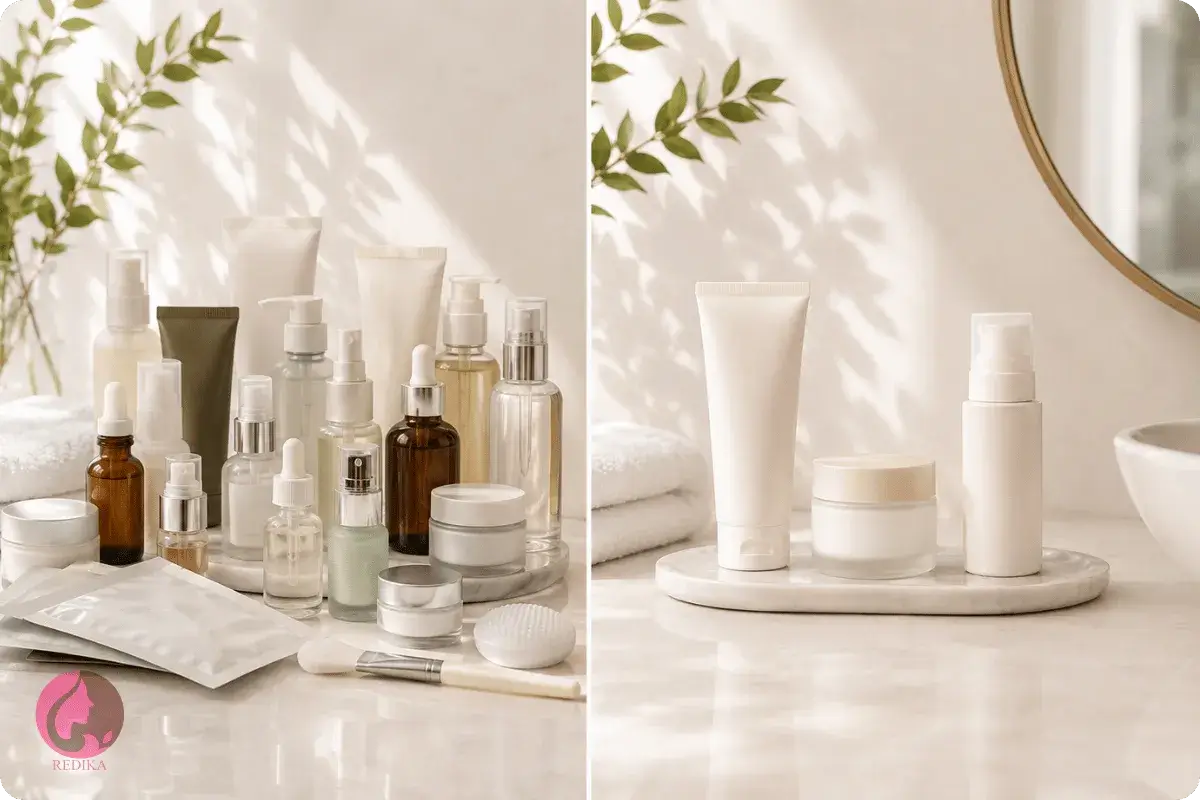
Skin minimalism, also known in global trends as Skinimalism, is an approach that suggests the skin does not always need more products to stay healthy. Sometimes the main problem is not a lack of products; the problem is having too many of the wrong products.
In this style, instead of using several serums, toners, masks, and different creams, the routine is limited to a few main steps. The goal is not to abandon skincare; the goal is to make care smarter, calmer, and more sustainable.
To put it simply, a busy routine is like giving a plant water, fertilizer, pesticide, artificial light, and new soil all at the same time every day. Your intentions might be good, but the plant will go into shock. The skin is the same way.
How is skin minimalism different from neglecting the skin?
Some people think a minimal routine means “applying nothing to the skin.” This is a misconception. Skin minimalism means eliminating unnecessary products, not eliminating essential care.
In skin minimalism, these items are not removed
- Gentle skin cleansing
- Moisturizing appropriate for skin type
- Daily sunscreen
- Targeted treatment, if the skin truly needs it
In skin minimalism, these items are eliminated or limited
- Duplicate products with similar functions
- Excessive exfoliants
- Serums for which we have no clear reason to use
- Irritating masks
- Fragrant products for sensitive skin
- Impulse purchases based on social media trends
Why has skin minimalism become a trend?
Skin minimalism is not just a passing fad. This approach is a response to user fatigue from multi-step routines, high costs, and skin irritation caused by excessive product use.
In the last few years, many people started with long routines; routines including cleanser, toner, essence, several serums, eye cream, masks, exfoliants, facial oils, and various treatment products. But the result was not great for everyone. Some experienced breakouts, redness, dryness, stinging, or sensitivity.
Reasons for the popularity of a minimal skin routine
- It is simpler to execute.
- The cost of purchasing products is lower.
- The likelihood of skin irritation decreases.
- It becomes easier to recognize the effect of each product.
- It is more suitable for a busy lifestyle.
- It helps maintain the skin’s barrier.
- It is more understandable for beginner users.
What is the difference between a minimal skin routine and a multi-step routine?
One of the best ways to understand skin minimalism is to compare it with busy, multi-step routines. A multi-step routine is not necessarily bad, but it is not suitable for everyone. If you have sensitive, acne-prone, or intolerant skin, simplification is usually a more logical choice.
| Comparison criteria | Minimal skin routine | Multi-step routine |
|---|---|---|
| Number of products | Few, essential, and targeted | Many and sometimes redundant |
| Likelihood of skin irritation | Lower, especially for sensitive skin | Higher, especially with the combination of active ingredients |
| Cost | More economical and manageable | Usually more expensive |
| Long-term sustainability | More, because it is simpler to execute | Less, because it is time-consuming and tedious |
| Suitable for beginners | Yes, very suitable | Not always; it can be confusing |
| Identifying an effective product | Easier | Harder, because there are many products |
The Core Principles of Skin Minimalism
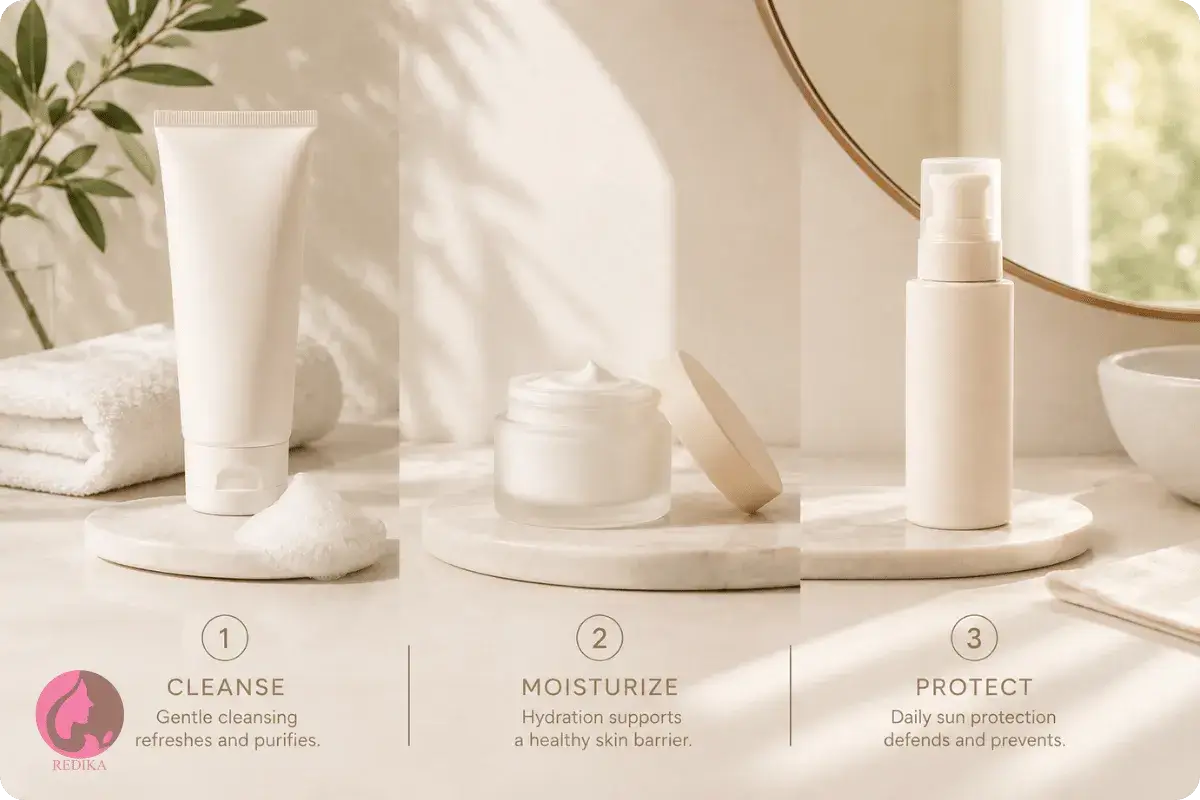
A minimal skin routine is built on a few simple principles. These principles are the very foundations that, if chosen correctly, can yield better results than an expensive and cluttered routine.
1. Gentle Skin Cleansing
Cleansing means removing dirt, excess oil, sunscreen, and makeup from the skin’s surface. However, cleansing should not cause tightness, dryness, redness, or irritation.
A suitable cleanser should have these characteristics:
- Be compatible with your skin type.
- Not dry out the skin excessively.
- Be suitable for daily use.
- Leave a feeling of cleanliness after washing, not a feeling of roughness or tightness.
- For sensitive skin, it is better to be fragrance-free.
If your skin feels so dry after washing your face that you immediately look for cream, your cleanser is likely too strong.
2. Moisturizing and Strengthening the Skin Barrier
Moisturizer is not just for dry skin. Oily skin also needs moisturizer, because dehydration can cause irritation, dullness, and even an increase in the feeling of oiliness.
A good moisturizer usually performs one or more of the following tasks:
- Retains water in the skin.
- Softens the skin’s surface.
- Helps reduce dryness and flaking.
- Supports the skin’s barrier.
- Improves the skin’s tolerance to treatment products.
The skin barrier is like the protective wall of a house. If this wall is damaged, moisture escapes and irritants enter the skin more easily. The result can be redness, dryness, irritation, small breakouts, or sensitivity.
3. Daily Sunscreen
Sunscreen is the most important part of the morning routine. Even if you don’t use any serums, sunscreen must still remain in the routine.
Sunscreen helps protect the skin against these problems:
- Skin spots
- Darkening of acne scars
- Premature aging
- Sunburn
- Damage caused by ultraviolet rays
- Exacerbation of certain skin inflammations
For daily use, a sunscreen with a Sun Protection Factor or SPF of 30 or higher is a better choice. If the product states Broad-spectrum, it means it provides protection against a wider range of harmful sun rays.
4. Treatment product only if needed
A treatment product means a product used for a specific problem. For example, for acne, spots, redness, severe dryness, uneven texture, or fine lines.
In a minimal routine, the treatment product should have a specific goal. It is not intended to introduce several strong active ingredients into the routine at the same time.
Examples of choosing a targeted treatment product
- For blackheads: Salicylic acid
- For spots and darkening: Vitamin C
- For redness and oiliness: Niacinamide
- For dryness and a weak skin barrier: Ceramides and Panthenol
- For fine lines and skin texture: Retinoid with a slow start
Minimal morning routine for skin

The morning routine should focus more on protection. Throughout the day, the skin faces sunlight, air pollution, sweat, makeup, and environmental stress. So, the morning routine does not need to be complicated; it just needs to be correct and consistent.
Step one: Gentle washing or rinsing
If you have oily skin, it is better to use a gentle cleanser in the mornings. If you have dry or sensitive skin, sometimes rinsing with lukewarm water is enough. The goal is to remove overnight oil and sweat without damaging the skin.
Step two: Appropriate moisturizer
Apply moisturizer when the skin is slightly damp. This helps lock moisture into the skin better.
To choose a moisturizer:
- Dry skin: A slightly richer cream
- Oily skin: A light gel-cream
- Sensitive skin: A simple, fragrance-free formula
- Combination skin: A light moisturizer for the entire face and a larger amount for dry areas
Step three: Sunscreen
Sunscreen is the final step of the morning routine. If you go outside, sit by a window, drive, or are exposed to daylight, take sunscreen seriously.
For better effectiveness:
- Apply a sufficient amount.
- Do not just limit it to your cheeks.
- Do not forget your neck.
- Reapply if you are sweating or spending a long time outdoors.
- Use sunscreen under your makeup as well.
Minimalist Nighttime Skincare Routine
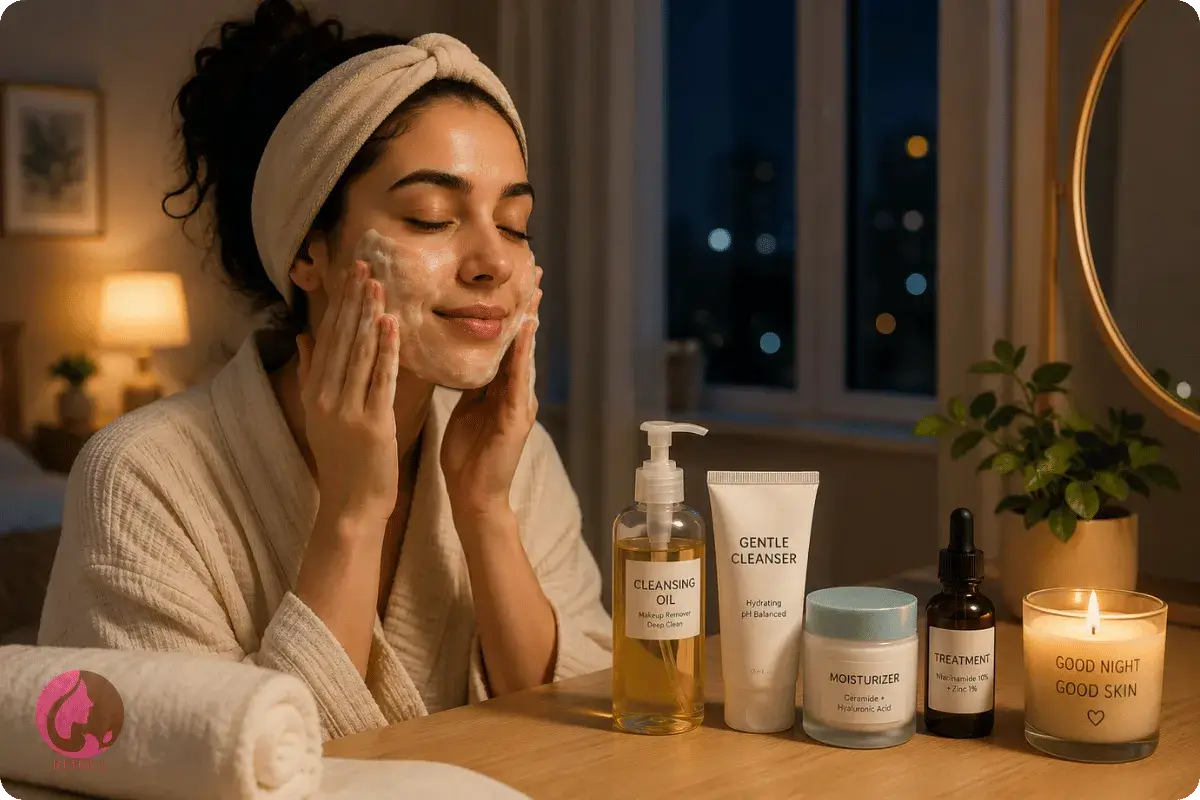
The nighttime routine should focus on cleansing and repair. Throughout the day, your skin has been exposed to pollution, sunscreen, oil, dust, and makeup. Night is a good time to soothe the skin and give it a chance to regenerate.
Step One: Removing Makeup and Sunscreen
If you are wearing makeup or have used a water-resistant sunscreen, a thorough cleanse is important. In this case, you can first use a suitable cleanser and then wash your face with a gentle wash.
If you are not wearing makeup and have used a light sunscreen, a good cleanser might be enough. The main criterion is that after washing, there should be no feeling of heaviness or an oily layer left on the skin.
Step Two: Gentle Cleanser
A nighttime cleanser should remove impurities but not strip the skin or leave it dry. Very hot water is also not a good choice, as it can increase dryness and sensitivity.
Step Three: Moisturizer or Targeted Treatment
If your skin does not have any specific issues, a moisturizer is sufficient. If you have a specific concern, add a treatment product according to your skin’s tolerance.
Simple Rules for Nighttime
- Do not use an exfoliant and a retinoid on the same night.
- Do not start a new treatment product every night.
- If you experience severe irritation, simplify your routine.
- If your skin becomes dry or sensitive, first repair the skin’s barrier.
Minimalist Skincare Routine Table by Skin Type
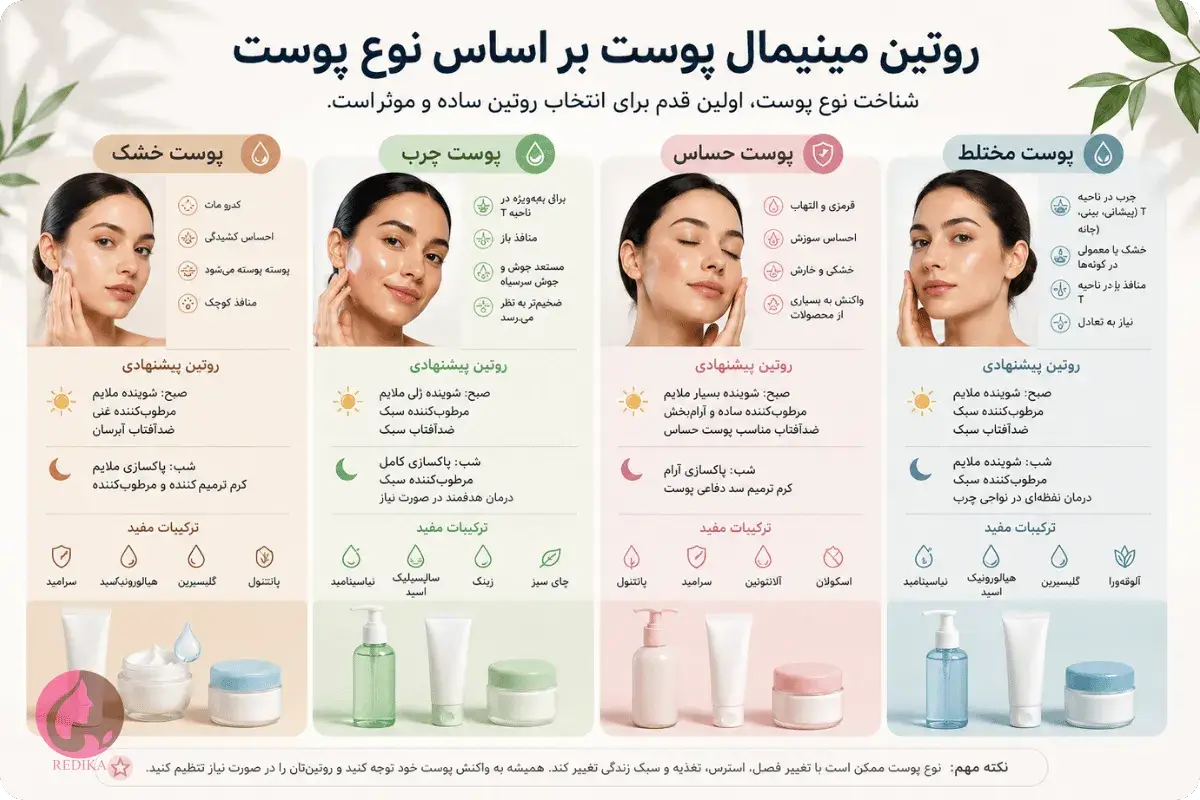
| Skin Type | Morning Routine | Nighttime Routine | Suggested Ingredients | Common Mistake |
|---|---|---|---|---|
| Dry Skin | Rinsing or a very gentle cleanser, moisturizing cream, hydrating sunscreen | Gentle cleansing, repairing cream, and rich moisturizer | Ceramide, glycerin, panthenol, hyaluronic acid | Over-exfoliation and using a harsh cleanser |
| Oily skin | Gentle gel cleanser, lightweight moisturizer, lightweight sunscreen | Cleanser, lightweight moisturizer, targeted acne treatment if needed | Niacinamide, salicylic acid, zinc | Skipping moisturizer and over-drying the skin |
| Sensitive skin | Very gentle cleanser, simple moisturizer, sunscreen suitable for sensitive skin | Gentle cleansing, skin barrier repair cream | Panthenol, allantoin, ceramide, squalane | Using scented products and not patch-testing new products |
| Combination skin | Gentle cleanser, lightweight moisturizer, sunscreen | Cleanser, moisturizer, spot treatment for oily areas | Glycerin, niacinamide, lightweight hydrators | Treating all areas of the face the same |
Skin minimalism for dry skin
Dry skin usually has less oil and moisture. For this reason, a minimalist routine for this skin type should focus on hydration, moisturizing, and protecting the skin barrier.
Suggested routine for dry skin
Morning:
- Rinse with lukewarm water or a very gentle cleanser
- Moisturizing cream containing repairing ingredients
- Sunscreen with a hydrating texture
Night:
- Gentle cleansing without a feeling of tightness
- Rich moisturizer
- Treatment product only if needed
Important tips for dry skin
- Use strong foaming cleansers less frequently.
- Keep exfoliation limited.
- Apply moisturizer to slightly damp skin.
- If the skin is flaky, prioritize repairing the skin barrier first.
- Avoid scented and alcohol-based products, unless your skin is compatible with them.
Skin minimalism for oily and acne-prone skin
Oily skin also needs gentle care. A common mistake is thinking that you must completely strip the skin of its oil. This usually irritates the skin and may make breakouts worse.
Suggested routine for oily skin
Morning:
- Gentle gel cleanser
- Lightweight moisturizer
- Lightweight and non-heavy sunscreen
Night:
- Thorough cleansing
- Lightweight moisturizer
- A targeted anti-acne product if needed
Important tips for oily skin
- Do not skip moisturizer.
- Do not use multiple anti-acne products at the same time.
- Look for the term Non-comedogenic on the product.
- A very harsh cleanser can irritate the skin.
- Introduce acne treatments into your routine slowly and consistently.
Skin minimalism for sensitive skin
Sensitive skin usually reacts to too many products, fragrances, harsh exfoliants, and rapid changes in routine. For this skin type, skin minimalism is one of the most logical choices.
Suggested routine for sensitive skin
Morning:
- Very gentle cleanser or simple rinsing
- Simple and soothing moisturizer
- Sunscreen suitable for sensitive skin
Night:
- Gentle cleansing
- Repair cream or simple moisturizer
- Temporary removal of active ingredients during inflammation
The golden rule for sensitive skin
Test every new product on a small area of skin first. If you do not have redness, itching, or severe irritation after a few days, slowly introduce it into your routine.
For sensitive skin, the term Fragrance-free on a product can be a good sign. Of course, it is not always enough, but it is a good starting point.
Skin minimalism for combination skin
Combination skin means some areas of the face are oilier and some areas are drier. Usually, the forehead, nose, and chin area are oilier, and the cheeks are drier or more sensitive.
The right way to care for combination skin
- Use a gentle cleanser for the entire face.
- Apply a lightweight moisturizer to the entire face.
- If the cheeks are dry, moisturize those specific areas more.
- If the nose and forehead area are oily, use oil-control treatment only there.
- Avoid excessive exfoliation of the entire face.
7-day plan to start skin minimalism

If your current routine is busy, do not change everything at once. It is better to introduce the skin to a new path gradually. The following plan is simple and practical for getting started.
| Timeframe | Main Action | Goal |
|---|---|---|
| Days 1 to 3 | Use only a gentle cleanser, moisturizer, and sunscreen. | Calming the skin and removing unnecessary irritants |
| Days 4 to 7 | Check skin reaction: dryness, breakouts, redness, or irritation. | Identifying the skin’s true needs |
| Week 2 | If needed, add only one treatment product. | Targeted treatment without cluttering the routine |
| Week 3 | Evaluate the result and remove ineffective or irritating products. | Building a sustainable and personalized routine |
Which products can be removed from the routine?
If you want your routine to be minimal, you do not need to keep all products. Some products only clutter the routine and have no clear effect.
Products that are usually removable or limitable
- Redundant toners with no specific purpose
- Multiple serums with similar ingredients
- Drying and irritating masks
- Harsh scrubs
- Multiple exfoliants
- Creams that only feel luxurious but do not target the skin’s real needs
- Fragrant products for sensitive skin
- Heavy oils for acne-prone skin
Shopping checklist for products in a minimal routine

In skin minimalism, purchasing a product should be conscious. Before buying, ask yourself: “What problem is this product exactly supposed to solve?” If you do not have a clear answer, it is probably not necessary to buy it.
| Product Type | What to look for? | Suitable for |
|---|---|---|
| Cleanser | Gentle, no feeling of tightness, suitable for daily use | All skin types |
| Moisturizer | Glycerin, ceramide, panthenol, or hyaluronic acid | Dry, sensitive, and dehydrated skin |
| Sunscreen | SPF 30 or higher and broad-spectrum protection | Everyone in their daily routine |
| Oily skin product | Non-comedogenic, lightweight, non-greasy feel | Oily and acne-prone skin |
| Sensitive skin product | Fragrance-free, simple formula, soothing ingredients | Sensitive and irritable skin |
| Product texture | Lightweight or Gel Cream | Oily, combination skin, and warmer seasons |
Common mistakes in skin minimalism
Skin minimalism is simple, but it is not without rules. If you repeat a few common mistakes, even a simple routine can yield poor results.
Mistake one: Skipping sunscreen
Sunscreen is not a step to be skipped to simplify a routine. If you set sunscreen aside, the likelihood of dark spots, post-acne hyperpigmentation, and premature aging increases. Sunscreen becomes even more important, especially if you are using anti-spot products, retinoids, or exfoliants.
Mistake two: Using multiple active ingredients simultaneously
Active ingredients like retinoids, exfoliating acids, vitamin C, and salicylic acid can be beneficial. However, if used without a plan and simultaneously, they irritate the skin.
Signs of overusing active ingredients
- Stinging when applying moisturizer
- Persistent redness
- Dryness and flaking
- Unnatural shine on the skin
- Sudden tiny breakouts
- Sensitivity to products that previously caused no issues
Mistake three: Changing products too quickly
The skin needs time to adapt. If you introduce a new product into your routine every week, you will not understand which product was beneficial and which caused a problem.
It is better to add each new product slowly and separately. This is like testing food to find an allergy; if you try everything at once, the main culprit cannot be identified.
Mistake four: Copying others’ routines
The routine of a friend, blogger, or celebrity is not necessarily suitable for your skin. Skin type, climate, age, lifestyle, medications, amount of makeup, and sun exposure all affect your skin’s needs.
Therefore, a minimal routine must be personalized. There is no one-size-fits-all version.
Skin Minimalism and the Skin Barrier
If we want to summarize the philosophy of skin minimalism in one sentence, we should say: first calm the skin, then start the treatment.
The skin barrier is a protective layer that helps retain moisture and reduce the entry of irritants. When this barrier is damaged, the skin reacts more quickly. In such a state, even a regular product may cause irritation.
Signs of a Damaged Skin Barrier
- Severe dryness
- Redness
- Burning sensation
- Itching
- Flaking
- Sudden skin sensitivity
- Small, scattered breakouts
- Feeling of tightness after washing
What to do when the skin barrier is damaged?
- Limit your routine to a cleanser, moisturizer, and sunscreen.
- Temporarily stop using exfoliants.
- Discontinue or reduce retinoids until the skin calms down.
- Do not use fragranced products.
- Take restorative moisturizers seriously.
- If inflammation persists, consult a dermatologist.
Skin Minimalism for Iranian Users; Some Practical Tips
The Iranian consumer usually faces several challenges simultaneously: intense sun, air pollution, daily makeup use, climate changes, and sometimes limited access to high-quality products. Therefore, a minimal routine must be realistic.
If you live in a polluted city
- Take cleansing more seriously at night.
- Choose a gentle but effective cleanser.
- Completely remove sunscreen and pollution before going to sleep.
- Do not use excessive exfoliation for a feeling of extra cleanliness.
If you wear makeup every day
- Do not consider makeup removal an optional step.
- Use a suitable cleanser for the eye area and face.
- Apply moisturizer after cleansing.
- If you get breakouts, opt for lighter, non-comedogenic products.
If you have a limited budget
- First, buy a good cleanser, moisturizer, and sunscreen.
- Put off buying multiple serums.
- One suitable treatment product is better than several mediocre ones.
- Avoid buying just because of packaging or advertising.
When should we consult a dermatologist?
Skin minimalism is great for daily care, but some problems require professional examination. If the symptoms are serious, painful, or long-lasting, it is better not to self-medicate.
In these cases, visiting a dermatologist is better
- You have severe, purulent, or painful acne.
- Spots have suddenly increased.
- You have persistent redness and inflammation.
- Your skin burns and does not calm down even with simple products.
- You have conditions like eczema, rosacea, or dermatitis.
- You are taking prescribed skin medication.
- You have hair loss, a changing mole, or a long-lasting skin wound.
This section is important because smart care means knowing when we can manage it ourselves and when we should get help from a specialist.
Does skin minimalism mean eliminating serums?
No, serums are not necessarily eliminated. There just needs to be a clear reason for their presence in the routine.
If your skin has spots, an anti-spot serum is logical. If you have breakouts, a targeted anti-acne product can help. If you have dryness and a weakened barrier, a repairing product is a better choice.
The rule for choosing a serum in a minimal routine
- Introduce only one treatment serum into the routine at a time.
- Before adding a new product, check the result of the previous product.
- If the skin is irritated, reduce or stop usage.
- Buy the product based on skin needs, not advertisements.
- Avoid combining several strong active ingredients without knowledge.
Is skin minimalism enough for anti-aging?
For anti-aging care, the foundations of skin minimalism are very important. Sunscreen, moisturizer, and gentle cleansing play a significant role in maintaining a healthy skin appearance. If more serious treatments are needed, a targeted product like a retinoid can be added gradually.
A minimal anti-aging routine can include these items
- Gentle cleanser
- Barrier-strengthening moisturizer
- Daily sunscreen
- Retinoid with a slow start, if the skin tolerates it
- Caring for the neck and eye area with the right product
You do not need to have 10 products to prevent premature aging. Sometimes, consistent use of 3 correct products is more effective than buying several products without a plan.
A complete minimal routine sample to start
If you do not know where to start, this template can be a good starting point. Later, you can personalize it based on your skin’s reaction.
Morning routine
- Gentle cleanser or simple rinsing
- Moisturizer suitable for your skin type
- Sunscreen with a protection factor of 30 or higher
Night routine
- Removing makeup or sunscreen
- Washing with a gentle cleanser
- Moisturizer
- A treatment product, only if needed
Weekly routine
- Checking skin condition once a week
- Gentle exfoliation only if needed
- Removing products that have caused irritation, breakouts, or dryness
- Noting skin changes to better understand reactions
Recommended reading to complete your skincare routine
If you want to refine your daily care path after understanding skin minimalism, these three articles can be a good starting point: Skincare guide for understanding the main foundations, skincare articles for studying more specialized topics, and skincare methods for choosing solutions suitable for your skin type.
Redika editorial team’s view on skin minimalism
Skin minimalism means choosing more carefully instead of buying more. Often, our skin is not damaged by a lack of products; it gets tired from the wrong combination of products, rapid changes, and excessive use of active ingredients.
“Healthy skin is not always the result of a busy routine; sometimes it is the result of a few simple, correct, and consistent choices.”
This sentence summarizes Redika’s perspective on minimal care. We are not supposed to fight our skin; we are supposed to align with its real needs.
Scientific sources used for content validation
To increase the scientific accuracy of this article, general principles of skincare have been cross-referenced with the following reputable guides and sources:
- American Academy of Dermatology
- Harvard Health Publishing
- Cleveland Clinic
- PubMed Central
- Scientific articles related to the skin barrier, moisturizers, and basic skincare
Conclusion
Skin minimalism means making skincare simple, purposeful, and repeatable. In this approach, instead of using many products, we focus on a few key principles: gentle cleansing, moisturizing, sunscreen, and targeted treatment if needed. This style is suitable for those who have sensitive skin, are tired of busy routines, have a limited budget, or want to know which product is actually helping their skin.
If you are just starting out, you do not need to change everything at once. First, limit the routine to three basic products, observe the skin’s reaction, and then add only one appropriate treatment product. Good skincare does not always mean more products; sometimes it means less, but done more correctly.
Frequently Asked Questions about Skin Minimalism
1. Is skin minimalism suitable for acne-prone skin?
Yes, if implemented correctly, it can be beneficial for acne-prone skin. A simple routine helps eliminate extra irritants and makes it easier to identify effective products. For acne-prone skin, a gentle cleanser, a lightweight moisturizer, a non-heavy sunscreen, and a targeted treatment are usually sufficient.
2. How many products are enough in a minimal routine?
For most people, 3 basic products are enough: cleanser, moisturizer, and sunscreen. If there is a specific problem such as acne, blemishes, or severe dryness, one treatment product can also be added. Usually, a minimal routine has between 3 to 5 products.
3. Should we remove toner in skin minimalism?
Not always. If a toner truly helps your skin and does not cause dryness or irritation, it can stay. But if you are using it only out of habit or because of advertisements and do not see a clear effect, removing it is logical.
4. How long does it take for the results of a minimal routine to become apparent?
For the skin to calm down, a few weeks are sometimes enough. But for problems like blemishes, uneven texture, or persistent acne, more time is needed. It is better to give the routine at least a few weeks and not change products quickly.
5. Is skin minimalism better for dry or oily skin?
It can be used for both skin types, but the way it is implemented differs. Dry skin needs a stronger moisturizer and barrier repair. Oily skin needs lightweight, non-heavy, and controlled products. The common principle is that extra products are removed and the routine is adjusted based on the skin’s actual needs.